Define the biological objective
A prompt or paper defines the desired function. The Assay Builder translates it into a computational assay.
Adapting biological mechanisms
for agentic protein design
Starting from a prompt or paper, BindClaw defines a biological mechanism,
builds a computational assay and iteratively designs protein binders.
Define the biological objective
A prompt or paper defines the desired function. The Assay Builder translates it into a computational assay.
Binding-site preferences differ
On EGFR, the preferred binding site reversed between Proteina-Complexa and RFD4-Proteina.
Revise designs using computational results
Agents revise interfaces and generation settings while keeping assessment criteria fixed.
15 of 18 designs bound holo CaM
Fifteen designs bound calcium-loaded calmodulin. Thirteen showed no detected binding under calcium-depleted conditions.
BindClaw uses a prompt or paper to define a biological mechanism, construct a mechanism-specific computational assay, and guide iterative protein binder design. In a human designer-assisted campaign, 15 of 18 designs bound calcium-loaded calmodulin. Under the tested conditions, 13 of the 15 binders showed no detected binding to calcium-depleted calmodulin.
OVERVIEW
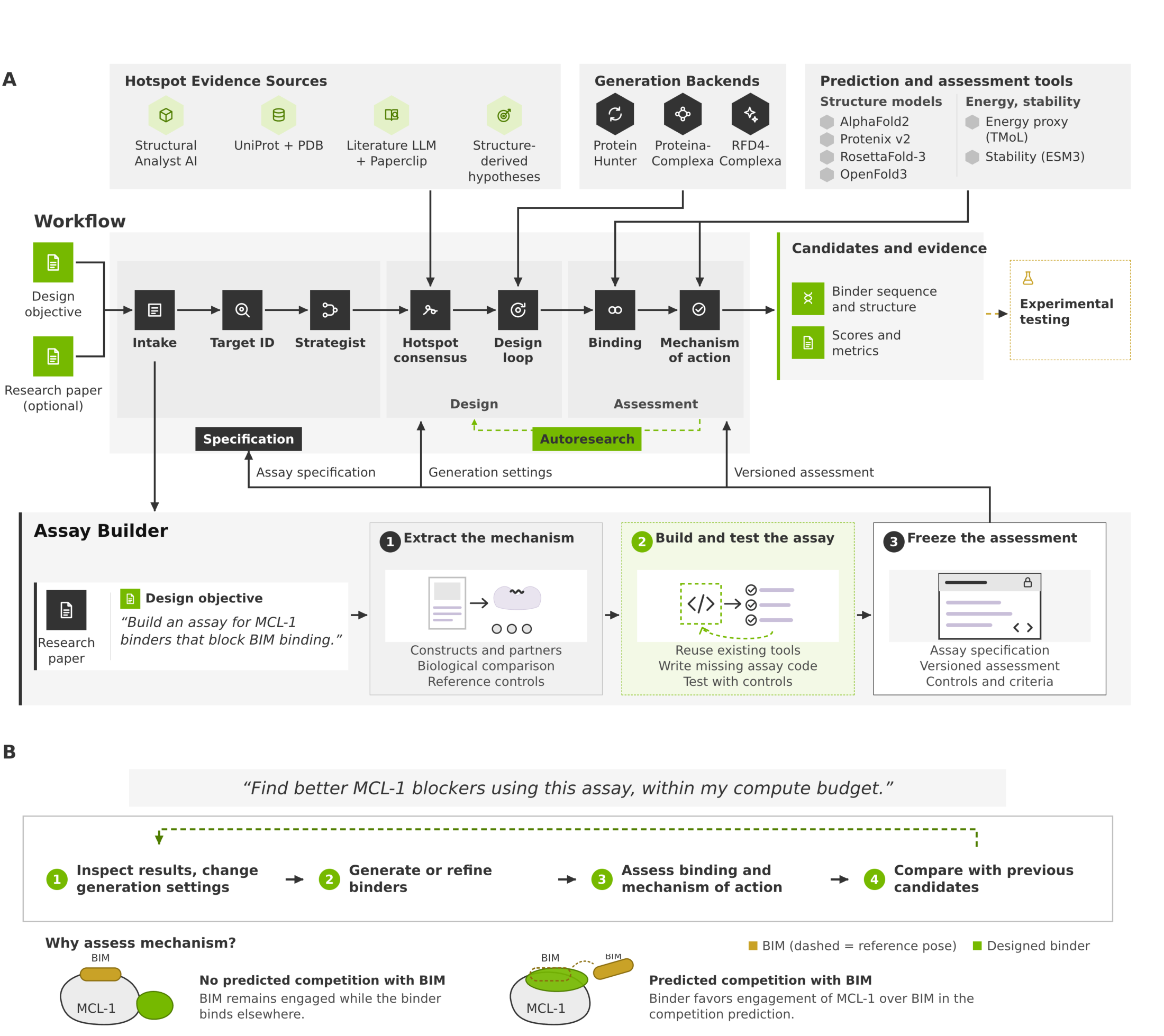
In silico protein design models address only one step toward achieving a desired biological function. An inhibitor must compete with a native partner, a recruiter must engage both proteins, and a state-selective binder must distinguish alternative target states. BindClaw uses these requirements to define computational tests and guide binder design.
The specification defines the biological objective, molecular inputs and comparisons needed to assess the intended function. Intake extracts the target, desired function and design constraints. Target ID retains a named target or identifies one through literature and database searches. The strategist proposes the mechanism and relevant partners, states or molecular arrangements.
The Assay Builder translates these requirements into executable measurements and assessment criteria. It selects existing measurements or uses a coding agent to implement and test new ones before fixing the assessment criteria. Autoresearch then uses binding and mechanism assessments to revise generation settings or binder sequences and compare the resulting designs. Agents interpret evidence and propose choices. Software validates inputs, executes model calls and applies the recorded criteria.
The technical report describes five predefined assays, five paper-derived examples, a nine-target binding-site benchmark, recorded agent-directed search campaigns, and experimental calmodulin binding.
 Open the full-resolution PDF
METHOD
Supply the desired function, reference structures, sequences or papers, and a compute budget.
Specify the construct, partners or alternative states, controls and pass criteria.
Generate designs, predict the complexes, apply the structural criteria, then the mechanism-specific comparison.
The agent revises sites, settings or sequences within budget. The report lists sequences, structures, control results and unresolved requirements.
 Open the full-resolution PDF
ASSAY BUILDER
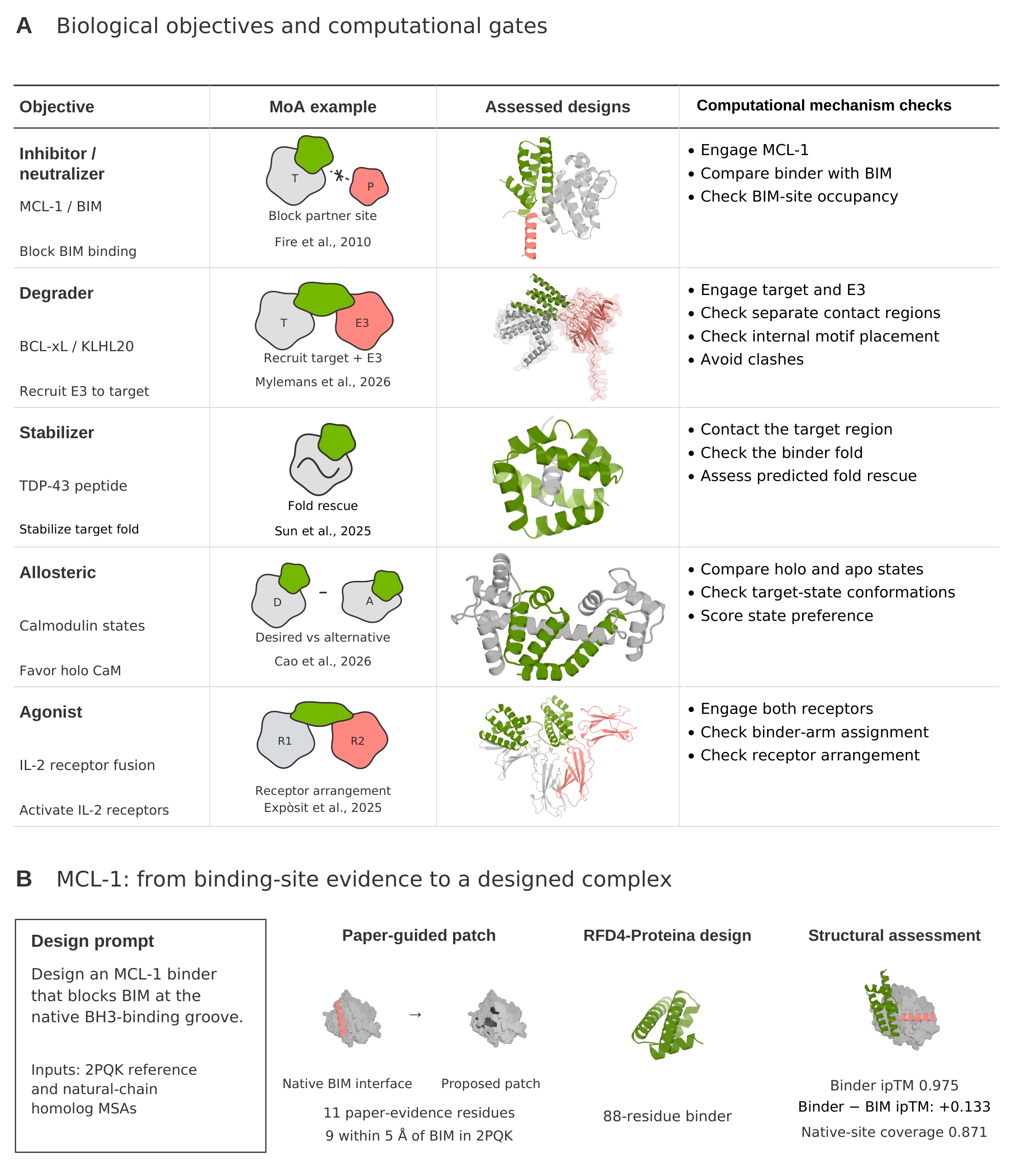
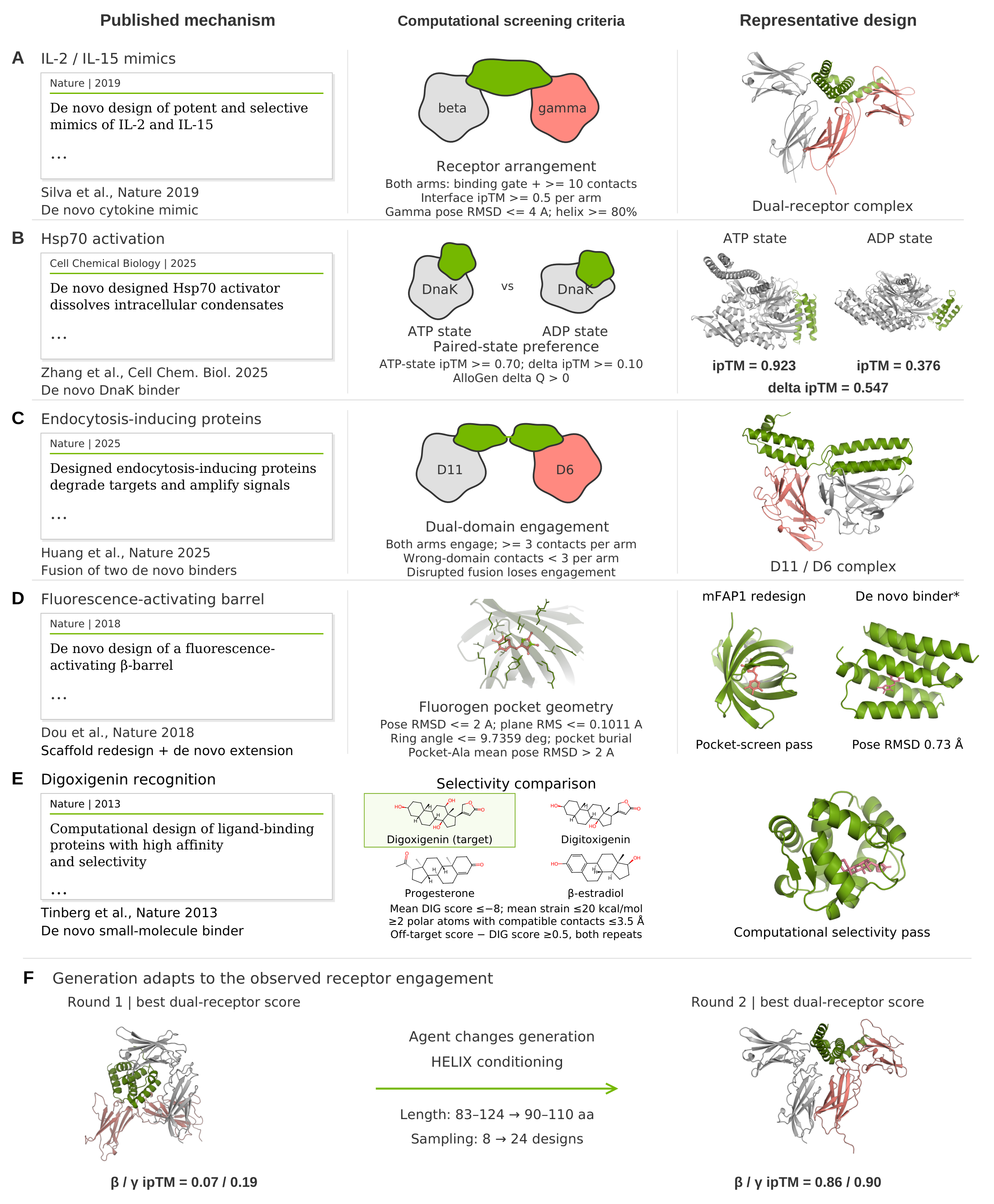
The Assay Builder uses each paper’s biological objective to define the molecular interactions, states or arrangements to compare. The Assay Builder uses Paper2Agent to extract text and assets from the supplied paper. Agents use this evidence to define molecular inputs, controls and comparisons. The five examples test receptor engagement (IL-2/IL-15 mimic), ATP- versus ADP-state binding (DnaK), two-arm receptor engagement (endocytosis inducer), fluorogen-pocket geometry (DFHBI) and ligand selectivity (digoxigenin).
 Open the full-resolution PDF
COMPUTATIONAL STUDIES
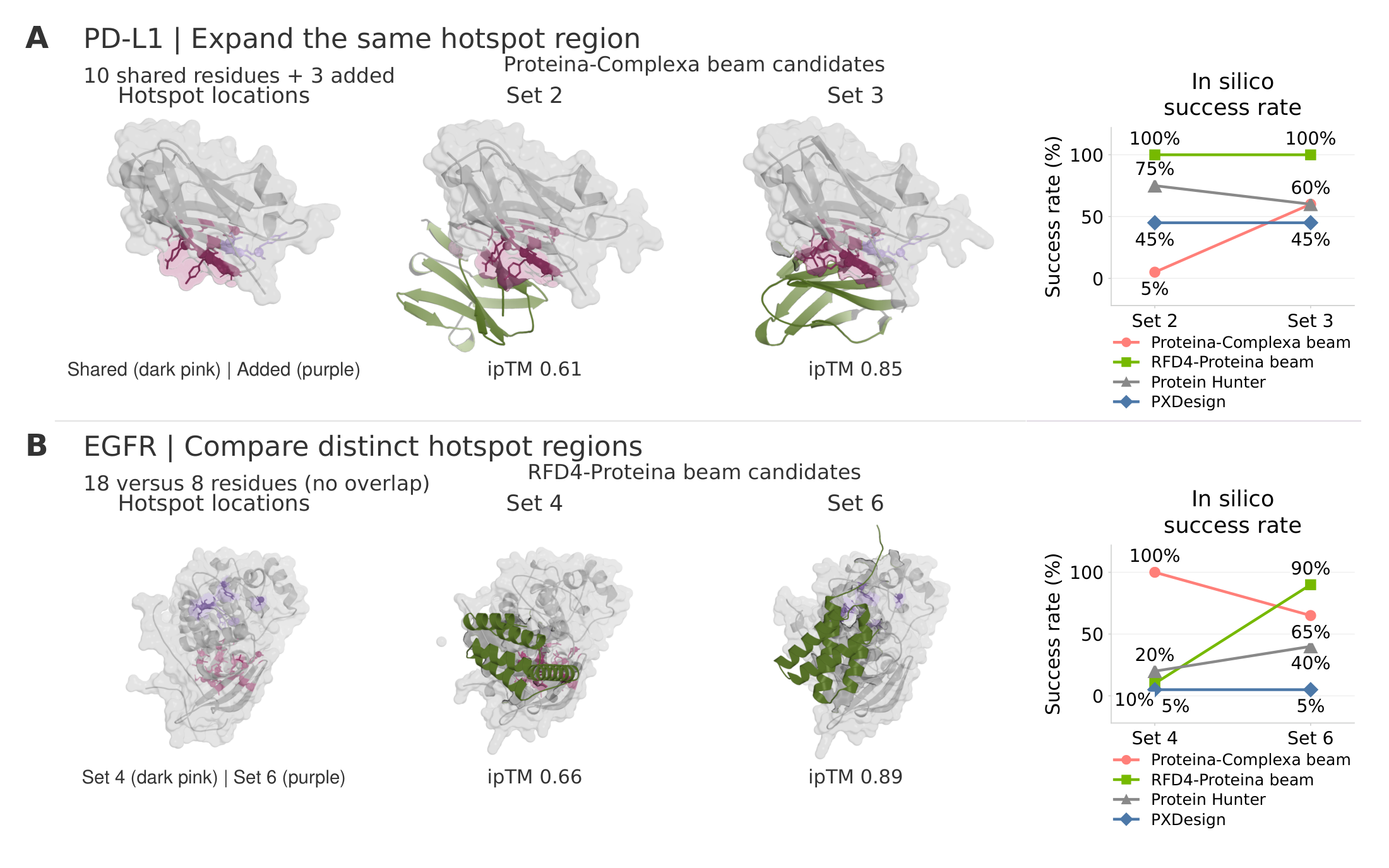
On EGFR, Proteina-Complexa beam achieved 100% in silico success at set 4 and 65% at set 6. RFD4-Proteina beam achieved 10% and 90%, respectively. Protein Hunter achieved 20% and 40%, while PXDesign remained at 5% at both sites (20 evaluations per site for each backend).
The preferred site therefore reversed between generators. The study used Proteina-Complexa, RFD4-Proteina, Protein Hunter and PXDesign. Standard and beam-search settings for the first two gave six configurations in total, with 20 valid evaluations per condition. Protein Hunter uses Boltz-2 during design. Candidates from every generator were evaluated with the same Protenix-v2 protocol.
For PD-L1, adding just three hotspots to a shared ten-residue patch increased Proteina-Complexa beam’s in silico success rate from 5% to 60% (1 to 12 passes out of 20). RFD4-Proteina beam remained at 100%, while Protein Hunter decreased from 75% to 60%. PXDesign remained at 45% (9 of 20 passes at each site). The effect of adding hotspots depended on the generator.
 Open the full-resolution PDF
AGENT-ASSISTED SEARCH
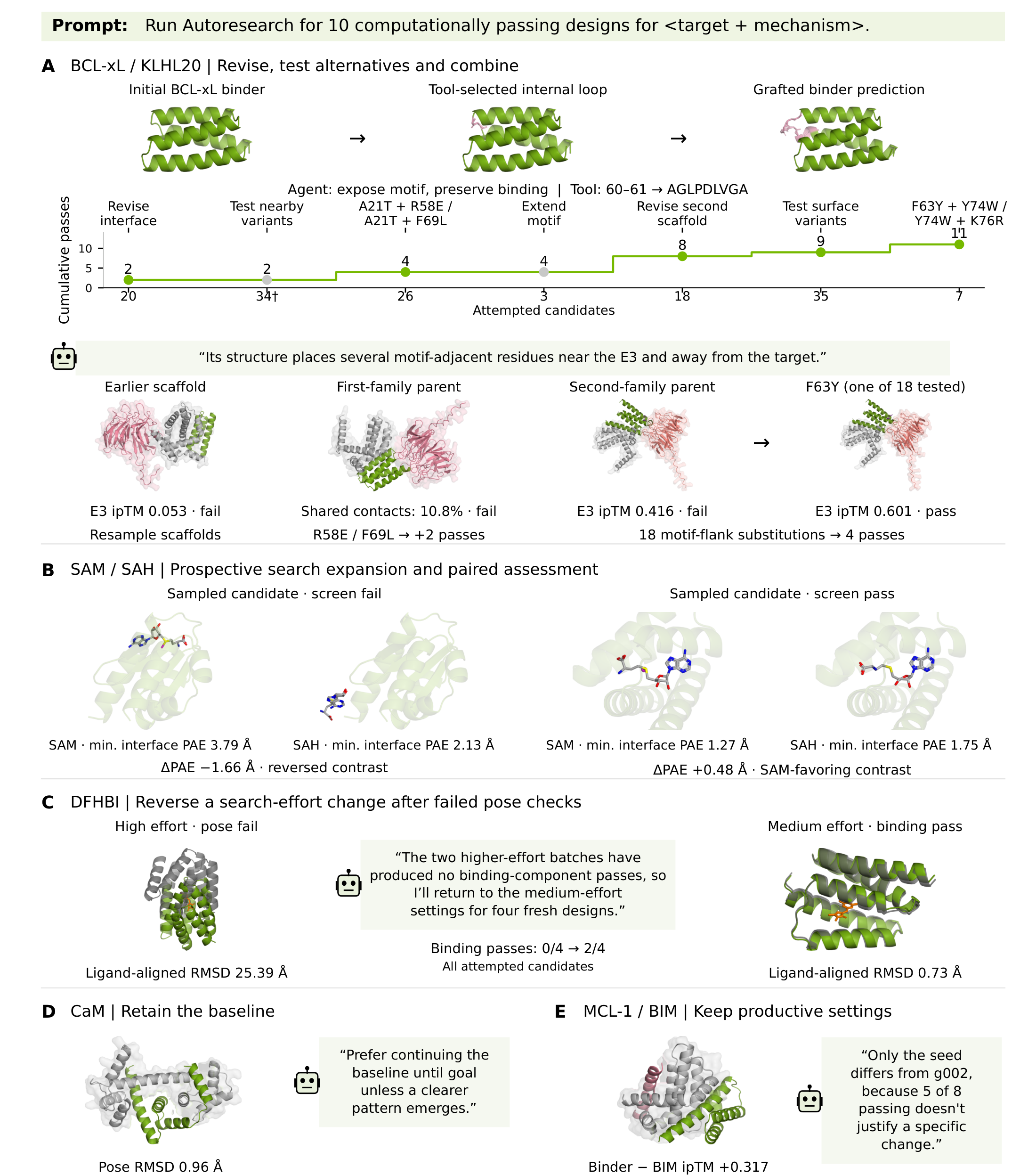
Autoresearch agents inspect binding and mechanism scores to decide whether to revise a sequence, change generation settings or sample more candidates. Each campaign uses a fixed assay and resource budget.
BCL-xL/KLHL20 recruitment. The agent generated target binders with Protein Hunter and grafted a KLHL20-recruiting peptide into an internal loop to expose the motif while preserving target contacts. It tested interface substitutions, motif extensions and combinations of individually passing mutations. After a second scaffold failed the E3-engagement criterion, the agent tested 18 motif-flanking substitutions. F63Y reached E3 ipTM 0.601, compared with 0.416 for its parent, and passed the full computational screen. Across the two scaffold families, 11 unique designs passed the same computational screen.
SAM versus SAH. The agent varied binder lengths and seeds to sample alternative designs, expanding the search before evaluation results were available. Each candidate was independently predicted with both ligands using Protenix-v2. The illustrated failed design had higher minimum interface PAE with SAM than SAH (3.79 versus 2.13 Å). A different design showed computational selectivity for SAM (1.27 versus 1.75 Å) and met the remaining screen criteria.
DFHBI search effort. The agent increased RFD4-Proteina beam-search sampling from four to eight branches, with 60 steps and beam width one. This produced three pose failures and one invalid prediction. It then returned to four branches with new seeds. The resulting designs passed the check for agreement between generated and independently predicted poses and the remaining binding-screen criteria.
Keeping the same settings. The CaM agent proposed reducing six hotspots to four after pose failures. When more designs passed with six hotspots, it kept six and did not test the four-hotspot proposal. The MCL-1/BIM agent kept its settings after five of the first eight designs passed and finished with 11 unique passes among 16 designs. These search cohorts are separate from the experimental CaM campaign.
 Open the full-resolution PDF
EXPERIMENTAL BINDING
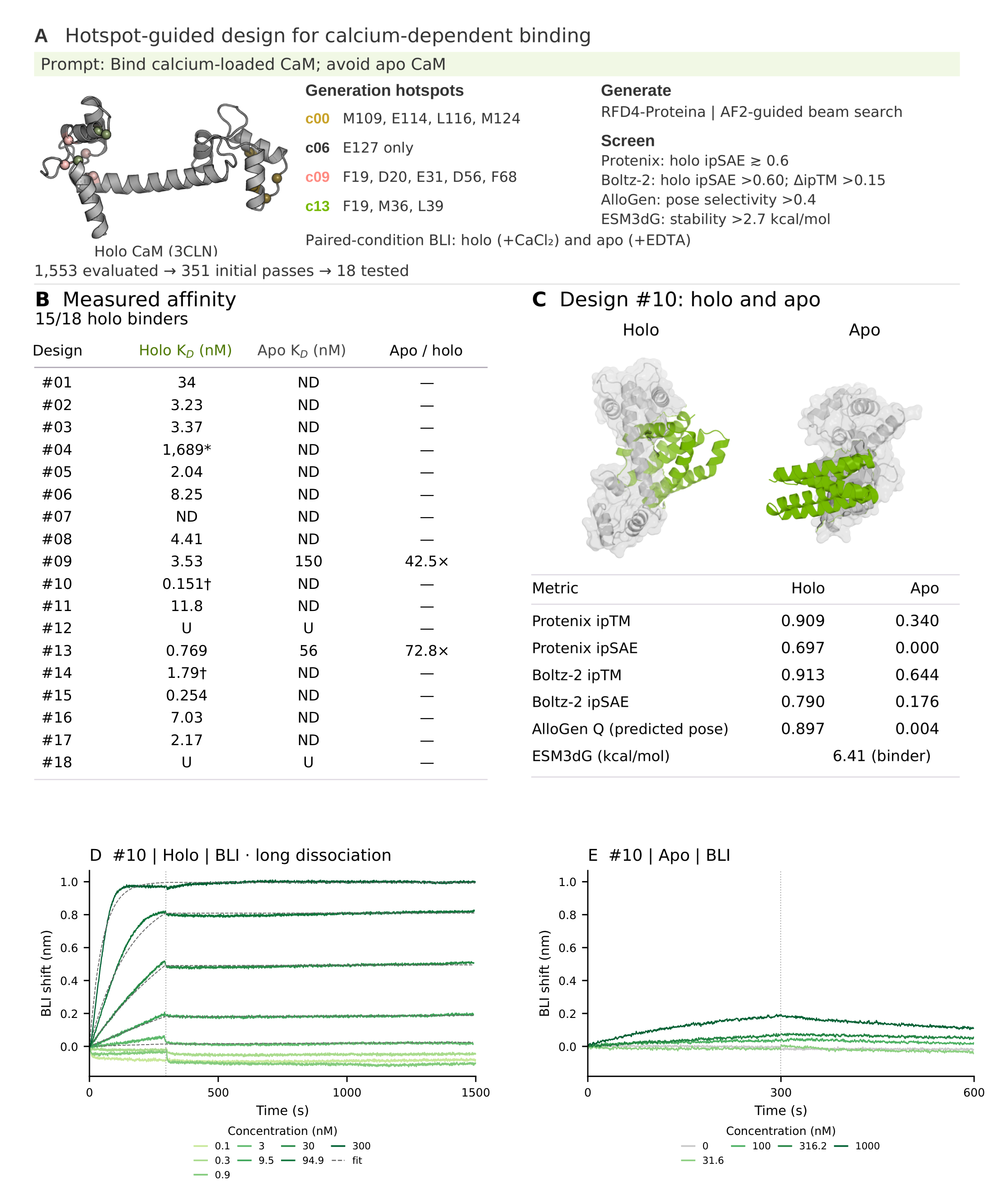
In a human designer-assisted campaign, 15 of 18 submitted designs bound calcium-loaded calmodulin.
Three designs had BLI replicate-median apparent holo affinities below 1 nM: #10, 151 pM, #15, 254 pM, and #13, 769 pM. Design #10 has one reported BLI binding fit, which reaches the imposed lower bound for the dissociation rate and limits the precision of its affinity estimate. Design #15 has two BLI replicates spanning 252–257 pM. No apo binding was detected for #10 or #15. Design #13 bound both conditions with a lower apparent dissociation constant for holo CaM. Nine additional designs had single-digit nanomolar BLI median apparent affinities (1.79–8.25 nM). Design #04 had a BLI median of 1,689 nM (replicate range 617–3,529 nM), with estimates extending beyond the tested concentration range.
Biolayer interferometry (BLI) experiments were performed by Adaptyv Bio, comparing calcium-loaded (holo) CaM in 2 mM CaCl₂ with calcium-depleted (apo) CaM in 3 mM EDTA. Follow-up holo measurements extended dissociation to approximately 1,200 seconds to better resolve slow off-rates, including the displayed measurement for #10. Apo measurements retained 300-second dissociation windows. Fifteen of the 16 loading-assessable designs showed holo binding. Design #07 had no detected binding in either condition, and #12 and #18 had unassessable loading. Apparent affinities are the median of reported BLI binding fits rated Good or Medium. Replicate ranges describe observed variability, not confidence intervals.
SPR also detected binding to calcium-loaded CaM. Design #10 had a median SPR apparent affinity of 319 pM (range 229–409 pM), and #15 had a median of 100 pM (range 100–101 pM). BLI and SPR results are reported independently and are not averaged across platforms.
 Open the full-resolution PDF
All measurement series for design #10 (PDF) · BLI and SPR plots for assessable designs (PDF)
RESOURCES
Methods, the nine-target benchmark, paper-derived assays, and calmodulin BLI and SPR measurements.
References for the tools and studies discussed on this page. The full bibliography is in the technical report.