Cosmos-Predict2.5

Improved World Simulation with Video Foundation Models for Physical AI

NVIDIA


intro

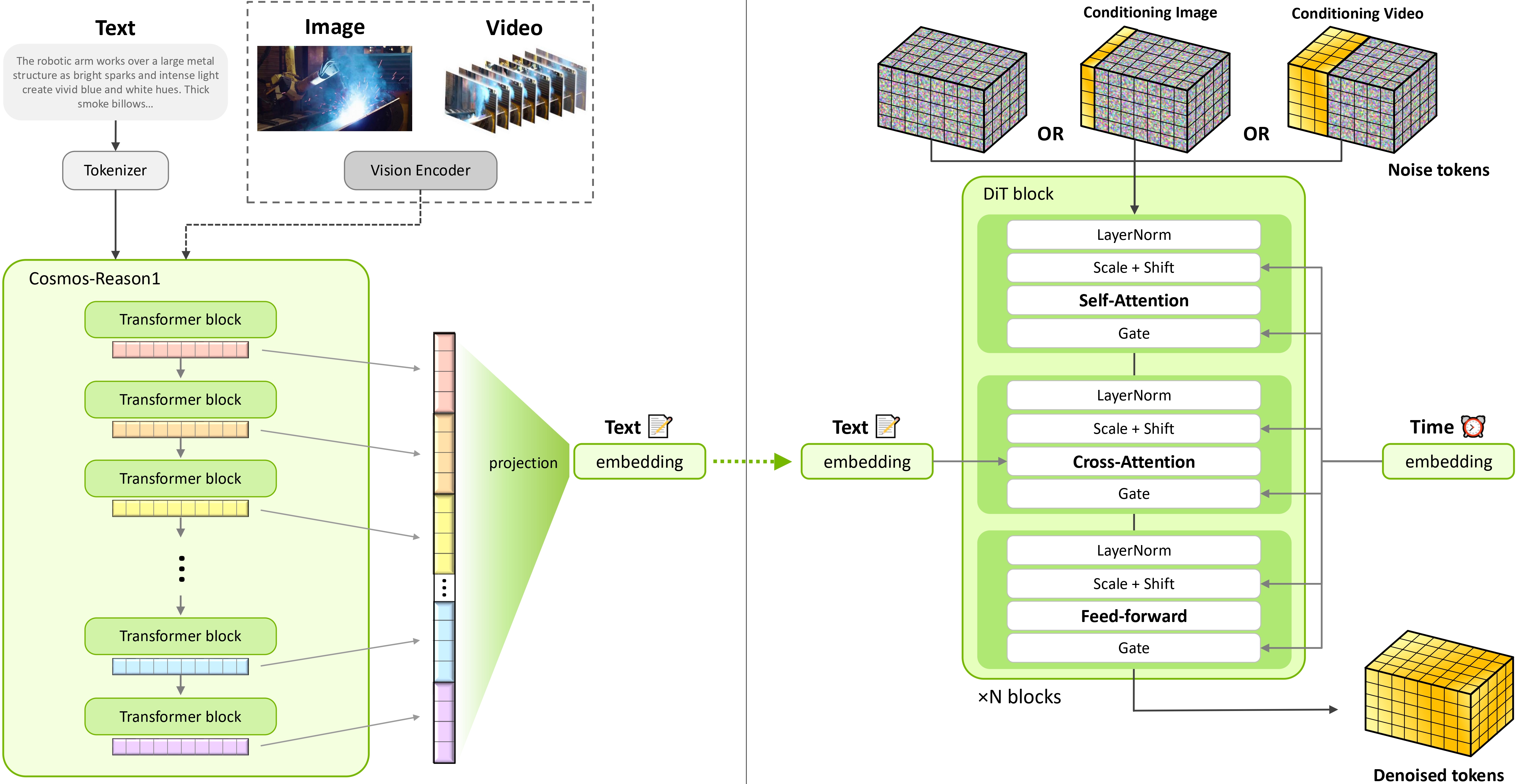
We introduce Cosmos-Predict2.5, the latest version of the Cosmos World Foundation Models (WFMs) family, specialized for simulating and predicting the future state of the world in the form of video. Cosmos-Predict2.5 is a flow based model that unifies Text2World, Image2World, and Video2World into a single model and utilizes Cosmos-Reason1, a Physical AI reasoning vision language model (VLM), as the text encoder.

With an improved data pipeline, we curated 200 million high-quality pre-training video clips and post-training data covering various physical AI domains. We further leverage model merging and a new reinforcement learning algorithm to post-train Cosmos-Predict2.5 for model quality boost. Experimental results on various benchmark datasets show Cosmos-Predict2.5 significantly improves upon Cosmos-Predict1 in both quality and prompt alignment. Cosmos-Predict2.5 comes with two model sizes: 2B and 14B. We show how they can be used for various robotics and autonomous vehicle tasks through post-training. We further extend Cosmos-Predict2.5 into a broader family with Cosmos-Transfer2.5 control-net models for various sim2real and real2real applications. To facilitate the development of world models for Physical AI, we make our code, model weights, and benchmarks available under the NVIDIA Open Model License at Cosmos-Predict2.5 and Cosmos-Transfer2.5.


Models and Capabilities

Model Name Capability Input
Cosmos-Predict2.5 base
Cosmos-Predict2.5-2B/pre-trained pre-trained base text + image or video
Cosmos-Predict2.5-14B/pre-trained pre-trained base text + image or video
Cosmos-Predict2.5-2B/post-trained post-trained base text + image or video
Cosmos-Predict2.5-14B/post-trained post-trained base text + image or video
Cosmos-Predict2.5 domain specialized
Cosmos-Predict2.5-2B/auto/multiview driving, 7-camera view text + image or video
Cosmos-Predict2.5-2B/robot/multiview robotic, 3-camera view text + third-person video
Cosmos-Predict2.5-2B/robot/multiview-agibot robotic, AgiBot data, 3-camera view text + head-view video
Cosmos-Predict2.5-2B/robot/action-cond robotic, action-conditioned action
Cosmos-Predict2.5-2B/robot/gr00tdream-gr1 robotic, GR00T GR1 data text + image or video


Cosmos-Predict2.5/pre-trained

2B

14B


Cosmos-Predict2.5-2B/auto/multiview


Cosmos-Predict2.5-2B/robot/multiview

Agibot

Basic


Cosmos-Predict2.5-2B/robot/action-cond

Ground Truth vs Cosmos-Predict2.5-2B vs Cosmos-Predict1-7B


Benchmark Scores


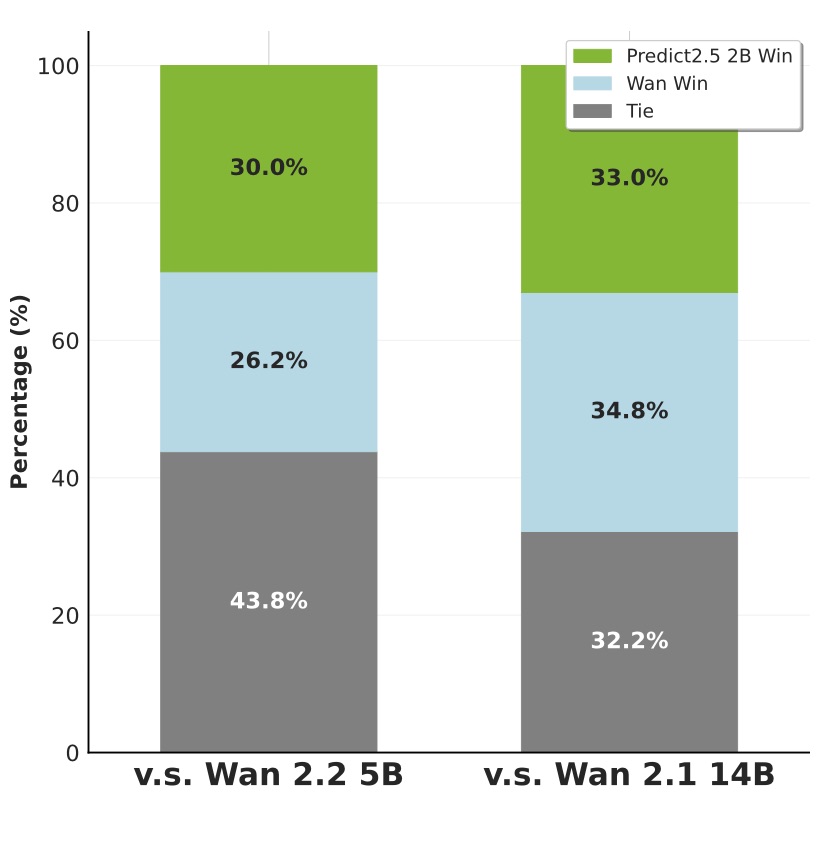
Despite being of smaller size, post-trained Cosmos Predict 2.5 is on par with Wan 2.2 5B and 2.1 14B on a diverse set of prompts.

intro

PAI-Bench-Predict-Text2World Benchmark

We evaluate on PAI-Bench’s predict task and report two main scores: the Domain Score, which measures performance on domain-specific physical AI tasks, and the Quality Score, which reflects the quality of generated videos. The Quality Score is derived from eight text-to-video and image-to-video metrics adapted from VBench. In contrast, the Domain Score is obtained through VQA-based evaluation across seven domains: av, common, human, industry, misc, physics, and robotics. The final PAI-Bench Overall Score is computed as the average of the Quality and Domain scores.

The [Cosmos- Predict2.5-2B] post-trained model performs similarly to the larger Wan2.2-5B model in T2W, and is the best-performing model in I2W.

Model Domain Score Quality Score Overall Score
Predict2.5-2B [pre-train] 0.782 0.720 0.751
Predict2.5-2B [post-train] 0.804 0.732 0.768
Predict2.5-14B [pre-train] 0.791 0.722 0.757
Predict2.5-14B [post-train] 0.803 0.732 0.768
Wan2.1-1.3B 0.786 0.726 0.756
Wan2.1-14B 0.794 0.727 0.761
Wan2.2-5B 0.797 0.730 0.764
Wan2.2-A14B 0.810 0.728 0.769


PAI-Bench-Predict-Image2World Benchmark

Comparison of Cosmos-Predict2.5 with Wan2.1 and Wan2.2 I2V models.

Model Domain Score Quality Score Overall Score
Predict2.5-2B [pre-train] 0.824 0.775 0.799
Predict2.5-2B [post-train] 0.840 0.779 0.810
Predict2.5-14B [pre-train] 0.835 0.777 0.806
Predict2.5-14B [post-train] 0.838 0.781 0.810
Wan2.1-14B 0.827 0.768 0.797
Wan2.2-5B 0.834 0.774 0.804
Wan2.2-A14B 0.841 0.772 0.806


Visual metrics on generated multi-view videos

We use a 1,000 multi-view clip dataset in RQS-HQ (Ren et al., 2025), with HD map, as well as human-labeled lanes and cuboids. We observe a significant boost from Transfer1-7B-Sample-AV (up to 2.3x) in FVD/FID scores while remaining competitive in temporal and cross-camera Sampson error compared to real videos.

Model FVD StyleGAN ↓ FVD I3D ↓ FID ↓ TSE ↓ CSE ↓
Predict2.5-2B/auto/multiview 23.060 25.308 12.095 0.948 1.903
Predict1-7B-Sample-AV 63.685 69.613 25.341 0.930 2.631
Real Videos (Reference) - - - 1.193 1.832


Multi-Camera Video Generation Evaluation

We evaluate both our model and the baseline on 80 in-the-wild robotic manipulation videos across 16 diverse camera trajectories. Best is bolded.

Model Camera Accuracy View Synchronization
TransErr ↓ RotErr (rad) ↓ Sampson Error (px) ↓
Cosmos-Predict2.5-2B/robot/singleview-basic 0.08 0.19 26.61
Cosmos-Predict2.5-2B/robot/multiview-basic 0.08 0.20 19.73


Evaluation of action-conditioned video prediction on Bridge dataset

Method PSNR ↑ SSIM ↑ Latent L2 ↓ FVD ↓
Cosmos-Predict1-7B-Video2World-Sample-ActionCond 21.14 0.82 0.32 190
Cosmos-Predict2.5-2B/robot/action-cond 24.95 0.85 0.28 146


Cosmos-Predict2.5 for VLA Training: DreamGen Bench Statistics and Results

GPT represents the evaluation from GPT4o, and Qwen represents the evaluation from Qwen2.5VL. -sft represents fine-tuned variants. Best is bolded and second best is underlined.

DreamGen Bench GR1 Instruction Following
Object Behavior Env
GPT Qwen GPT Qwen GPT Qwen
Hunyuan-sft 38.0 26.0 38.3 10.6 27.6 27.6
CogVideoX-sft 72.0 38.0 44.0 28.0 55.2 41.4
WAN2.1-sft 72.0 58.0 72.3 55.3 48.3 65.5
Cosmos2-sft 90.0 62.0 59.6 61.7 69.0 65.5
Cosmos2.5-sft 91.8 69.4 70.2 59.6 69.0 69.0


Citation

Please cite as NVIDIA et al., and use the following BibTeX for citation:

@misc{nvidia2025worldsimulationvideofoundation,
  title     = {World Simulation with Video Foundation Models for Physical AI}, 
  author    = {NVIDIA and Ali, Arslan and Bai, Junjie and Bala, Maciej and Balaji, Yogesh and Blakeman, Aaron and Cai, Tiffany and Cao, Jiaxin and Cao, Tianshi and Cha, Elizabeth and Chao, Yu-Wei and Chattopadhyay, Prithvijit and Chen, Mike and Chen, Yongxin and Chen, Yu and Cheng, Shuai and Cui, Yin and Diamond, Jenna and Ding, Yifan and Fan, Jiaojiao and Fan, Linxi and Feng, Liang and Ferroni, Francesco and Fidler, Sanja and Fu, Xiao and Gao, Ruiyuan and Ge, Yunhao and Gu, Jinwei and Gupta, Aryaman and Gururani, Siddharth and El Hanafi, Imad and Hassani, Ali and Hao, Zekun and Huffman, Jacob and Jang, Joel and Jannaty, Pooya and Kautz, Jan and Lam, Grace and Li, Xuan and Li, Zhaoshuo and Liao, Maosheng and Lin, Chen-Hsuan and Lin, Tsung-Yi and Lin, Yen-Chen and Ling, Huan and Liu, Ming-Yu and Liu, Xian and Lu, Yifan and Luo, Alice and Ma, Qianli and Mao, Hanzi and Mo, Kaichun and Nah, Seungjun and Narang, Yashraj and Panaskar, Abhijeet and Pavao, Lindsey and Pham, Trung and Ramezanali, Morteza and Reda, Fitsum and Reed, Scott and Ren, Xuanchi and Shao, Haonan and Shen, Yue and Shi, Stella and Song, Shuran and Stefaniak, Bartosz and Sun, Shangkun and Tang, Shitao and Tasmeen, Sameena and Tchapmi, Lyne and Tseng, Wei-Cheng and Varghese, Jibin and Wang, Andrew Z. and Wang, Hao and Wang, Haoxiang and Wang, Heng and Wang, Ting-Chun and Wei, Fangyin and Xu, Jiashu and Yang, Dinghao and Yang, Xiaodong and Ye, Haotian and Ye, Seonghyeon and Zeng, Xiaohui and Zhang, Jing and Zhang, Qinsheng and Zheng, Kaiwen and Zhu, Andrew and Zhu, Yuke},
  journal   = {arXiv preprint arXiv:2511.00062},
  year      = {2025},
  url       = {https://arxiv.org/abs/2511.00062}
}