Abstract
Generation in video diffusion or flow models is computationally expensive due to the slow and iterative sampling process. Current state-of-the-art (SOTA) acceleration methods heavily rely on variational score distillation (VSD) and adversarial losses to distill diffusion models into few-step generators. Although these methods achieve high-quality video generation, their training losses are notoriously hard to optimize and suffer from mode collapse, leading to a lack of video diversity and motion.
In this paper, we introduce Parallel Decoding Distillation (PDD), a simplified and scalable trajectory-based distillation method for fast inference of diffusion and flow matching models. Our architecture and training procedure are compatible with any pre-trained model and support sampling with a varying number of function evaluations (NFE). PDD accelerates generation by predicting multiple denoising steps per network evaluation. Conceptually, it learns a representation of the mean velocity without regressing its derivative using JVPs or finite-difference approximations. Instead, it decomposes the mean-velocity prediction over a fixed interval into parallel sub-interval predictions. Then, optimizing over a single sub-interval per training iteration provides the signal for learning the full-interval mean velocity.
Our method achieves SOTA performance with 4-8 NFE on LTX-2.3 Text-to-Video/Audio, Wan2.1 14B Text-to-Video, and Qwen-Image Text-to-Image. Moreover, PDD shows a significant improvement in generated video diversity.
Parallel Decoding Distillation (PDD): Intuition
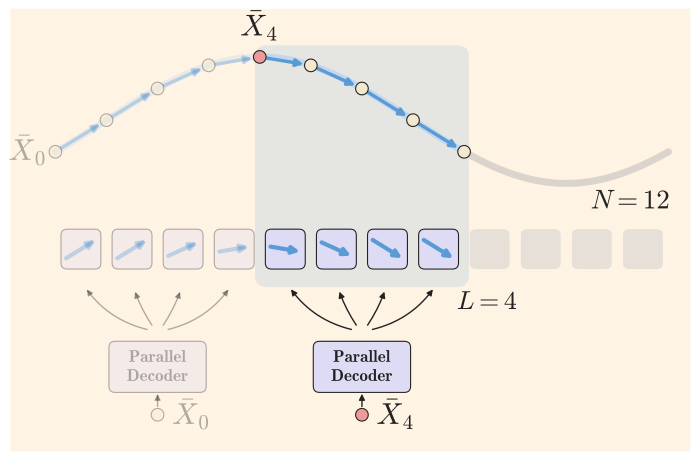
Sampling diffusion and flow matching models using classical ordinary differential equation (ODE) solvers requires many small denoising steps, resulting in hundreds of network evaluations. The common strategy of trajectory-based distillation methods for training a few-step generator is to train a student model to predict a large-step update, essentially merging multiple small teacher updates. In Parallel Decoding Distillation (PDD), we take a different approach: instead of merging the teacher updates into one large update, we predict multiple teacher updates in a single network evaluation. Specifically, we discretize time \(t\in[0,1]\) into a fixed sequence of \(N\in\mathbb{N}\) intervals \([t_{n},t_{n+1}]\) for \(n=0,1,\ldots,N-1\) and group them into blocks of size \(L\leq N\). During training, the student model learns to predict the teacher's ODE-solver step for all intervals within a block using a single forward pass. Then, at generation, each student evaluation advances \(L\) intervals, as illustrated in Figure 2.
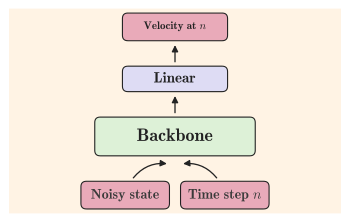
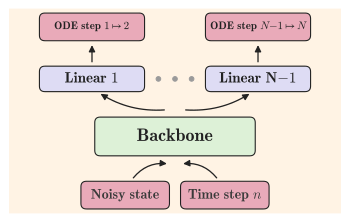
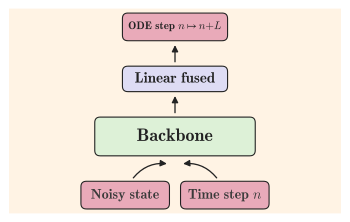
Figure 3(b) illustrates our student architecture, alongside the teacher in Figure 3(a). We start from the teacher architecture and simply repeat the final linear layer \(N\) times, where \(N\) is the grid size. That is, we use a distinct final linear layer for each interval \([t_n,t_{n+1}]\) in the discretization. Predicting \(N\) grid-level outputs, rather than only \(L\) block-level outputs, enables sampling with varying NFEs at inference time. We achieve this by training with variable block sizes and then adjusting the block size at generation according to the desired NFE. Moreover, since a weighted sum of linear transformations is itself a linear transformation, we can fuse the relevant linear layers at generation. As a result, for each block, we only need to evaluate and store a single fused linear layer; see Figure 3(c). Lastly, this architecture allows the student weights to be initialized seamlessly from the teacher weights.
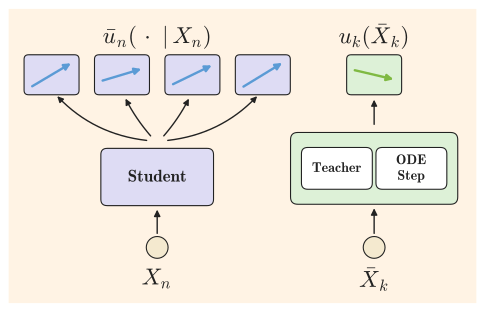
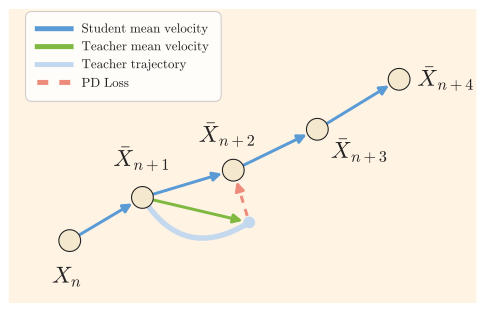
To train our parallel decoder (student), we employ an on-policy training algorithm. The goal is to align each student output with the corresponding teacher ODE-solver step. That is, we align the \(n\)-th student output with the teacher ODE-solver step over the interval \([t_n, t_{n+1}]\). We illustrate a single optimization step with block size \(L=4\) in Figure 4. First, we sample a noisy state \(X_n\) at time step \(n\). Then, starting from \(X_n\), we roll out the student over the next block of intervals:
\[ X_n=\bar{X}_n,\ \bar{X}_{n+1},\ldots,\bar{X}_{n+L-1}. \]
Next, we sample a single state \(\bar{X}_k\) from the student trajectory, where \(k\in\{n,n+1,\ldots,n+L-1\}\). Finally, we match the \(k\)-th student output to the teacher's ODE-solver step evaluated at \(\bar{X}_k\). Figure 5 shows a simulation of PDD training on a toy problem. For each iteration, we plot the largest-error sample from the batch. Notably, the student trajectory becomes aligned with the teacher trajectory (labeled “Optimal trajectory”) as training progresses.
PDD vs. Teacher and DMD2 on Wan2.1 14B T2V
Comparison between the teacher (Wan2.1 14B T2V), PDD, and DMD2. The teacher requires 2 network evaluations per step due to CFG. Each row is a method; the three videos are three different noise samples for the same prompt. Use the side arrows or swipe to browse all 23 prompts.
| Model | Noise 1 | Noise 2 | Noise 3 |
|---|---|---|---|
| Teacher (2x50 NFE) | |||
| PDD (4 NFE) | |||
| DMD2 (4 NFE) | |||
| A person is jogging through a scenic park trail, surrounded by lush green trees and blooming flowers. They are wearing a bright athletic outfit with reflective elements for safety, and their face is focused and determined, showing a mix of sweat and effort. The jogger is moving at a steady pace, arms swinging naturally. The background shows a clear blue sky and patches of sunlight filtering through the leaves. The scene captures the jogger from a medium distance, providing a balanced view of the environment and the individual. | |||
| Model | Noise 1 | Noise 2 | Noise 3 |
|---|---|---|---|
| Teacher (2x50 NFE) | |||
| PDD (4 NFE) | |||
| DMD2 (4 NFE) | |||
| A serene African savanna scene with tall grasses and scattered trees. A tall giraffe, with distinctive brown spots on its creamy white coat, bends its long neck gracefully to drink from a calm river. The giraffe's gaze is focused intently on the water as it lowers its head, revealing its long eyelashes and gentle expression. The river reflects the golden hues of the late afternoon sun, casting a warm glow over the scene. The background shows the vast expanse of the savanna with distant hills. The video is a medium close-up, capturing the giraffe's elegant movement and the tranquil environment. | |||
| Model | Noise 1 | Noise 2 | Noise 3 |
|---|---|---|---|
| Teacher (2x50 NFE) | |||
| PDD (4 NFE) | |||
| DMD2 (4 NFE) | |||
| A wild mustang gallops across an open grassland, kicking up dust as it runs towards a herd of horses. The herd is scattered in the distance, grazing peacefully under a bright blue sky dotted with fluffy clouds. The mustang’s coat gleams in the sunlight, showcasing its muscular build and powerful legs. It arches its neck and prances with determination, its mane flowing freely behind it. As it approaches, the herd begins to notice, turning their heads curiously. The scene captures the mustang’s journey from solitude to unity with its kin, conveying a sense of belonging and community. Wide shot, focusing on the mustang’s movement and the expansive landscape. | |||
| Model | Noise 1 | Noise 2 | Noise 3 |
|---|---|---|---|
| Teacher (2x50 NFE) | |||
| PDD (4 NFE) | |||
| DMD2 (4 NFE) | |||
| A couple dressed in elegant formal evening wear walks down a busy city street at night, holding umbrellas as they navigate through a sudden heavy downpour. The man is wearing a black tuxedo and the woman a floor-length white gown with a fitted bodice. They are walking side by side, maintaining a steady pace, with their heads slightly tilted upwards to avoid the rain. The background shows illuminated storefronts and bustling crowds, with reflections from the raindrops creating a shimmering effect on the wet pavement. The scene is captured from a steady and smooth perspective, maintaining a medium shot that focuses on the couple’s interaction and the vibrant city backdrop. | |||
| Model | Noise 1 | Noise 2 | Noise 3 |
|---|---|---|---|
| Teacher (2x50 NFE) | |||
| PDD (4 NFE) | |||
| DMD2 (4 NFE) | |||
| A person is digging in a sunny, rural field. They are wearing a brown work jacket, blue jeans, and a straw hat to protect themselves from the sun. Their face is covered with sweat, and they have a determined look as they focus intently on the task. The person uses a shovel with strong, repetitive motions, throwing dirt to the side. The field has tall grass and scattered wildflowers in the background. The scene is captured in a mid-shot, focusing on the person's upper body and the immediate area where they are digging. The camera remains static to highlight the continuous action of digging. | |||
| Model | Noise 1 | Noise 2 | Noise 3 |
|---|---|---|---|
| Teacher (2x50 NFE) | |||
| PDD (4 NFE) | |||
| DMD2 (4 NFE) | |||
| A person is flying a kite in a sunny park. The person, a young adult with medium-length brown hair, is standing on lush green grass under a clear blue sky. They are holding the kite string tightly in their right hand, with a joyful smile on their face. The kite, a traditional diamond-shaped design with vibrant colors, is soaring high in the air, gently swaying with the wind. In the background, there are other people enjoying the park, walking their dogs, and playing with children. The scene is captured in a mid-shot, focusing on the person and the kite, with a slight upward angle to emphasize the height of the kite. | |||
| Model | Noise 1 | Noise 2 | Noise 3 |
|---|---|---|---|
| Teacher (2x50 NFE) | |||
| PDD (4 NFE) | |||
| DMD2 (4 NFE) | |||
| A person is ice skating on a smooth, icy lake under a clear winter sky. They are wearing a black helmet, a bright red parka, and matching red gloves and skates. The person glides gracefully across the ice, arms extended slightly for balance. Snowflakes gently fall around them, creating a serene and wintery atmosphere. The scene is captured in a medium shot from a static camera angle, emphasizing the fluid motion of the skater. | |||
| Model | Noise 1 | Noise 2 | Noise 3 |
|---|---|---|---|
| Teacher (2x50 NFE) | |||
| PDD (4 NFE) | |||
| DMD2 (4 NFE) | |||
| A person is ironing clothes in a cozy living room. The individual, who appears to be in their mid-thirties, is wearing casual clothing and has a focused expression. They are using a steam iron on a white cotton shirt, carefully smoothing out wrinkles. The ironing board is set up next to a comfortable armchair, with a window behind them letting in soft natural light. The background includes a small bookshelf and some houseplants. The scene focuses on the detailed actions of ironing, showing the hand movements and the interaction between the person and the garment. Medium close-up shot, static. | |||
| Model | Noise 1 | Noise 2 | Noise 3 |
|---|---|---|---|
| Teacher (2x50 NFE) | |||
| PDD (4 NFE) | |||
| DMD2 (4 NFE) | |||
| A person with warm, gentle facial expressions is petting a friendly, medium-sized dog. The person is standing with a relaxed posture, one hand gently resting on the dog’s head, while the other hand strokes its fur. The dog has a playful demeanor, wagging its tail happily. Both the person and the dog are in a green park setting with patches of grass and trees in the background. The scene is captured from a mid-shot perspective, focusing on the interaction between the two, with no camera movement. | |||
| Model | Noise 1 | Noise 2 | Noise 3 |
|---|---|---|---|
| Teacher (2x50 NFE) | |||
| PDD (4 NFE) | |||
| DMD2 (4 NFE) | |||
| A bicycle accelerating to gain speed, captured in a smooth time-lapse sequence. The bicycle is a classic red road bike with sleek aerodynamic handlebars and reflective wheels. The rider, a focused individual in cycling gear, leans forward, pedaling vigorously. The background shows a winding asphalt road leading into a forest, with trees and bushes blurring past as the bike speeds up. The camera starts from a mid-shot and gradually zooms in to focus on the rider's determined face and the spinning wheels, emphasizing the acceleration. | |||
| Model | Noise 1 | Noise 2 | Noise 3 |
|---|---|---|---|
| Teacher (2x50 NFE) | |||
| PDD (4 NFE) | |||
| DMD2 (4 NFE) | |||
| A playful cat exploring a sunny park. The cat is brown with white spots, running and jumping between patches of grass and under a large oak tree. It occasionally stops to sniff at flowers or chase after butterflies. The park is filled with lush greenery, including various bushes and tall trees, creating a vibrant and lively environment. The background shows children playing on a playground and people walking their dogs. The scene captures the cat in various playful postures, from a curious crouch to a joyful leap. Medium shot, capturing the cat's dynamic movements and interactions with the park environment. | |||
| Model | Noise 1 | Noise 2 | Noise 3 |
|---|---|---|---|
| Teacher (2x50 NFE) | |||
| PDD (4 NFE) | |||
| DMD2 (4 NFE) | |||
| A peaceful, tranquil barn interior with a single cow resting in the foreground. The cow is lying down, chewing its cud slowly and steadily, with a calm and content expression. The barn has wooden walls and a rustic wooden floor, with hay bales and farm tools scattered around. Soft natural light filters through small windows, casting gentle shadows. The background includes a few other sleeping animals and a cozy corner with a feeding trough. Medium shot, static scene focusing on the cow’s relaxed posture and rhythmic chewing motion. | |||
| Model | Noise 1 | Noise 2 | Noise 3 |
|---|---|---|---|
| Teacher (2x50 NFE) | |||
| PDD (4 NFE) | |||
| DMD2 (4 NFE) | |||
| A majestic brown horse galloping across an expansive green field with rolling hills in the distance. The horse's mane and tail flow freely in the wind as it runs at full speed. Its legs move powerfully under a sleek, muscular body, creating a sense of dynamic motion. The sun is setting, casting a warm golden glow over the landscape. The background shows vibrant wildflowers and tall grass swaying gently. The scene is captured from a mid-shot angle, focusing on the horse's powerful gallop without any camera movement, emphasizing the natural beauty and freedom of the moment. | |||
| Model | Noise 1 | Noise 2 | Noise 3 |
|---|---|---|---|
| Teacher (2x50 NFE) | |||
| PDD (4 NFE) | |||
| DMD2 (4 NFE) | |||
| A realistic animation of a Mars rover navigating across the rugged Martian terrain. The rover is equipped with solar panels, antennas, and various scientific instruments. It moves slowly and steadily over large boulders and fine red dust, leaving tire tracks behind. The landscape is dotted with craters, rocky outcrops, and barren plains under a pale orange sky. The camera follows the rover from a mid-shot perspective as it continues its exploration mission. Static scene, focusing on the rover's movement and interaction with the environment. | |||
| Model | Noise 1 | Noise 2 | Noise 3 |
|---|---|---|---|
| Teacher (2x50 NFE) | |||
| PDD (4 NFE) | |||
| DMD2 (4 NFE) | |||
| A playful Welsh Corgi is energetically playing a drum kit. The corgi is standing on its hind legs, front paws rhythmically hitting the snare drum and cymbals. Its ears are perked up, and its tail is wagging excitedly. The corgi's expressive face shows joy and concentration as it plays. The drum kit is brightly lit against a plain background, focusing all attention on the corgi's performance. Medium close-up view, capturing the corgi's focused expression and active paws. | |||
| Model | Noise 1 | Noise 2 | Noise 3 |
|---|---|---|---|
| Teacher (2x50 NFE) | |||
| PDD (4 NFE) | |||
| DMD2 (4 NFE) | |||
| A playful domestic cat running joyfully across a green grassy field, with a bright sunny day in the background. The cat has soft fur, bright green eyes, and a striped coat. It is leaping and twisting as it runs, tail held high and ears perked up, conveying pure happiness and energy. The scene is captured from a medium shot, focusing on the cat's dynamic movements against a serene backdrop of rolling hills and blue skies. | |||
| Model | Noise 1 | Noise 2 | Noise 3 |
|---|---|---|---|
| Teacher (2x50 NFE) | |||
| PDD (4 NFE) | |||
| DMD2 (4 NFE) | |||
| Drone aerial view of a festive celebration featuring a brightly lit Christmas tree surrounded by joyful people. The scene includes colorful fireworks bursting in the starry night sky behind the tree. People are seen smiling and waving, adding to the lively atmosphere. The background shows a clear, twinkling night sky filled with stars. The camera maintains a stable wide shot, capturing the entire scene from above. | |||
| Model | Noise 1 | Noise 2 | Noise 3 |
|---|---|---|---|
| Teacher (2x50 NFE) | |||
| PDD (4 NFE) | |||
| DMD2 (4 NFE) | |||
| A plump, fluffy rabbit donning a voluminous purple robe walks gracefully through a vibrant fantasy landscape. The rabbit has large, expressive eyes and a gentle, curious expression. Its fur is soft and thick, and the robe drapes elegantly over its body. The landscape features rolling hills covered in lush green grass, colorful wildflowers, and towering magical trees with shimmering leaves. In the distance, there are sparkling waterfalls and mystical castles. The scene is bathed in warm, golden sunlight. Medium shot, focusing on the rabbit's walk through the picturesque environment. | |||
| Model | Noise 1 | Noise 2 | Noise 3 |
|---|---|---|---|
| Teacher (2x50 NFE) | |||
| PDD (4 NFE) | |||
| DMD2 (4 NFE) | |||
| A koala bear playing a grand piano in a lush, dense forest. The koala has soft, grey fur and large, round ears. It sits upright on the piano bench, paws delicately placed on the keys, creating gentle melodies. The forest background is filled with tall eucalyptus trees, dappled sunlight filtering through the leaves, and a carpet of green moss beneath the piano. The scene is calm and serene, with the koala focused intently on its performance. Medium close-up shot, capturing the koala and part of the forest surroundings. | |||
| Model | Noise 1 | Noise 2 | Noise 3 |
|---|---|---|---|
| Teacher (2x50 NFE) | |||
| PDD (4 NFE) | |||
| DMD2 (4 NFE) | |||
| A cute and playful panda bear swinging back and forth on a traditional swing set in a lush bamboo forest. The panda has black patches around its eyes and on its ears, giving it an endearing and curious expression. It is holding onto the chains of the swing with both front paws while its hind legs dangle freely. The bamboo trees sway gently in the breeze, and the sunlight filters through the leaves, casting a soft glow over the scene. The panda giggles as it swings higher, enjoying the fun. Mid-shot capturing the panda mid-swing, with a slight tilt upwards to show the surrounding forest. | |||
| Model | Noise 1 | Noise 2 | Noise 3 |
|---|---|---|---|
| Teacher (2x50 NFE) | |||
| PDD (4 NFE) | |||
| DMD2 (4 NFE) | |||
| In a futuristic Tokyo rooftop set during a heavy rainstorm, a robot DJ is spinning records at a cyberpunk nightclub. The robot has sleek metallic arms and a glowing LED screen for a face, expressing intense concentration as it mixes tracks. The DJ is surrounded by neon lights and holographic displays, casting colorful reflections off the wet surroundings. The rain creates a misty atmosphere, enhancing the dystopian feel. The scene includes other robots and humans dancing under umbrellas, adding dynamic movement. Close-up shots of the DJ's hands manipulating the turntables and a wide shot capturing the lively rooftop party. Sci-fi, fantasy style. | |||
| Model | Noise 1 | Noise 2 | Noise 3 |
|---|---|---|---|
| Teacher (2x50 NFE) | |||
| PDD (4 NFE) | |||
| DMD2 (4 NFE) | |||
| A beautiful coastal beach during springtime, where gentle waves lap against the soft golden sand. The scene transitions smoothly from a clear blue ocean to the vibrant green foliage of palm trees on the shore, creating a captivating rack focusing effect. The sun casts a warm glow, illuminating the serene waters and casting dappled shadows through the trees. The air is filled with the sounds of seagulls and the rhythmic crashing of waves. The background showcases rolling hills covered in lush vegetation, adding depth to the picturesque landscape. Wide shot capturing the expansive beauty of the coastline. | |||
| Model | Noise 1 | Noise 2 | Noise 3 |
|---|---|---|---|
| Teacher (2x50 NFE) | |||
| PDD (4 NFE) | |||
| DMD2 (4 NFE) | |||
| A joyful, fluffy Corgi running and playing in a sunlit park during sunset. The Corgi has a playful expression with its tail wagging and ears perked up. It is chasing after a red ball, leaping and bounding across the grassy field. The background showcases a picturesque sunset with warm hues of orange and pink. The scene transitions smoothly between the Corgi and the beautiful sunset using rack focusing. Medium close-up shots capture the Corgi’s lively movements and expressions. | |||
PDD vs. AnyFlow on Wan2.1 14B T2V
Comparison between PDD and AnyFlow on Wan2.1 14B T2V. Each method is one row; the first two videos are 4 NFE and the last two are 8 NFE, for the same prompt. Use the side arrows or swipe to browse all 22 prompts.
| Model | 4 NFE | 8 NFE | ||
|---|---|---|---|---|
| Noise 1 | Noise 2 | Noise 1 | Noise 2 | |
| PDD | ||||
| AnyFlow | ||||
| A bicycle accelerating to gain speed, captured in a smooth time-lapse sequence. The bicycle is a classic red road bike with sleek aerodynamic handlebars and reflective wheels. The rider, a focused individual in cycling gear, leans forward, pedaling vigorously. The background shows a winding asphalt road leading into a forest, with trees and bushes blurring past as the bike speeds up. The camera starts from a mid-shot and gradually zooms in to focus on the rider's determined face and the spinning wheels, emphasizing the acceleration. | ||||
| Model | 4 NFE | 8 NFE | ||
|---|---|---|---|---|
| Noise 1 | Noise 2 | Noise 1 | Noise 2 | |
| PDD | ||||
| AnyFlow | ||||
| A person is riding a brown horse through a picturesque countryside, with rolling hills and lush green fields stretching out behind them. The rider, wearing a cowboy hat and a casual western outfit, sits tall in the saddle with one hand gently guiding the reins. The horse moves gracefully at a steady trot, its mane flowing freely. In the background, there are scattered trees and a clear blue sky with fluffy clouds. The scene is captured from a mid-shot perspective, focusing on the rider and the horse as they navigate the serene landscape. | ||||
| Model | 4 NFE | 8 NFE | ||
|---|---|---|---|---|
| Noise 1 | Noise 2 | Noise 1 | Noise 2 | |
| PDD | ||||
| AnyFlow | ||||
| A zebra sprinting towards a herd of zebras in a vast African savanna. The zebra is mid-stride, with its legs extended as it accelerates towards the group. It has a sleek black and white striped coat, and its mane flows freely behind it. The herd is scattered across the grasslands, grazing peacefully, with a few zebras lifting their heads to watch the newcomer. The sun is setting, casting a warm golden glow over the landscape. The background includes tall grasses and distant acacia trees. The scene is captured from a low-angle perspective to emphasize the zebra's speed and the expansive environment. | ||||
| Model | 4 NFE | 8 NFE | ||
|---|---|---|---|---|
| Noise 1 | Noise 2 | Noise 1 | Noise 2 | |
| PDD | ||||
| AnyFlow | ||||
| A person is enthusiastically air drumming, their arms moving rapidly and energetically as they mimic playing drums. They have a joyful, intense expression on their face, fully engaged in the performance. The person is standing in a room with dim lighting, and there are posters and musical instruments visible in the background. The scene captures the dynamic motion of the air drumming, focusing closely on the person's hands and arms. Close-up shot, static frame. | ||||
| Model | 4 NFE | 8 NFE | ||
|---|---|---|---|---|
| Noise 1 | Noise 2 | Noise 1 | Noise 2 | |
| PDD | ||||
| AnyFlow | ||||
| A large brown bear, with thick fur and powerful muscles, crouches at the edge of a fast-flowing river. The bear’s sharp claws grip the damp earth as it lunges forward, opening its massive jaws to catch a shimmering salmon mid-air. The salmon struggles violently, but the bear’s jaw closes firmly around it. The water splashes around them, creating ripples that disturb the tranquil surface. The background shows dense forest and mist-covered rocks. The scene is captured from a low-angle perspective, emphasizing the bear’s strength and dominance. The motion is fluid and dynamic, focusing on the moment of the catch. | ||||
| Model | 4 NFE | 8 NFE | ||
|---|---|---|---|---|
| Noise 1 | Noise 2 | Noise 1 | Noise 2 | |
| PDD | ||||
| AnyFlow | ||||
| A majestic eagle soaring gracefully over a vast, snowy forest. The bird has striking golden feathers with black wingtips, and it is in full flight, wings spread wide as it glides effortlessly through the crisp winter air. The forest below is covered in pristine snow, with tall pine trees reaching towards the sky. The sun casts a soft, warm glow through the branches, creating a serene and tranquil atmosphere. The scene is captured from a medium-high angle, emphasizing the bird's flight path and the expansive landscape beneath. | ||||
| Model | 4 NFE | 8 NFE | ||
|---|---|---|---|---|
| Noise 1 | Noise 2 | Noise 1 | Noise 2 | |
| PDD | ||||
| AnyFlow | ||||
| A majestic African elephant walking gracefully through a lush savannah. The elephant moves slowly and calmly, swinging its trunk gently from side to side as it takes in its surroundings. Its skin is wrinkled and gray, and the grasses and small bushes of the savannah sway softly in the breeze around it. The background shows a vast landscape with tall trees and rolling hills under a clear blue sky. The scene is captured in a medium shot, emphasizing the elephant's gentle and peaceful demeanor. | ||||
| Model | 4 NFE | 8 NFE | ||
|---|---|---|---|---|
| Noise 1 | Noise 2 | Noise 1 | Noise 2 | |
| PDD | ||||
| AnyFlow | ||||
| A detailed close-up of a person creating clay pottery, focusing on their hands and the clay. The person is an adult with a focused expression, carefully shaping the clay on a pottery wheel. They wear a simple apron over their clothes to protect them from clay stains. The camera remains static, emphasizing the intricate motions of pinching, smoothing, and spinning the clay. The background shows the pottery studio with shelves filled with various clay pots and tools. The scene captures the essence of craftsmanship and creativity in action. | ||||
| Model | 4 NFE | 8 NFE | ||
|---|---|---|---|---|
| Noise 1 | Noise 2 | Noise 1 | Noise 2 | |
| PDD | ||||
| AnyFlow | ||||
| A person is digging in a sunny, rural field. They are wearing a brown work jacket, blue jeans, and a straw hat to protect themselves from the sun. Their face is covered with sweat, and they have a determined look as they focus intently on the task. The person uses a shovel with strong, repetitive motions, throwing dirt to the side. The field has tall grass and scattered wildflowers in the background. The scene is captured in a mid-shot, focusing on the person's upper body and the immediate area where they are digging. The camera remains static to highlight the continuous action of digging. | ||||
| Model | 4 NFE | 8 NFE | ||
|---|---|---|---|---|
| Noise 1 | Noise 2 | Noise 1 | Noise 2 | |
| PDD | ||||
| AnyFlow | ||||
| A person is jogging through a scenic park trail, surrounded by lush green trees and blooming flowers. They are wearing a bright athletic outfit with reflective elements for safety, and their face is focused and determined, showing a mix of sweat and effort. The jogger is moving at a steady pace, arms swinging naturally. The background shows a clear blue sky and patches of sunlight filtering through the leaves. The scene captures the jogger from a medium distance, providing a balanced view of the environment and the individual. | ||||
| Model | 4 NFE | 8 NFE | ||
|---|---|---|---|---|
| Noise 1 | Noise 2 | Noise 1 | Noise 2 | |
| PDD | ||||
| AnyFlow | ||||
| A person with warm, gentle facial expressions is petting a friendly, medium-sized dog. The person is standing with a relaxed posture, one hand gently resting on the dog’s head, while the other hand strokes its fur. The dog has a playful demeanor, wagging its tail happily. Both the person and the dog are in a green park setting with patches of grass and trees in the background. The scene is captured from a mid-shot perspective, focusing on the interaction between the two, with no camera movement. | ||||
| Model | 4 NFE | 8 NFE | ||
|---|---|---|---|---|
| Noise 1 | Noise 2 | Noise 1 | Noise 2 | |
| PDD | ||||
| AnyFlow | ||||
| A close-up of a young adult playing a shiny brass trumpet. The person has curly brown hair and wears a black turtleneck shirt. They hold the trumpet with both hands, their fingers moving nimbly over the valves as they blow into the mouthpiece. The person’s face shows concentration and passion, with lips pursed and cheeks slightly puffed. In the background, there is a dimly lit music room with various musical instruments and posters of famous musicians. The scene emphasizes the fluid motion of the person's hands and fingers while playing the trumpet. Medium shot focusing on the player's upper body. | ||||
| Model | 4 NFE | 8 NFE | ||
|---|---|---|---|---|
| Noise 1 | Noise 2 | Noise 1 | Noise 2 | |
| PDD | ||||
| AnyFlow | ||||
| A person is pushing a grocery cart filled with various items down a busy supermarket aisle. The person has a casual appearance, wearing a simple t-shirt and jeans, with a focused expression as they navigate the narrow space between shelves. The cart contains a mix of groceries, including bags of produce, boxes of cereal, and canned goods. The background shows other shoppers moving around, creating a lively atmosphere. The scene captures the everyday motion of shopping, with the person walking steadily and occasionally reaching into the cart to rearrange items. Medium shot, static view. | ||||
| Model | 4 NFE | 8 NFE | ||
|---|---|---|---|---|
| Noise 1 | Noise 2 | Noise 1 | Noise 2 | |
| PDD | ||||
| AnyFlow | ||||
| A person is cycling through a scenic park trail. The rider is wearing a helmet, casual clothes, and sunglasses, pedaling steadily. They are mid-action, leaning slightly forward, with one hand on the handlebars and the other hanging loosely. The environment around them includes lush green trees, blooming flowers, and a winding dirt path. The sun is shining brightly, casting dappled shadows through the leaves. The scene captures a close-up of the rider from a side angle, focusing on their determined expression and the motion of the bicycle wheels. | ||||
| Model | 4 NFE | 8 NFE | ||
|---|---|---|---|---|
| Noise 1 | Noise 2 | Noise 1 | Noise 2 | |
| PDD | ||||
| AnyFlow | ||||
| A person is riding a scooter down a busy city street during rush hour. The rider is wearing a helmet and casual urban clothing, with a confident posture and focused expression. The scooter moves smoothly, weaving between other vehicles and pedestrians. In the background, there are tall buildings, billboards, and signs of urban life. The scene captures the dynamic energy of the city, with various vehicles and people moving around. The camera follows the scooter from behind, maintaining a medium shot as it navigates through the bustling environment. | ||||
| Model | 4 NFE | 8 NFE | ||
|---|---|---|---|---|
| Noise 1 | Noise 2 | Noise 1 | Noise 2 | |
| PDD | ||||
| AnyFlow | ||||
| A sleek, modern sports car accelerating rapidly down a straight, empty road, gaining speed with each passing second. The car's engine roars as it speeds up, tires leaving occasional smoke trails on the asphalt. The exterior of the car is a shiny metallic silver with minimalistic design elements. The background showcases a scenic countryside with rolling hills and a clear blue sky. The camera follows the car from a slight distance, capturing the intense acceleration and speed from a dynamic tracking shot. | ||||
| Model | 4 NFE | 8 NFE | ||
|---|---|---|---|---|
| Noise 1 | Noise 2 | Noise 1 | Noise 2 | |
| PDD | ||||
| AnyFlow | ||||
| A playful cat exploring a sunny park. The cat is brown with white spots, running and jumping between patches of grass and under a large oak tree. It occasionally stops to sniff at flowers or chase after butterflies. The park is filled with lush greenery, including various bushes and tall trees, creating a vibrant and lively environment. The background shows children playing on a playground and people walking their dogs. The scene captures the cat in various playful postures, from a curious crouch to a joyful leap. Medium shot, capturing the cat's dynamic movements and interactions with the park environment. | ||||
| Model | 4 NFE | 8 NFE | ||
|---|---|---|---|---|
| Noise 1 | Noise 2 | Noise 1 | Noise 2 | |
| PDD | ||||
| AnyFlow | ||||
| A serene boat gently sailing along the Seine River in Paris, with the iconic Eiffel Tower subtly visible in the distance. The scene is rendered in a vibrant Van Gogh-style painting, featuring swirling brushstrokes and a palette of rich blues, greens, and yellows. The boat is small, with a sail partially unfurled, and the water reflects the sky and distant structures. The riverbanks are lined with lush greenery and trees, adding to the picturesque ambiance. The overall composition captures the tranquility and beauty of a peaceful afternoon on the river. Medium shot, static view. | ||||
| Model | 4 NFE | 8 NFE | ||
|---|---|---|---|---|
| Noise 1 | Noise 2 | Noise 1 | Noise 2 | |
| PDD | ||||
| AnyFlow | ||||
| A brown bear climbing a tall pine tree in a dense forest. The bear uses its strong claws to grip the rough bark as it ascends, with muscles flexing visibly. Its fur is shaggy and brown, contrasting with the green foliage. The camera focuses closely on the bear's determined face and paws as it climbs higher. The forest floor is covered in fallen leaves and underbrush, with sunlight filtering through the canopy. The scene is calm and natural, capturing the bear's effort and surroundings in detail. Close-up view, focusing on the bear's climb. | ||||
| Model | 4 NFE | 8 NFE | ||
|---|---|---|---|---|
| Noise 1 | Noise 2 | Noise 1 | Noise 2 | |
| PDD | ||||
| AnyFlow | ||||
| A dimly lit alleyway at night, filled with shadows and graffiti-covered walls. The ground is covered in wet cobblestones reflecting the faint glow of distant streetlights. In the background, there are tall buildings with their windows barely illuminated. A lone figure walks cautiously down the center of the alley, casting long shadows as they move. The atmosphere is tense and mysterious, with a slight mist hanging in the air. The camera follows the figure closely, maintaining a medium shot as they continue walking. | ||||
| Model | 4 NFE | 8 NFE | ||
|---|---|---|---|---|
| Noise 1 | Noise 2 | Noise 1 | Noise 2 | |
| PDD | ||||
| AnyFlow | ||||
| A majestic African elephant running towards a herd of elephants in the savanna. The elephant is moving gracefully with its trunk held high, showcasing its powerful legs and smooth tanned skin. The herd is scattered across the grassy plains, some walking and others pausing to observe the newcomer. The landscape features tall golden grasses swaying gently in the breeze and distant acacia trees. The camera follows the elephant as it runs, maintaining a mid-shot perspective to capture both the individual and the expansive herd behind it. | ||||
| Model | 4 NFE | 8 NFE | ||
|---|---|---|---|---|
| Noise 1 | Noise 2 | Noise 1 | Noise 2 | |
| PDD | ||||
| AnyFlow | ||||
| A close-up of a young adult playing a classic acoustic guitar, with their fingers deftly plucking the strings. They sit in a cozy, dimly lit room, with soft ambient lighting casting gentle shadows across their face. The person has tousled brown hair, a relaxed expression, and wears a casual outfit consisting of a vintage t-shirt and jeans. Their posture is casual yet focused, leaning slightly forward as they play. The guitar's wooden body reflects the warm glow from a nearby lamp. The scene captures the intimate atmosphere of a musical performance, with the focus on the person's expressive face and skilled hands moving over the fretboard. | ||||
PDD vs. Teacher and official distilled model on LTX-2.3
Comparison between the teacher (LTX-2.3), PDD, and the official distilled model. We use the same official upscaler and refiner for all three methods. The teacher requires 4 network evaluations per step due to guidance. Each row is a method. Click the top right of each video for sound, and use the side arrows or swipe to browse all 12 prompts.
| Model | Generated video (with audio) |
|---|---|
| Teacher (4x30 NFE) | |
| PDD (8 NFE) | |
| Distilled LTX-2.3 (8 NFE) | |
| A young Caucasian man in his early twenties, wearing a casual t-shirt and jeans, is laughing heartily outdoors in a park, his loud, genuine laughter ringing out into the open air. His arms are spread wide as he leans back, enjoying the sunlight, the soft rustle of leaves in a gentle breeze accompanying the sound of his breathy, joyful chuckles. His face is animated, with crinkled eyes and a big smile, conveying genuine joy as he lets out a bright, spontaneous "Ha! That's amazing!" The background includes green grass, trees, and a clear blue sky, with the distant, faint chirping of birds blending into the ambient park atmosphere. The camera starts from a wide shot showing the park setting, then zooms in to focus on the man's expressive face, capturing the rhythmic cadence of his laughter, mid-shot, dynamic framing catching the full range of his infectious mirth. |
| Model | Generated video (with audio) |
|---|---|
| Teacher (4x30 NFE) | |
| PDD (8 NFE) | |
| Distilled LTX-2.3 (8 NFE) | |
| In an enchanting forest with vibrant green foliage and dappled sunlight filtering through the trees, a young woman clad in a flowing white gown ventures on a mystical journey, her soft footsteps muffled as they press into the damp moss and wildflowers. She wears a magical crown that radiates an ethereal glow, casting shimmering light around her with a faint, crystalline chiming sound that hums in the air. Her eyes are filled with wonder and determination as she walks confidently, her arms gently swinging at her sides, the fabric of her gown rustling softly against the undergrowth. As she moves forward, the camera follows her in a smooth tracking shot, capturing her every step amidst the gentle, rhythmic chirping of forest birds and the subtle, melodic swell of ambient ethereal strings. The scene is bathed in a warm, magical glow, creating an atmosphere of enchantment and adventure, accompanied by the light, airy whisper of a breeze moving through the leaves. 4K resolution, 16:9 aspect ratio. |
| Model | Generated video (with audio) |
|---|---|
| Teacher (4x30 NFE) | |
| PDD (8 NFE) | |
| Distilled LTX-2.3 (8 NFE) | |
| A man resembling Brad Pitt dressed as a Joker, with a pale face, blood-red lips, and wild, disheveled dark hair, sits in a dimly lit room where the only sound is the rhythmic, hollow dripping of a leaky pipe echoing against the cold stone walls. He has dark circles under his eyes and a menacing grin, wearing a purple suit with a high-collared shirt and bow tie, the fabric rustling faintly as he shifts his posture, which is slouched to convey a mix of madness and charisma. As the camera slowly pans from his face to reveal his surroundings, he lets out a low, raspy chuckle that vibrates with a gravelly, unsettling tone, then whispers, "Do you want to know how I got these scars?" his voice thin and sharp in the stagnant air. The scene captures the intensity of his gaze and the unsettling environment in a close-up to medium shot, accompanied by the subtle, low-frequency hum of an old flickering light fixture overhead. |
| Model | Generated video (with audio) |
|---|---|
| Teacher (4x30 NFE) | |
| PDD (8 NFE) | |
| Distilled LTX-2.3 (8 NFE) | |
| A dynamic music video scene set to heavy, thumping electronic beats, featuring a DJ in a dark, neon-lit nightclub filled with the low-frequency hum of a powerful sound system. The DJ, a young adult with intense facial expressions and focused eyes, is seen mixing tracks on a large turntable setup as the sharp, rhythmic clicks of faders and the scratching sound of vinyl records punctuate the air. The camera zooms in on the DJ's hands as they rapidly manipulate vinyl records and control knobs, producing distinct mechanical clicks and whirs. Surrounding the DJ are dancers moving energetically to the rhythm, their bodies contorting and flowing in sync with the pulsating bass and the muffled, echoing roar of the crowd. The scene transitions between close-ups of the DJ's face and wide shots of the crowd, capturing the raw energy of the dance floor amidst the steady, driving percussion. Vibrant, fast-paced editing complements the heavy, floor-shaking beats, creating a high-intensity atmosphere filled with the immersive, cavernous acoustics of a packed club. |
| Model | Generated video (with audio) |
|---|---|
| Teacher (4x30 NFE) | |
| PDD (8 NFE) | |
| Distilled LTX-2.3 (8 NFE) | |
| A whimsical animated children's story set in a lush forest, featuring a cunning fox and a sly wolf who often conspire to deceive each other, accompanied by the gentle rustling of leaves and the soft chirping of woodland birds. In this scene, the fox, with its bushy tail and mischievous eyes, crouches behind a tree, whispering in a raspy, playful tone, "I have the perfect plan," to the wolf who stands tall with a skeptical look on his face, his ears twitching as he grumbles back, "I doubt it." Both animals are illustrated in bright, cheerful colors typical of children's books, with expressive faces and dynamic poses. The forest background is filled with vibrant green foliage and dappled sunlight filtering through the trees, while the ambient sound of a light breeze whistles softly through the branches. The camera zooms in on their interaction, capturing their playful yet scheming expressions as the fox lets out a soft, conspiratorial giggle. |
| Model | Generated video (with audio) |
|---|---|
| Teacher (4x30 NFE) | |
| PDD (8 NFE) | |
| Distilled LTX-2.3 (8 NFE) | |
| Horror-themed forest scene, a lone man with a haunted expression walks cautiously through dense woods under a moonlit night, his footsteps crunching rhythmically against the dry, fallen leaves. His clothes are tattered and he clutches a flashlight tightly in his right hand, the plastic casing creaking slightly under his grip. Trees loom over him with twisted branches casting ominous shadows, while a low, mournful wind whistles softly through the dense canopy. The ground is covered in thick, dark foliage and the man’s face shows fear and tension as he glances nervously around, his ragged, shallow breathing audible in the damp, heavy air. Fog rolls across the forest floor adding to the eerie atmosphere as the low-angle shot captures the man from the waist up walking forward, the sharp click of the flashlight switch echoing as the beam cuts through the darkness, accompanied by a faint, high-pitched electronic hum. |
| Model | Generated video (with audio) |
|---|---|
| Teacher (4x30 NFE) | |
| PDD (8 NFE) | |
| Distilled LTX-2.3 (8 NFE) | |
| A vibrant underwater scene features colorful fish dancing gracefully through the water, accompanied by the muffled, rhythmic whoosh of water displacement and the faint, bubbly glug of their movement. The fish have shimmering scales and expressive fins, performing synchronized dance moves that produce soft, watery swishing sounds as they swim. Their movements are fluid and dynamic, with occasional flips and spins adding to the lively atmosphere, punctuated by the gentle, tinkling chime of light refracting through the waves. The background showcases a coral reef with soft, flowing seaweed and bright tropical fish swimming in the distance, set to a backdrop of a low-frequency, tranquil aquatic hum. The camera follows the fish in a smooth tracking shot, capturing their elegant dance from various angles, including close-ups of their faces showing joy and excitement, while the acoustic space remains vast and immersive, filled with the airy, resonant silence of the deep sea. |
| Model | Generated video (with audio) |
|---|---|
| Teacher (4x30 NFE) | |
| PDD (8 NFE) | |
| Distilled LTX-2.3 (8 NFE) | |
| Close-up shot inside a large semi-truck van, focusing on a man who is tied up, while the low, rhythmic rumble of a heavy diesel engine idling vibrates through the metal floor. The interior of the van is spacious, with various truck parts visible in the background, such as crates and storage containers that creak and shift slightly against the van's walls. The lighting is dim, casting shadows that enhance the tense atmosphere, accompanied by the muffled, hollow acoustic space of the cargo hold. The man, with a worried expression, is tightly bound with ropes, emphasizing his helpless state, his breathing ragged and audible in the quiet space. His hands are tied behind his back, and he is seated on the floor, the coarse hemp of the ropes rasping against his clothes as he struggles. The camera slowly pans around him, capturing his anxious glances and the details of his bindings, while he lets out a sharp, shaky exhale, then whispers, "Is anyone there?" into the cavernous, echoing silence. |
| Model | Generated video (with audio) |
|---|---|
| Teacher (4x30 NFE) | |
| PDD (8 NFE) | |
| Distilled LTX-2.3 (8 NFE) | |
| In an animated and vibrant studio environment, the host, a cheerful and energetic adult, stands in front of a colorful backdrop featuring various shapes and objects in primary colors, accompanied by the bright, upbeat jingle of a children's show playing softly in the background. The host wears a bright, fun-themed t-shirt and has an enthusiastic smile, their fabric rustling slightly as they move. They speak directly to the camera with excitement, waving energetically, the sound of their hand-claps echoing in the bright, acoustic space of the studio. The host says with a warm, high-energy tone, "Hello, kids!" they pause briefly with a wide grin, then continue, "Welcome to another exciting episode of 'Learning with Fun.' Today, we're going to explore the amazing world of colors!" The camera zooms in on the host's face, capturing their animated expressions and gestures as they engage the audience with dynamic hand movements and playful facial expressions. As the background transitions smoothly from still images to animated elements representing different colors, a subtle, magical "pop" and "whoosh" sound effect accompanies each new graphic, enhancing the educational yet fun atmosphere. |
| Model | Generated video (with audio) |
|---|---|
| Teacher (4x30 NFE) | |
| PDD (8 NFE) | |
| Distilled LTX-2.3 (8 NFE) | |
| A romantic, warm-hearted scene set in a cozy, dimly lit room with soft lighting casting gentle shadows, accompanied by the low, rhythmic scratching of a fountain pen against thick paper. A middle-aged man, wearing a vintage tweed jacket and glasses perched on his nose, sits at a wooden desk while the faint, crackling warmth of a distant fireplace fills the acoustic space. He is writing a heartfelt letter to his beloved, his pen moving swiftly across the paper as he pours out his feelings, the sound of fabric rustling softly as he shifts in his chair. His face is illuminated softly, revealing a tender and loving expression, and he lets out a quiet, contented sigh before murmuring softly to himself, "My dearest..." In the background, there are various personal items such as photographs, books, and a vase of flowers, adding to the intimate atmosphere as the subtle, muffled ticking of a clock echoes in the room. The scene is captured from a medium close-up perspective, focusing on the man’s hand writing and his expressive face, with the ambient stillness emphasizing the deep, quiet focus of the moment. |
| Model | Generated video (with audio) |
|---|---|
| Teacher (4x30 NFE) | |
| PDD (8 NFE) | |
| Distilled LTX-2.3 (8 NFE) | |
| Hand-drawn animation in a Van Gogh-inspired style, featuring a green frog with expressive eyes and a wide smile, accompanied by the gentle, rhythmic chirping of crickets and the faint, ethereal hum of a light breeze rustling through the sunflower leaves. The frog is sitting in a field of vibrant sunflowers under a swirling sky filled with stars, its skin showing a textured brushstroke effect that seems to vibrate with the soft, melodic swell of a lone, distant cello playing a melancholic yet peaceful tune. The background showcases a night sky with swirling patterns of blues and purples, blending seamlessly into the golden sunflower field, while the camera zooms in on the frog's lively face as it looks directly at the viewer and lets out a soft, low-pitched, resonant croak that echoes slightly in the vast, open acoustic space of the starry night. |
| Model | Generated video (with audio) |
|---|---|
| Teacher (4x30 NFE) | |
| PDD (8 NFE) | |
| Distilled LTX-2.3 (8 NFE) | |
| The video captures a serene scene of a person walking through a lush, dense forest, accompanied by the rhythmic, soft crunch of dry leaves and twigs snapping underfoot. Sunlight filters through the tall, verdant trees, casting dappled shadows on the forest floor covered with moss and ferns, while a gentle, melodic breeze rustles the canopy above. The individual, dressed in light-colored clothing and a hat, moves steadily forward, their figure small against the vast expanse of greenery, their fabric swishing softly with each measured step. The camera follows them from behind, emphasizing the tranquility and natural beauty of the environment, underscored by the distant, soothing trill of songbirds echoing through the open woodland air. The text overlay suggests that this peaceful walk will be followed by a guided meditation aimed at promoting relaxation and inner peace, hinting at a holistic wellness theme, as a warm, calm voiceover begins to speak softly, "Take a deep breath, and let the forest ground you." |