
PivotOPD: Learning to Recover from Pivotal Mistakes in Multi-Turn Agents
1Princeton University 2NVIDIA 3University of Maryland
*Work done during an internship at NVIDIA. †Corresponding authors.
1Princeton University 2NVIDIA 3University of Maryland
*Work done during an internship at NVIDIA. †Corresponding authors.
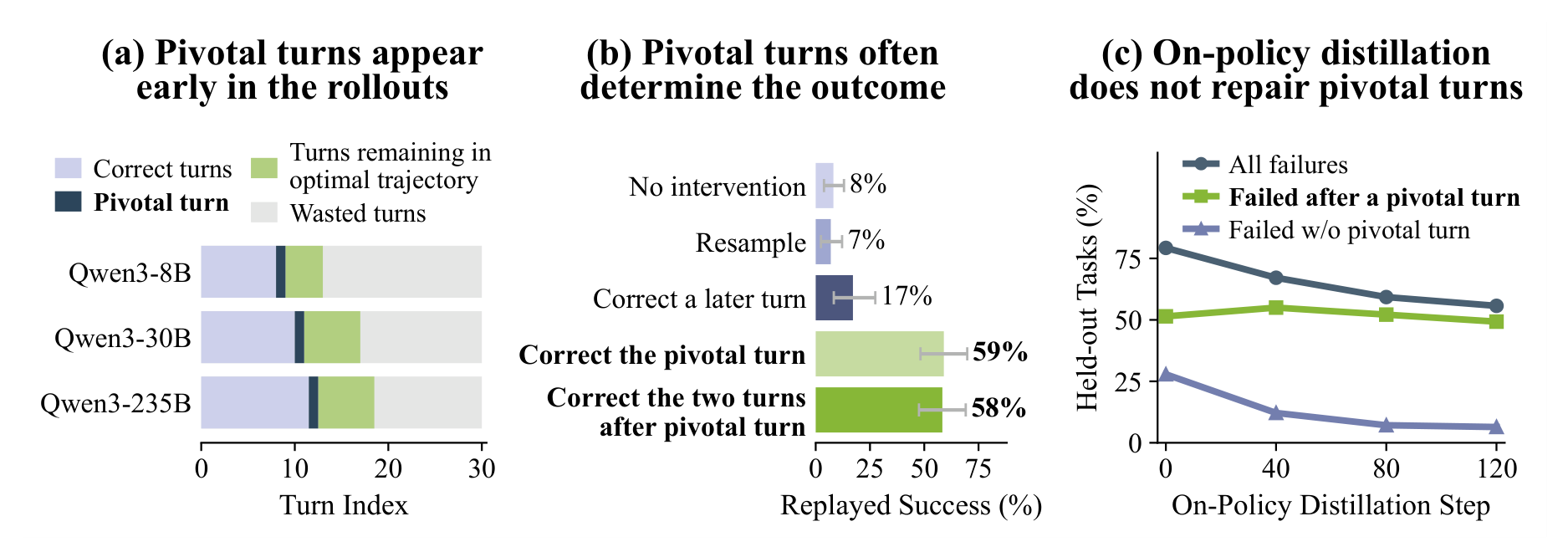
On-policy distillation (OPD) is a promising approach for training language agents, providing dense teacher supervision on student-generated trajectories. However, in multi-turn interaction, an incorrect action changes the states the student encounters later, so errors compound across turns. In our preliminary experiments across three Qwen3 models (8B–235B), we find that more than half of the failed rollouts contain a pivotal mistake, an action that moves the agent farther from completing the task, and this mistake typically occurs early. These pivotal mistakes often remain recoverable: guiding the model for only a few turns after the pivotal turn can restore task success. We therefore propose PivotOPD, an on-policy distillation framework that jointly trains the student to prevent pivotal mistakes and to recover from the states they create. At each pivotal mistake, a teacher model provides a gold action and then names a recovery action at each of the next few turns. Preventive distillation uses the gold action with reverse KL to steer the student away from the pivotal mistake, while recovery distillation uses the recovery actions with forward KL to transfer recovery behaviors that the student rarely samples. Against 13 baselines on ALFWorld, WebShop, and Search-based QA, PivotOPD achieves the strongest average performance for both Qwen3-1.7B and Qwen3-8B students, improving over the strongest baseline on ALFWorld by +5.5% with the 1.7B student. The gains also transfer to another model family on the software engineering domain, where PivotOPD raises the resolve rate of a Nemotron-3.5 student on SWE-Bench Verified by +3.2%.
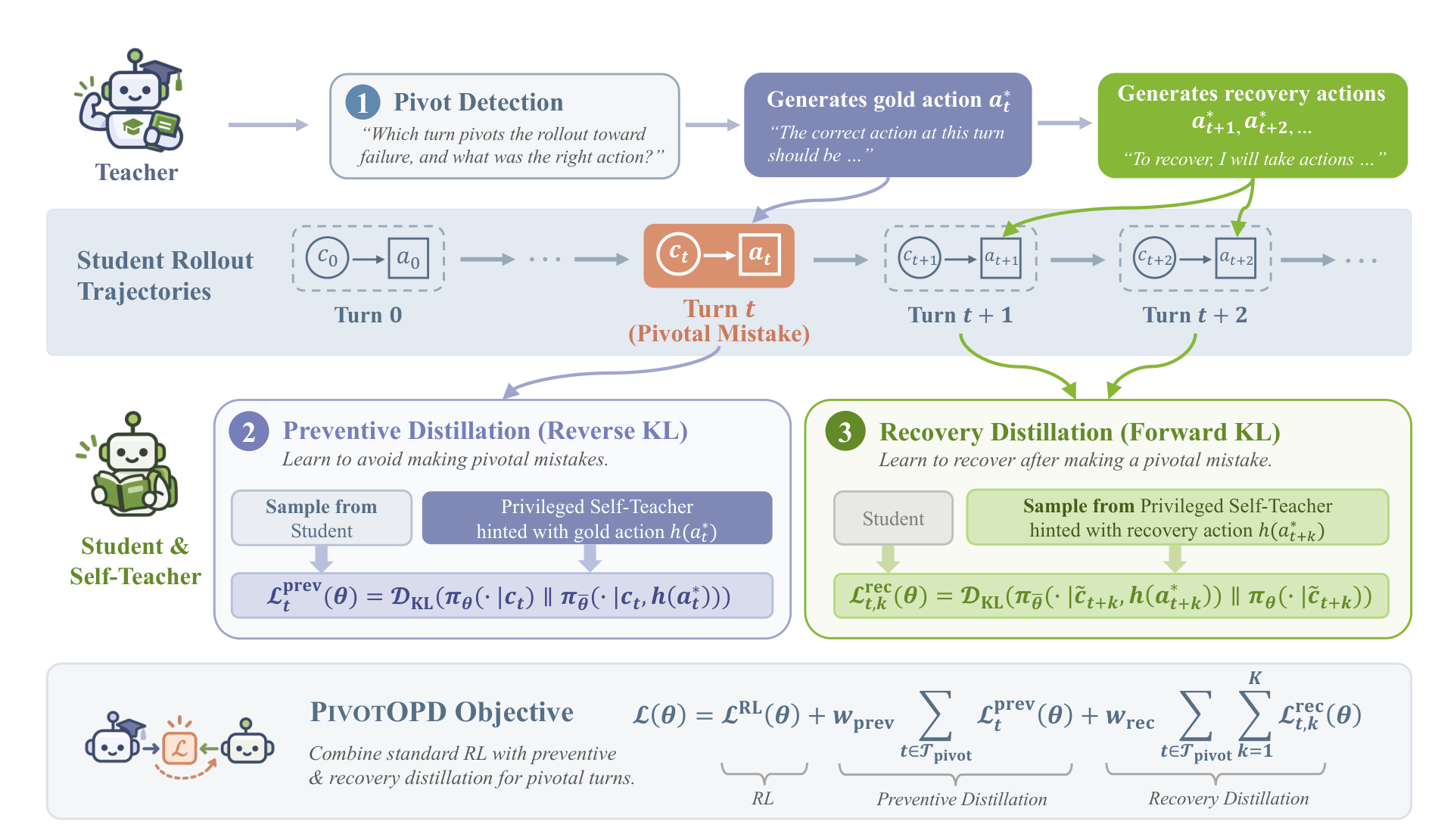
PivotOPD adds three components to group-based RL. A privileged self-teacher, the frozen student conditioned on a hint that names an action, turns every action the teacher names into a token-level target written in the student's own reasoning style, so the teacher only ever names actions. Both distillation terms enter a single PPO update as per-token distillation advantages.
A teacher model reads each rollout in hindsight, selects candidate turns, and names a gold action at each. A turn is pivotal when the student's committed action disagrees with it. After each pivotal turn, the teacher names a recovery action at each of the next K turns.
The student's own recorded response is re-scored against the self-teacher hinted with the gold action, which moves the student away from the committed mistake.
The self-teacher hinted with the recovery action writes recovery responses, and the unhinted student is trained on them. The mass-covering forward KL places probability on recovery actions the student almost never produces on its own.
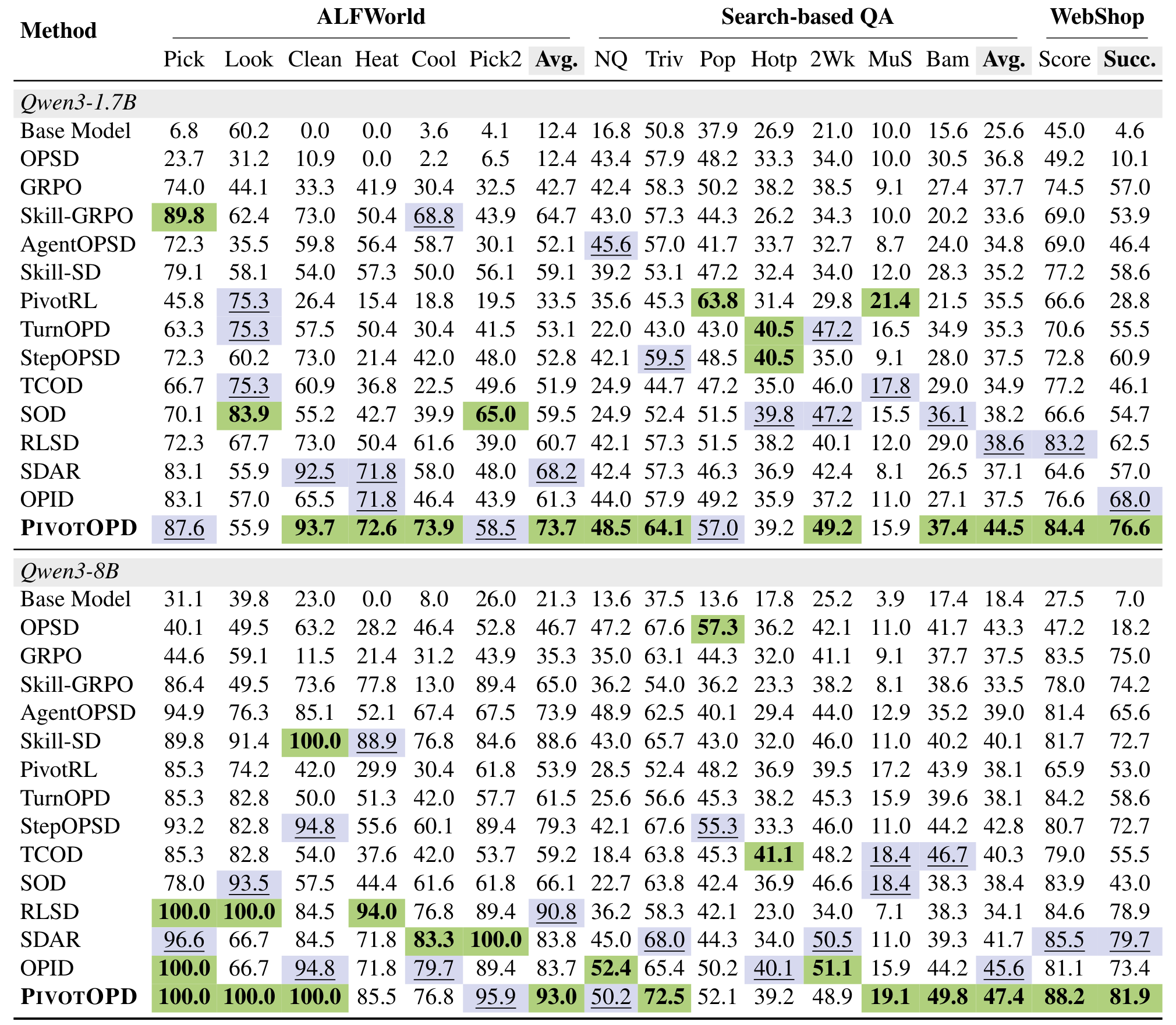
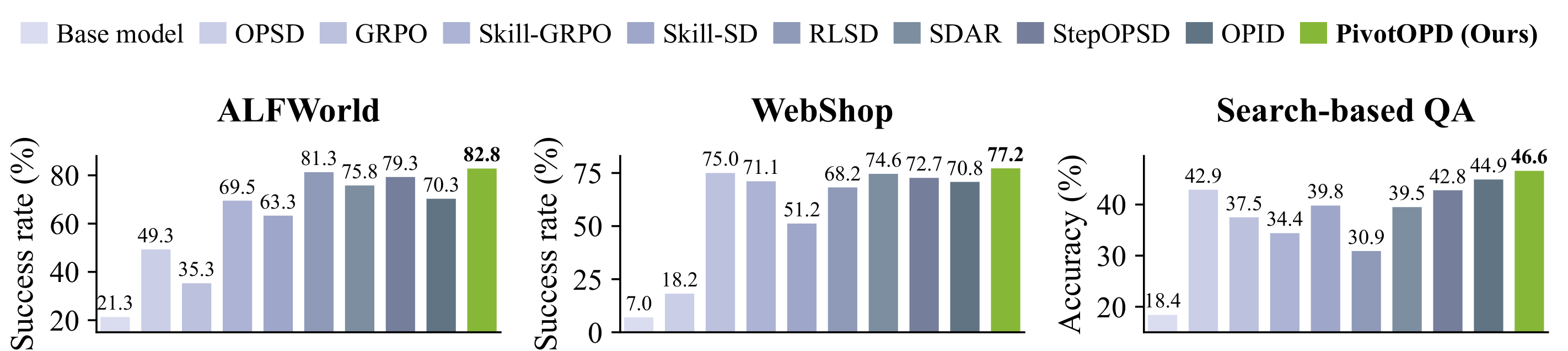
Against 13 baselines spanning RL and self-distillation, turn-level distillation for multi-turn agents, and guidance from skills or pivotal turns, PivotOPD attains the best average on ALFWorld, Search-based QA, and WebShop for both Qwen3-1.7B and Qwen3-8B students, ranking first on all eight per-benchmark averages over three seeds. With the 1.7B student it improves over the strongest baseline by +5.5% on ALFWorld and +5.9% on Search-based QA, with the largest gains on the task types where successful rollouts are scarcest and outcome-only RL receives no signal. It also turns partial progress into completed tasks: on WebShop it beats RLSD by only +1.2% in score but by +14.1% in success rate.
With Qwen3-8B serving as its own teacher, and every baseline that uses a teacher given the same treatment, PivotOPD remains best on all three benchmarks, ahead of the strongest baseline on each by at least +1.5% and by +3.9% on average. Much of the gain comes from where and how the teacher intervenes rather than from teacher capacity alone.
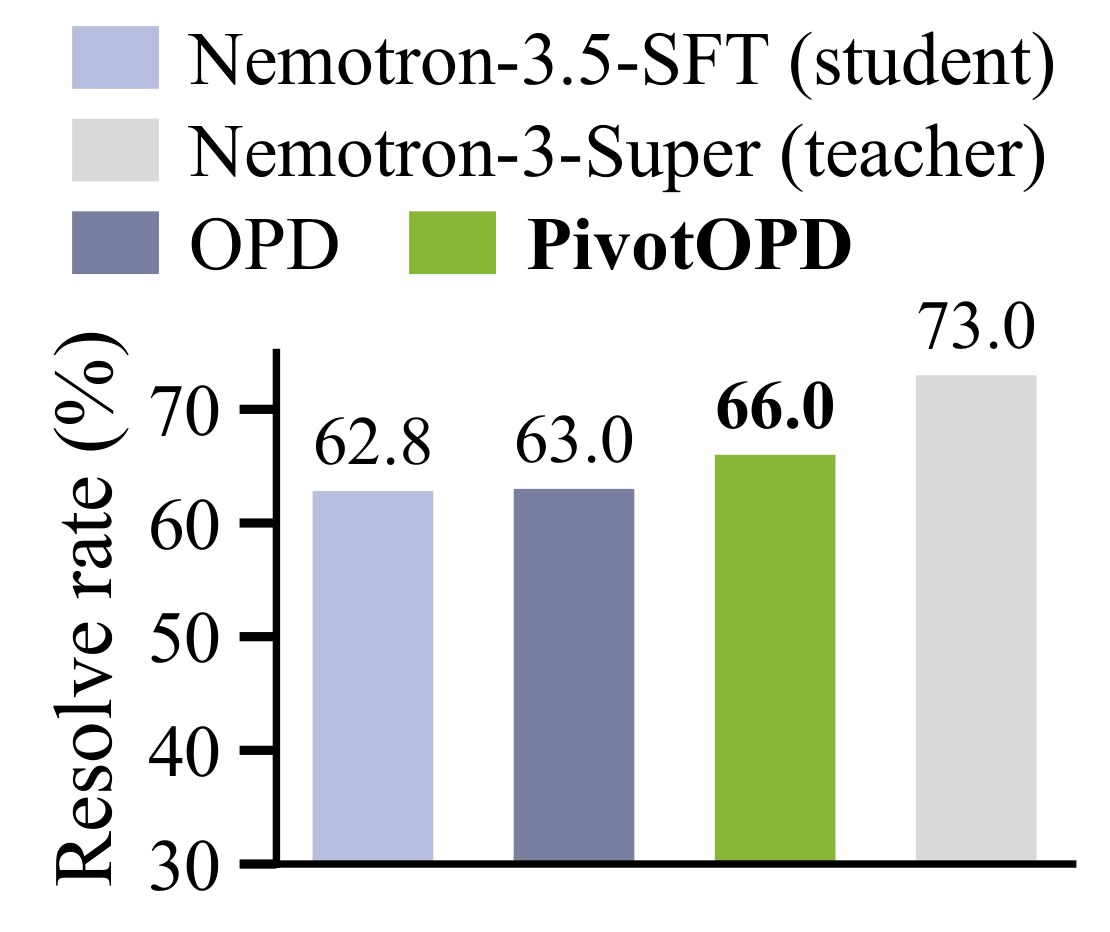
Trained on a curated bug-fix curriculum with Nemotron-3-Super as the teacher, a Nemotron-3.5-SFT student gains +3.2% resolve rate on SWE-Bench Verified (62.8% to 66.0%), closing roughly a third of the gap to the teacher, whereas standard on-policy distillation from the same teacher improves it by only +0.2%. Because SWE-Bench episodes are long and containerized, this experiment audits the final committed action and exercises preventive distillation alone.
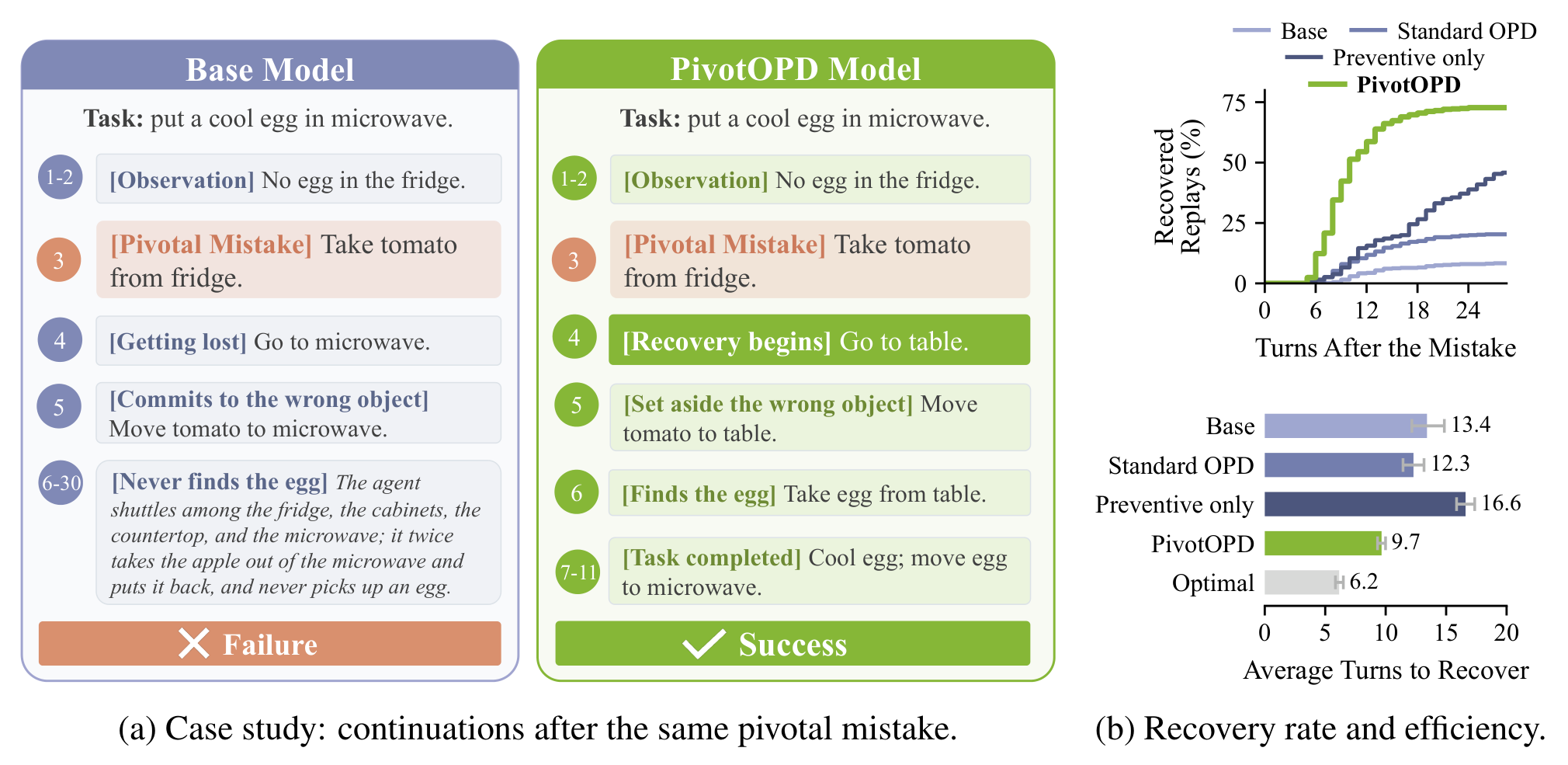
Replayed from the same 72 oracle-labeled pivotal mistakes, PivotOPD recovers in 72.7% of replays, against 8.3% for the base model, 20.3% for standard OPD and 45.8% for the preventive-only variant, and it does so in the fewest turns. It improves the recovery rate on 60 of the 72 mistakes and worsens none.
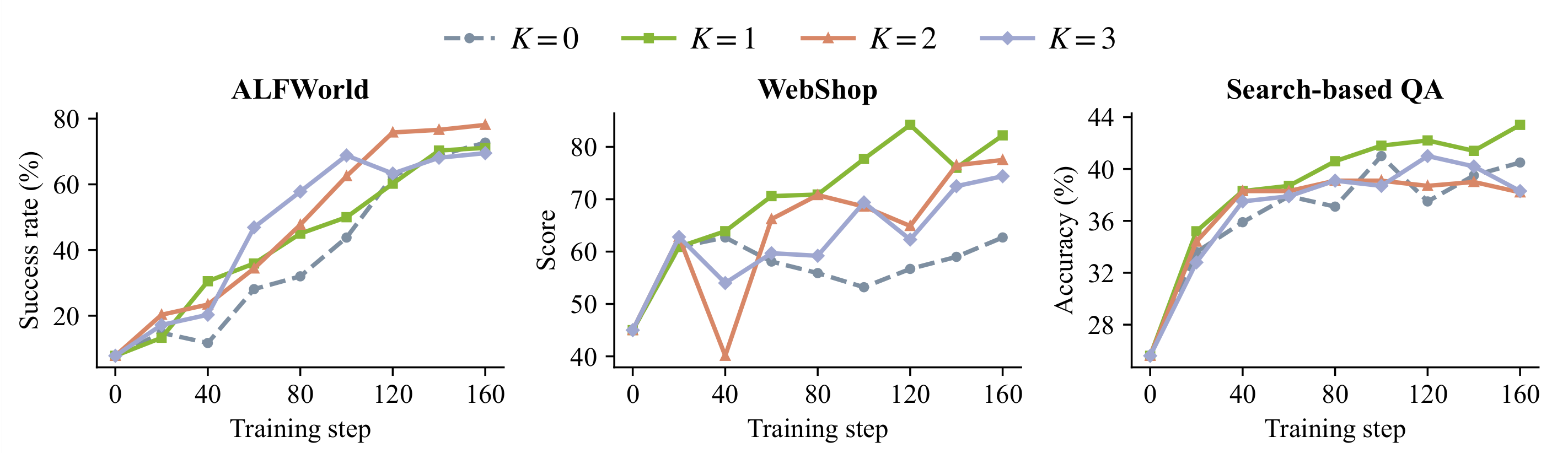
The selected recovery budget raises the best validation score over the preventive-only variant (K = 0) by 5.4 points on ALFWorld, 21.5 on WebShop and 2.4 on Search-based QA. One recovery turn is enough on WebShop and Search-based QA, while ALFWorld, whose tasks chain longer sequences of fine-grained actions after a mistake, needs two.
@article{he2026pivotopd,
  title   = {PivotOPD: Learning to Recover from Pivotal Mistakes in Multi-Turn Agents},
  author  = {He, Yinghui and Chang, Yapei and Bhardwaj, Khushi and Molinari, Daniele and Konuk, Tugrul and Kautz, Jan and Hatamizadeh, Ali},
  journal = {arXiv preprint arXiv:2609.40285},
  year    = {2026},
  url     = {https://arxiv.org/abs/2609.40285}
}
