UniProbe: A Learnable Token-Level Hallucination Detector for Large VLMs
using Multi-Structural Internal Representations

Dvir Samuel1 Guy Bar-Shalom2 Fabrizio Frasca2 Ethan Fetaya1,3
Yftah Ziser1,4 Gal Chechik1,3 Haggai Maron1,2

1NVIDIA Research     2Technion     3Bar-Ilan University     4University of Groningen

UniProbe with hallucination-aware decoding hallucinations never reach the output
Input image
Input to the frozen LVLM.

QueryWhat is the child wearing?

UniProbe hallucination score p = 0.03
τ
Decoding…
hallucinated token flagged by UniProbe grounded resample

Abstract

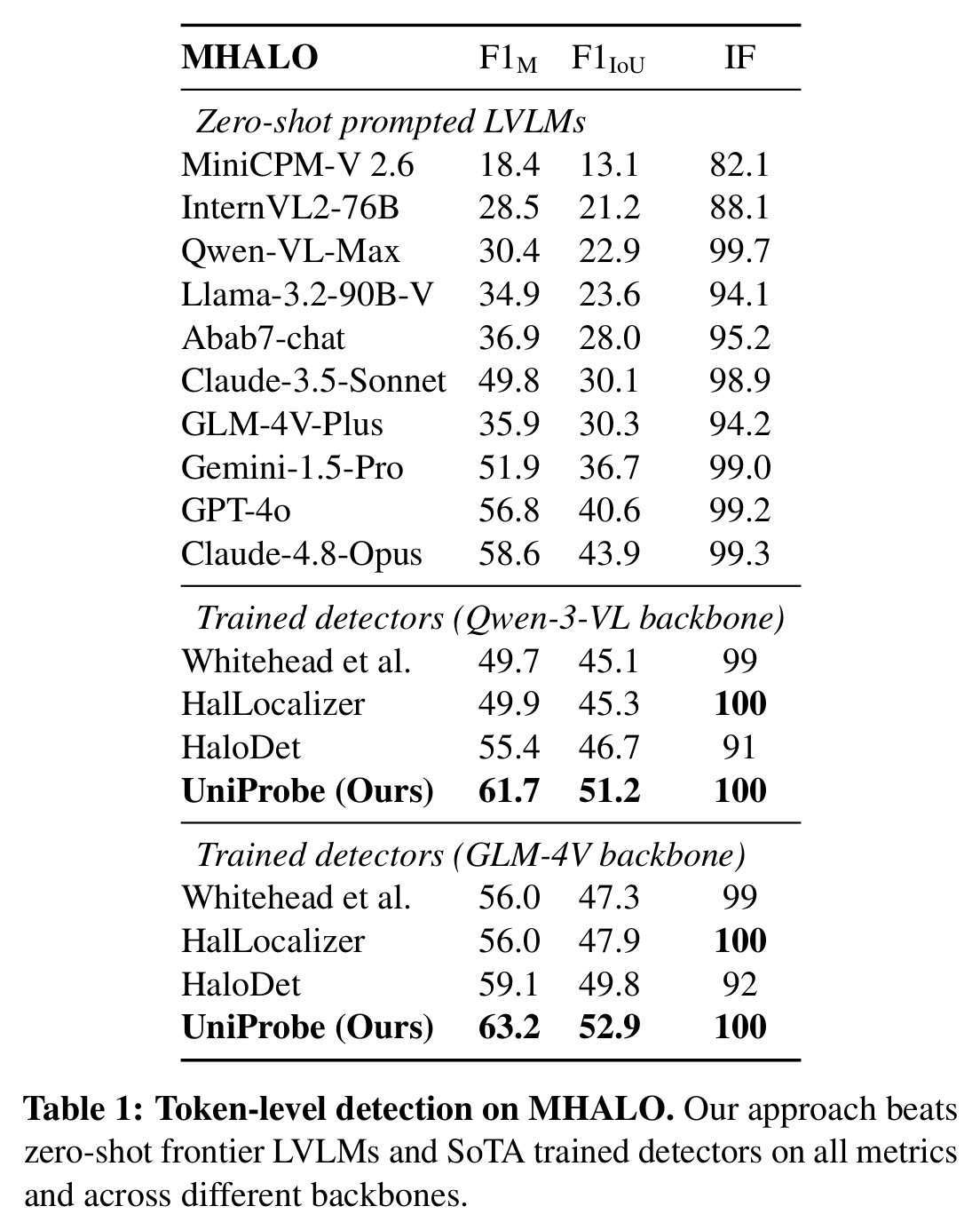
Large Vision-Language Models (LVLMs) achieve impressive visual reasoning and dialogue capabilities, yet frequently hallucinate content unsupported by the visual input. Effective mitigation requires token-level localization, enabling targeted intervention without discarding the entire response. Existing detectors require expensive full-model fine-tuning, rely on external verifiers that ignore the model's generation process, or reduce internal signals to isolated features and hand-crafted statistics, discarding spatial, sequential, and relational structure.

We introduce UniProbe, a lightweight, unified, learnable detector that models a frozen LVLM's heterogeneous computational trace from a single forward pass. UniProbe constructs a directed graph over image patches, query tokens, and generated tokens, with attention weights encoding their relations. It processes this trace with alternating structure-aware modules: a GNN for relational evidence, a ViT for 2-D visual geometry, and a GRU for response order. Interleaving them allows spatial, relational, and sequential evidence to interact throughout the detector.

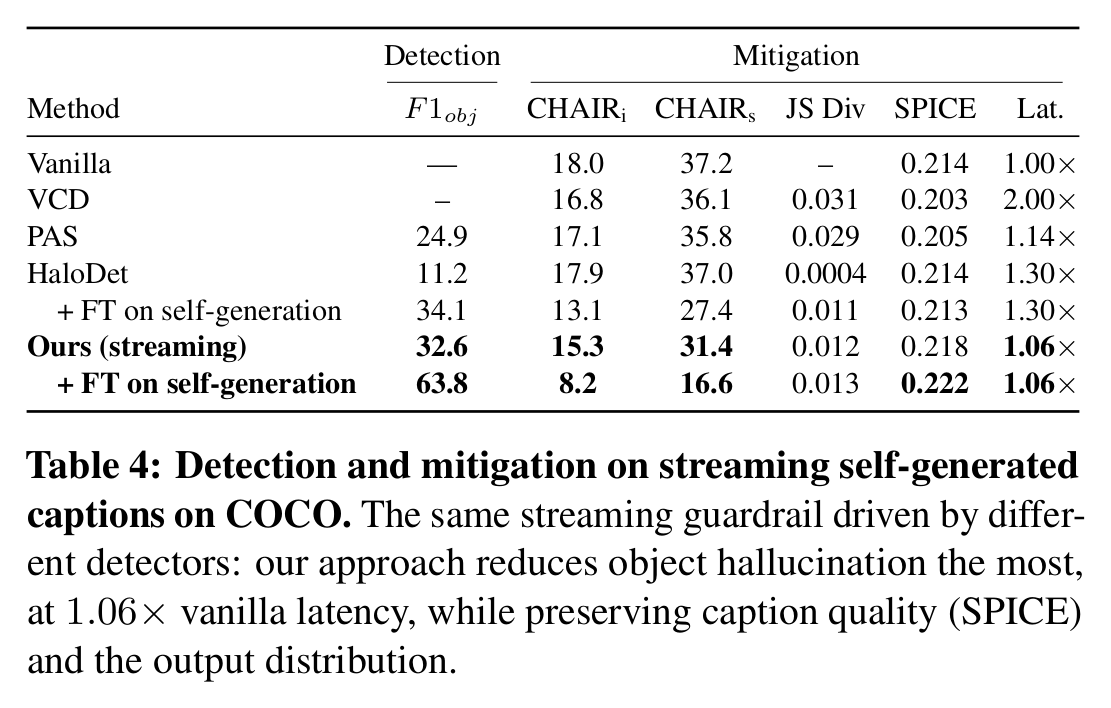
We further develop a streaming variant for hallucination-aware decoding, which detects and resamples hallucinated tokens during generation, and a self-adaptation strategy aligning the detector with the LVLM's own generations. Across diverse LVLM backbones, UniProbe achieves state-of-the-art token-level and object-hallucination detection. During decoding, it reduces object hallucinations by up to 55% at 1.06× the latency of standard generation.

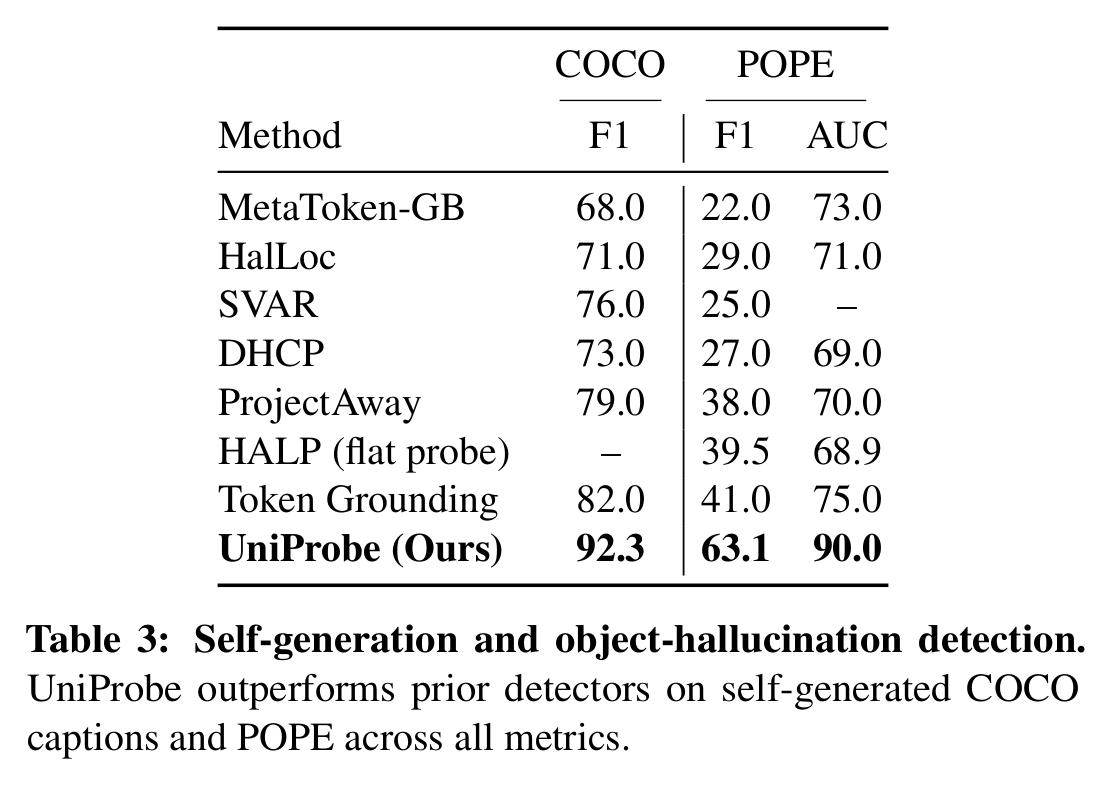
63.1 F1
object hallucination on POPE
(prior best: 41.0)
−55%
object hallucination
during decoding
1.06×
latency vs. vanilla generation
with the guardrail on
0 params
updated, the LVLM stays frozen

Method

One forward pass of a frozen LVLM yields a heterogeneous computational trace. UniProbe reads it as structured data instead of flattening it into a feature vector.

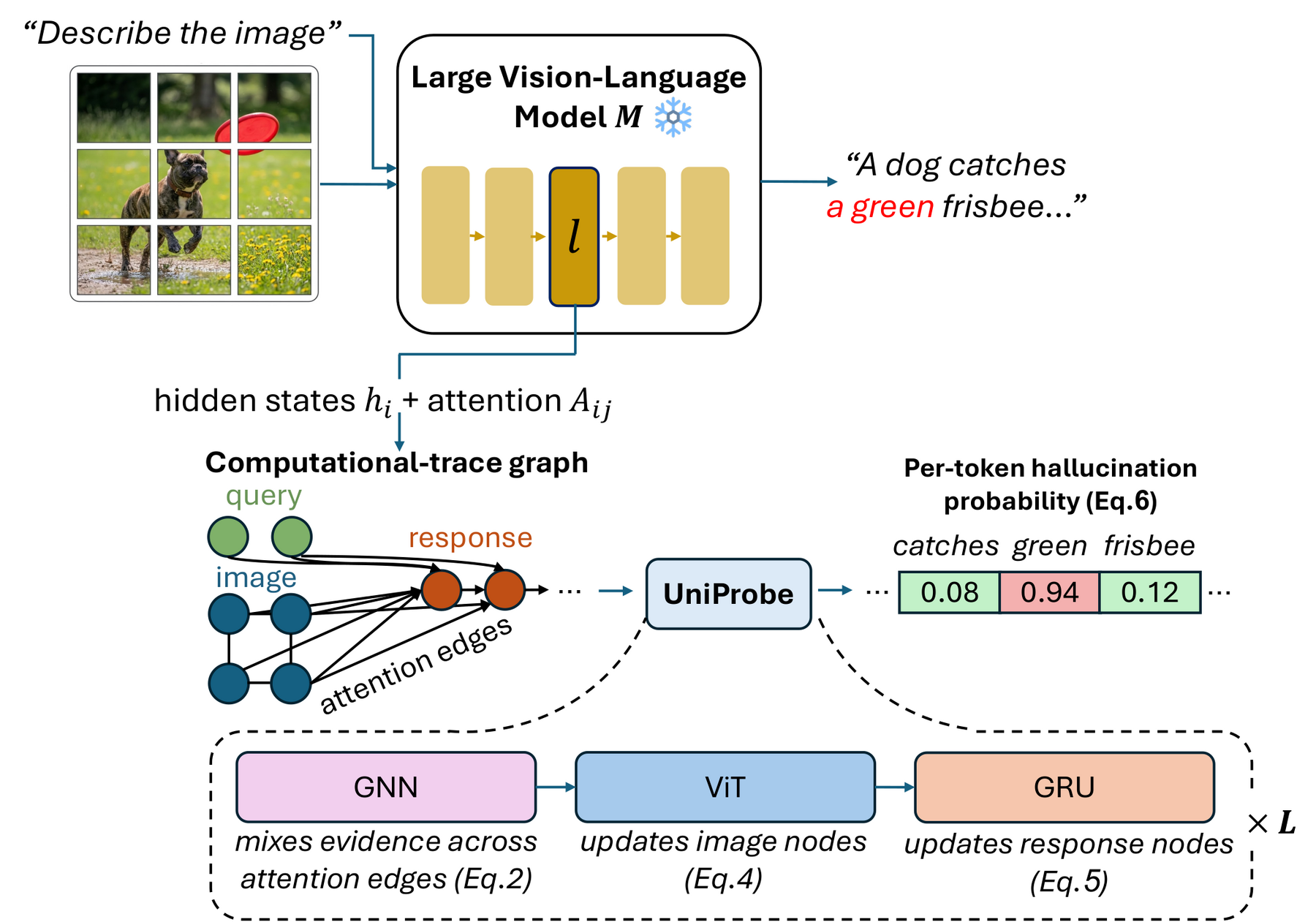
UniProbe architecture
UniProbe architecture. From a single forward pass of the frozen LVLM M, UniProbe reads layer-ℓ hidden states and attention to construct a computational-trace graph over image, query, and response tokens. L alternating blocks of GNN, ViT, and GRU integrate cross-modal, spatial, and sequential evidence, followed by a linear head that predicts a hallucination probability for each response token.

Computational-trace graph

Nodes are tokens of three types: all T response tokens, plus the image patches and query tokens that receive the most total attention from the response. Each node carries its layer-ℓ hidden state; image nodes additionally carry a 2-D encoding of their patch coordinates. Edges come straight from attention — for each response token we keep the strongest incoming connections from image patches, query tokens, and earlier response tokens. By causality, the neighborhood of a token is exactly the visual and textual evidence the model used to emit it.

Alternating structure-aware blocks

A GNN mixes evidence across modalities with type-specific projections, so “attends to an image patch” and “attends to the query” read as distinct evidence. A ViT then refines the image grid and a BiGRU the response in generation order. Interleaving the three — rather than running them in parallel — lets spatial, relational, and sequential evidence interact throughout the network. The whole detector is trained end-to-end while the backbone stays frozen.

Hallucination-aware decoding

Replacing the bidirectional response GRU with a unidirectional one makes the detector streaming: the score of token ri depends only on the prefix ri. As the model decodes, each new token is scored against the causal trace; if its hallucination probability exceeds τ, the token is rejected, its first sub-token banned, and the model re-decodes. The hallucination is corrected during generation and never reaches the final response.

Self-adaptation

Token-level benchmarks supervise detectors on responses from other LVLMs, but at deployment a detector must judge its host model's own, more fluent generations. We close this gap without manual annotation: caption a small set of Objects365 images with the target model, auto-label object mentions with CHAIR against ground-truth objects, and fine-tune UniProbe on those generations.

Results

Locating hallucinations in a completed response

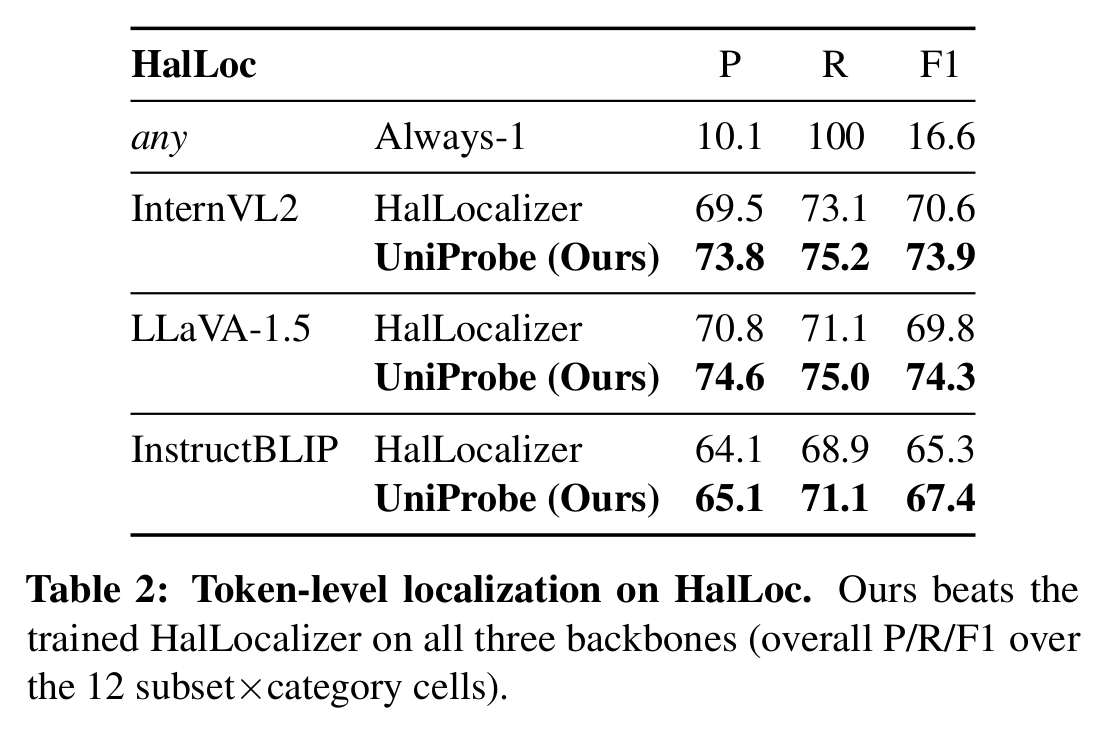
Two questions, one detector: which tokens of a response are unsupported (MHALO, HalLoc), and whether a mentioned object is actually in the image (self-generated COCO captions, POPE).

Table 1: token-level detection on MHALO
Table 3: self-generation and object-hallucination detection
Table 2: token-level localization on HalLoc

Catching hallucinations as they are generated

The same detector, made causal, runs inside the decoding loop: it scores each token the moment it is emitted, rejects the ones it flags, and re-decodes. Hallucinations are repaired mid-generation rather than after the fact.

Table 4: detection and mitigation on streaming self-generated captions

Caption quality holds up (SPICE 0.222 vs. 0.214 vanilla) and the output distribution barely moves (JS divergence 0.013) — the guardrail removes hallucinations without rewriting the model.

Qualitative results

Detection failures of prior methods, and what UniProbe generates instead.

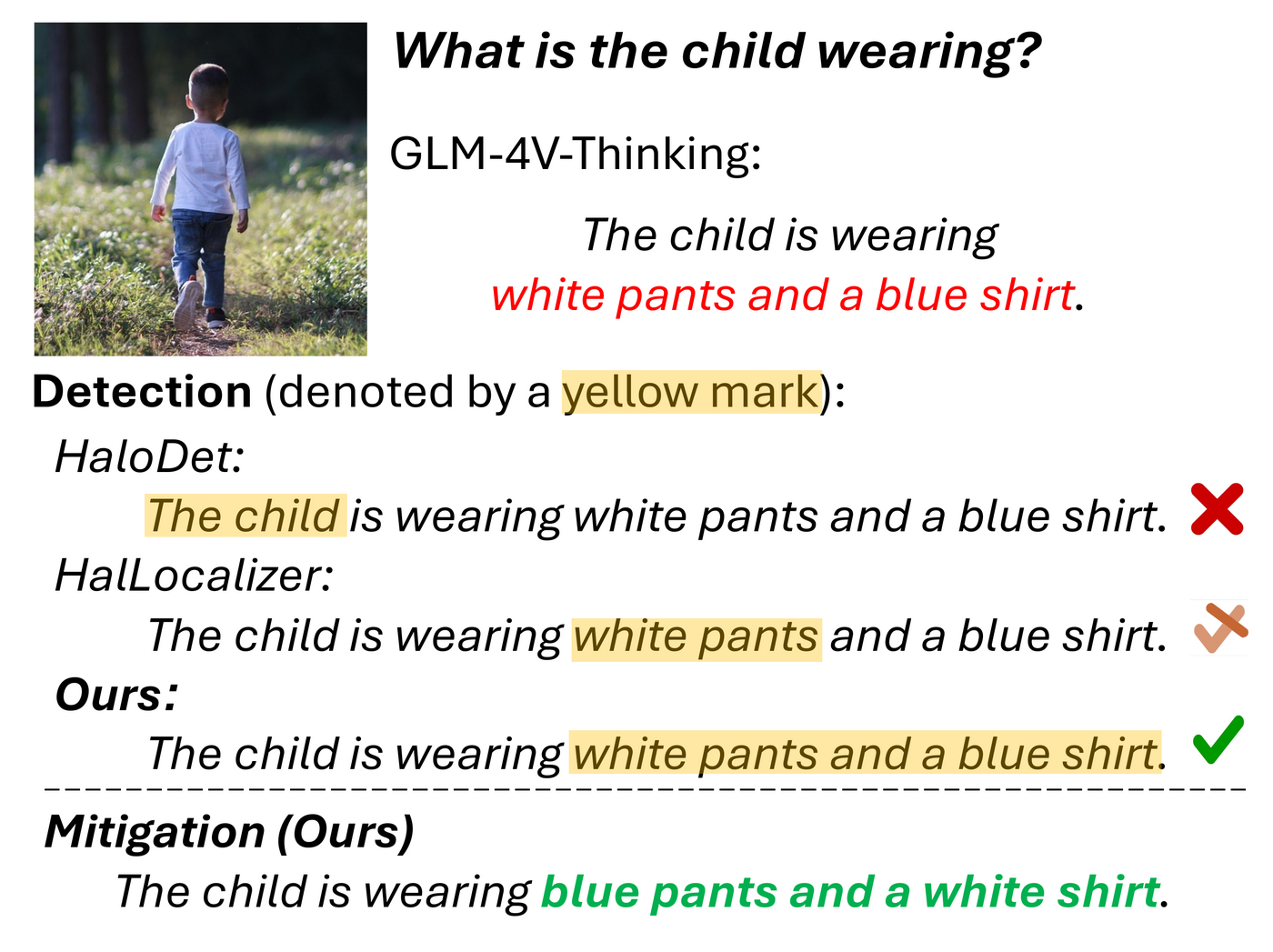
Token-level detection and mitigation example
Token-level hallucination detection and mitigation. Existing SOTA detectors either misidentify non-hallucinated tokens (HaloDet) or fail to capture the full hallucination (HalLocalizer). Yellow highlights denote tokens identified as hallucinated by each detector. UniProbe accurately detects the hallucinated tokens and actively mitigates them during generation to produce a grounded response.
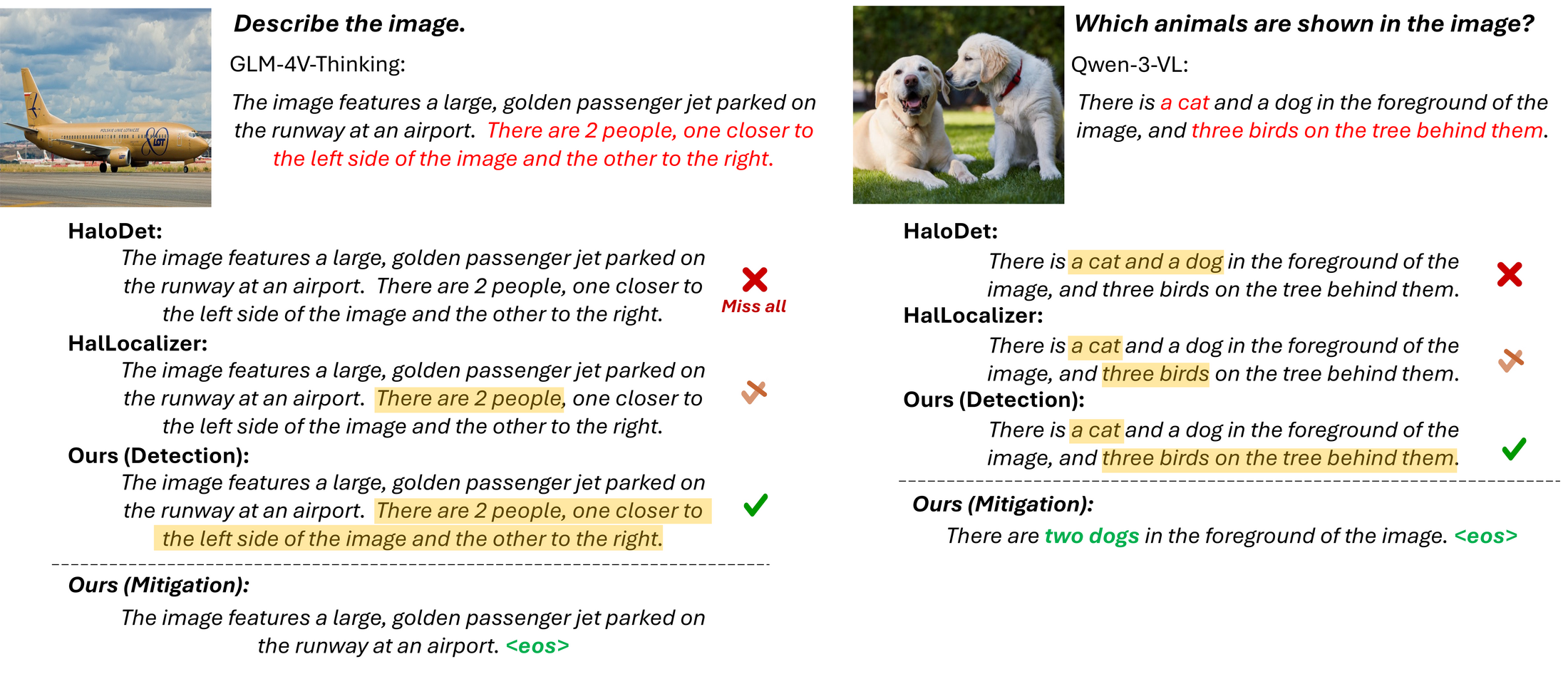
Qualitative comparison across backbones
Across LVLM backbones. Prior detectors over-flag visually grounded text, detect only part of a hallucinated span, or miss it entirely. UniProbe localizes the complete unsupported span, and the same detector driving hallucination-aware decoding produces the grounded outputs in green.

BibTeX

If you find this work useful, please cite:

@article{samuel2026uniprobe,
  title   = {UniProbe: A Learnable Token-Level Hallucination Detector
             for Large VLMs using Multi-Structural Internal Representations},
  author  = {Samuel, Dvir and Bar-Shalom, Guy and Frasca, Fabrizio and
             Fetaya, Ethan and Ziser, Yftah and Chechik, Gal and
             Maron, Haggai},
  journal = {arXiv preprint arXiv:2608.10835},
  year    = {2026}
}