Digital Humans
Physics-based simulation of digital humans, spanning upsampled facial animations, interactive hair dynamics, and large-scale character clothing.
Scalable algorithms and efficient tools for high-fidelity physical simulation.
We are broadly interested in developing advanced algorithms and tools that embed more accurate physics into neural understandings and encodings of the world. Our research spans both traditional (forward) and inverse physics solvers, with applications in robotics, engineering analysis, and computer graphics. We prioritize high-fidelity results and close the gap to real-time performance through sparse 3D representations and neural acceleration.
Finite Element & Monte Carlo Methods • Neural Solvers • Digital Humans • Synthetic Data Generation
Physics-based simulation of digital humans, spanning upsampled facial animations, interactive hair dynamics, and large-scale character clothing.
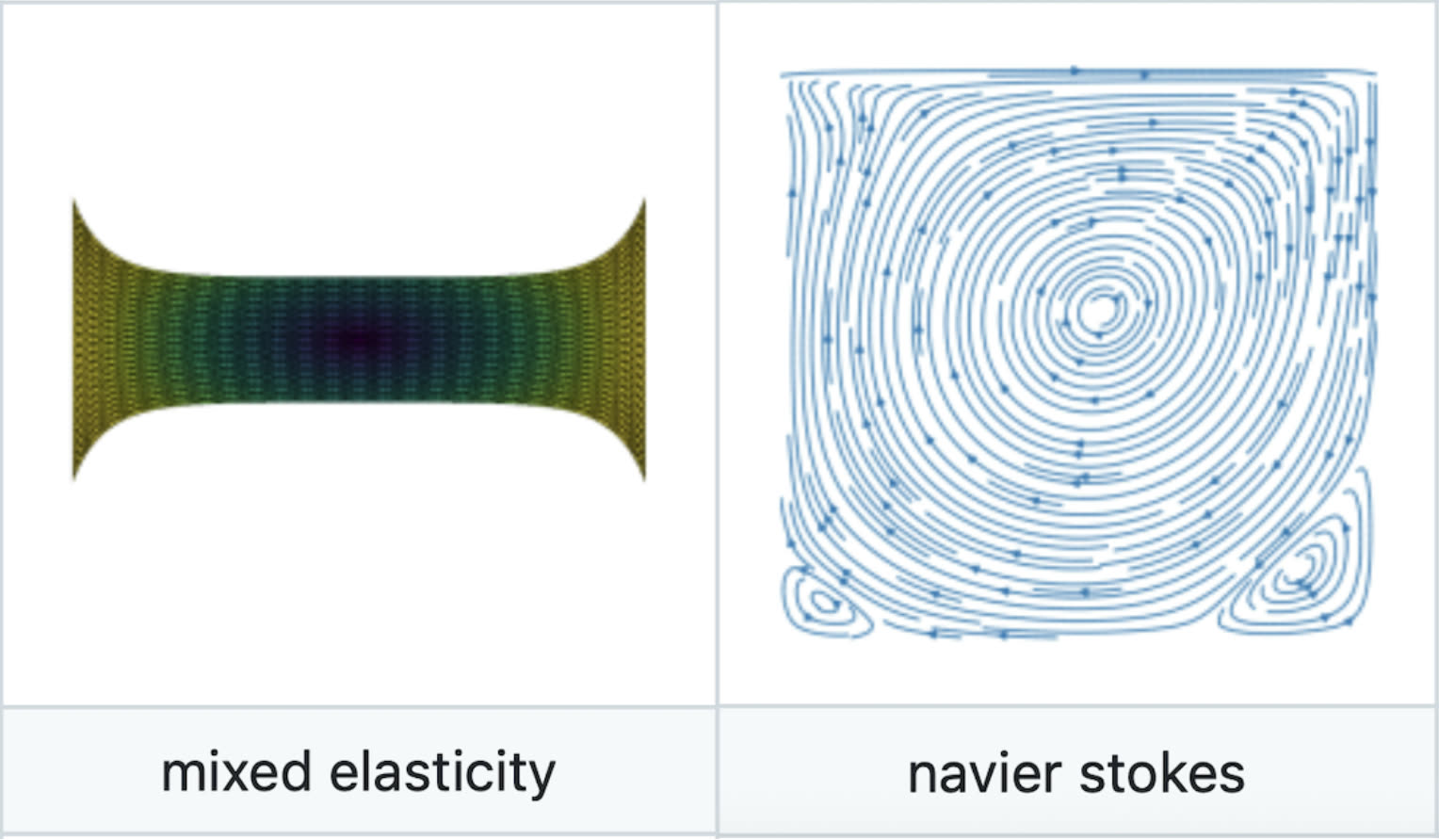
GPU-accelerated finite element framework in Python and NVIDIA Warp, targeting diffusion, convection, fluid flow, and elasticity problems.
Mesh-free, geometry-agnostic, elastic simulation on any point-sampled geometry, such as point clouds, meshes, as well as 3D Gaussian splats.
GPU-accelerated, grid-free Monte Carlo solvers for static physics in complex 3D scenes, inspired by ray-tracing methods for photorealistic rendering.
GPU-accelerated sparse volume data structures based on the OpenVDB toolset for large-scale, high-resolution 3D simulation and spatial intelligence.
Please visit our team's webpage for a full list of publications and resources.