Foundation4D
Towards a unified perception and reconstruction model for autonomous vehicles
NVIDIA
TL;DR
Foundation4D turns multi-camera driving video into geometry, 3D objects, semantic occupancy, and Gaussian reconstructions. A shared backbone combines information across cameras and time, while video processing refines camera trajectories and links objects into tracks. We also release the PAI–Foundation4D benchmark, with dense depth and occupancy annotations for 1,253 driving clips, and use predicted geometry and trajectories as priors for LiDAR-free NuRec.
Method
Per-chunk inference
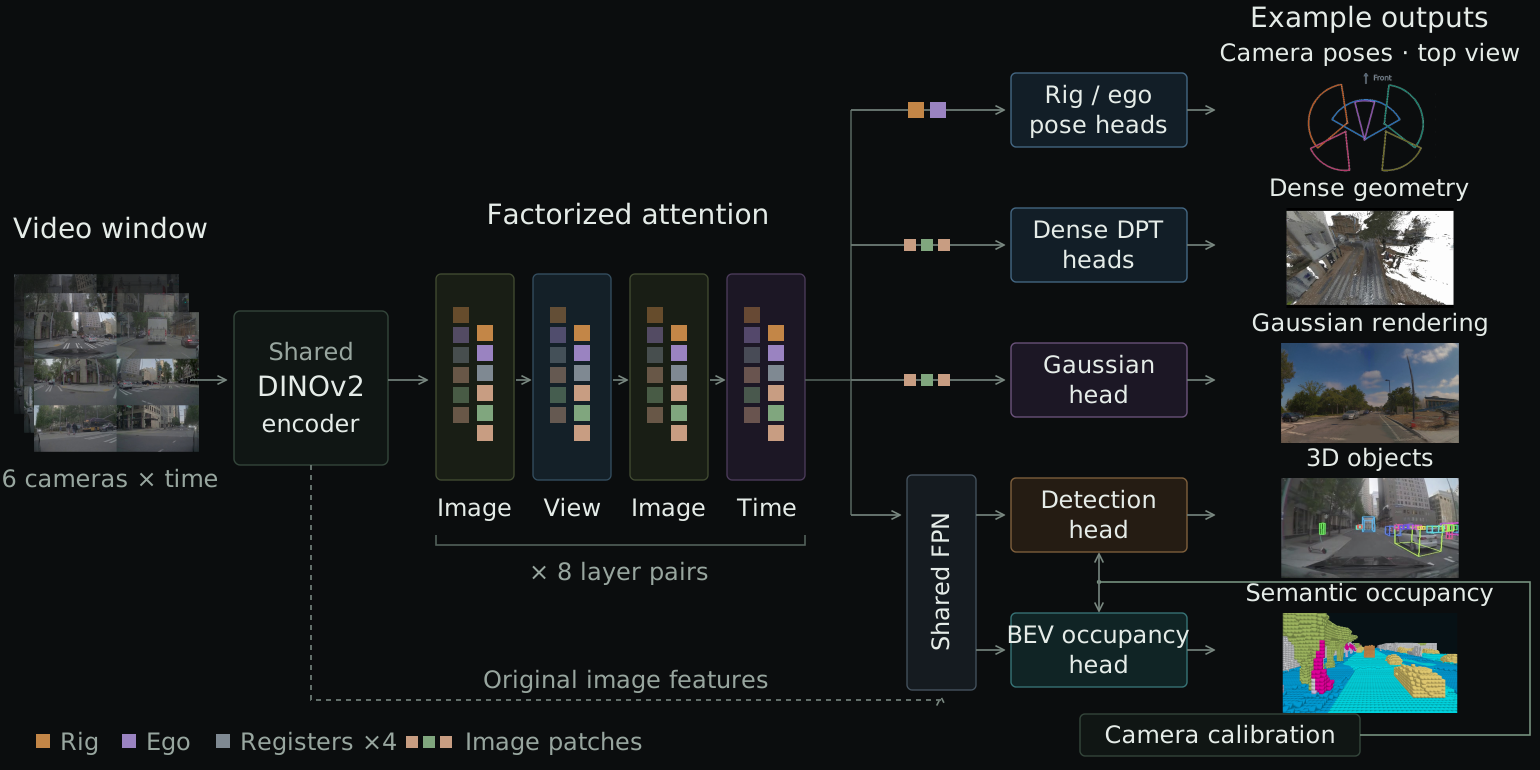
Video processing
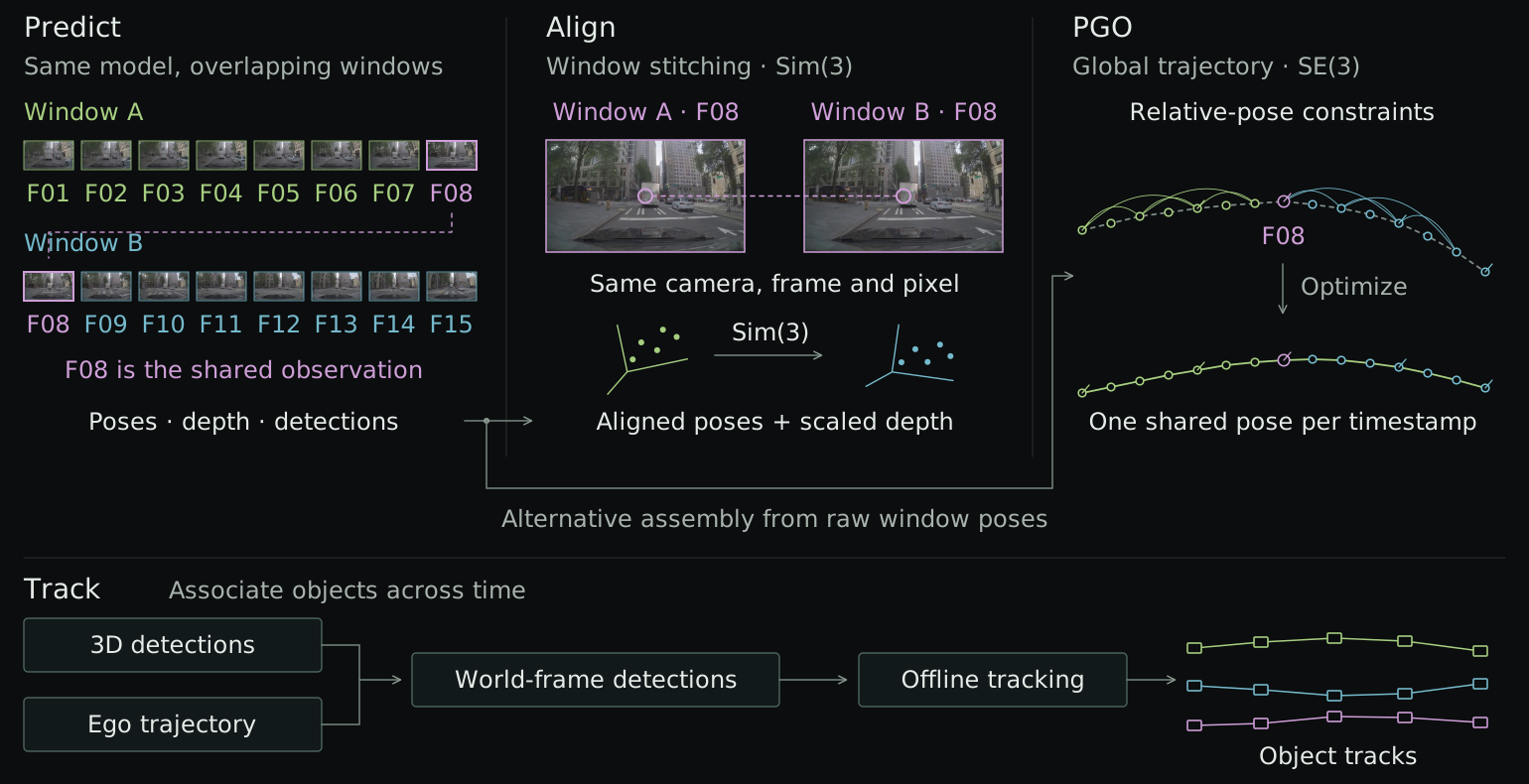
Geometry and detection retain the original checkpoint; occupancy uses a separately fine-tuned model. Geometry uses native video-wide depth fusion with current-frame dynamic-object depths restored.
Quantitative results
White Paper ↗Leading results among the methods compared in the white paper, with models adapted to each benchmark.
Depth estimation · Waymo & nuScenes
| Method | Waymo | nuScenes | ||
|---|---|---|---|---|
| AbsRel ↓ | δ₁.₂₅ ↑ | AbsRel ↓ | δ₁.₂₅ ↑ | |
| DVGT-1 | 0.20 | 72.87 | 0.18 | 78.97 |
| DVGT-2 | 0.26 | 70.93 | 0.22 | 75.32 |
| LiAuto-GeoX | 0.19 | 75.72 | 0.27 | 62.75 |
| GeoUP | 0.13 | 87.30 | 0.19 | 80.05 |
| Foundation4D | 0.09 | 91.97 | 0.15 | 86.44 |
48-frame windows; scale alignment per window. δ₁.₂₅ is reported in %. Training data and geometric inputs differ across methods. Table 2 ↗
Camera trajectories · Waymo & nuScenes
| Dataset | Assembly | Method | ATE ↓ (cm) | RTE ↓ (cm) | RRE ↓ (°) |
|---|---|---|---|---|---|
| Waymo · Stitching | |||||
| Waymo | Stitching | DVGT-1 | 62.33 | 3.54 | 0.06 |
| Foundation4D | 32.70 | 3.20 | 0.06 | ||
| Waymo · PGO+LM | |||||
| Waymo | PGO+LM | DVGT-1 | 54.55 | 2.38 | 0.05 |
| Foundation4D | 23.62 | 1.56 | 0.06 | ||
| nuScenes · Stitching | |||||
| nuScenes | Stitching | DVGT-1 | 31.02 | 3.98 | 0.07 |
| Foundation4D | 22.13 | 2.15 | 0.05 | ||
| nuScenes · PGO+LM | |||||
| nuScenes | PGO+LM | DVGT-1 | 30.54 | 1.24 | 0.07 |
| Foundation4D | 17.48 | 1.19 | 0.05 | ||
Both models use 48-frame windows with 5-frame overlap and the same video assembly system on official validation splits. Evaluation fits one Sim(3) alignment per complete clip; the depth table aligns each window separately.
ATE: absolute trajectory error; RTE/RRE: relative translation/rotation error. PGO+LM includes a linear-motion prior. Bold marks the lowest error within each dataset and assembly pair, including ties.
3D detection · nuScenes
| Method | mAP ↑ | NDS ↑ |
|---|---|---|
| PETRv2 | 42.1 | 52.4 |
| SparseBEV | 50.1 | 59.2 |
| Stream3DPPE | 50.0 | 58.5 |
| RoPETR | 52.9 | 61.4 |
| StreamPETR | 52.1 | 60.8 |
| RayDN (EVA02-L) | 54.1 | 62.4 |
| RayDN (DINOv3) | 49.9 | 55.3 |
| GeoUP-nuScenes | 56.5 | 63.0 |
| GeoUP-Joint | 59.2 | 65.3 |
| Foundation4D | 60.9 | 66.5 |
Camera-only, official validation split; scores in %. Foundation4D uses offline 8-keyframe windows with future context. Table 7 ↗
3D occupancy · OpenOccupancy
| Method | mIoU ↑ | IoU ↑ |
|---|---|---|
| MonoScene | 6.9 | 18.4 |
| TPVFormer | 7.8 | 15.3 |
| CONet | 12.8 | 20.1 |
| OccMamba | 13.2 | 21.7 |
| SparseOcc | 14.1 | 21.8 |
| OccGen | 14.5 | 23.4 |
| SPSC | 15.2 | 24.3 |
| SPSC-temporal | 16.2 | 25.5 |
| Foundation4D | 18.1 | 27.4 |
Camera-only, 16 semantic classes, 0.2 m voxels; scores in %. Highlighted values are the best aggregate scores in this comparison. Table 12 ↗
Precise Dense 3D Annotation Pipeline
Dataset ↗PAI–Foundation4D extends NVIDIA’s Physical AI Autonomous Vehicles dataset with dense depth and semantic occupancy annotations, including per-voxel velocities, for 1,253 driving clips.
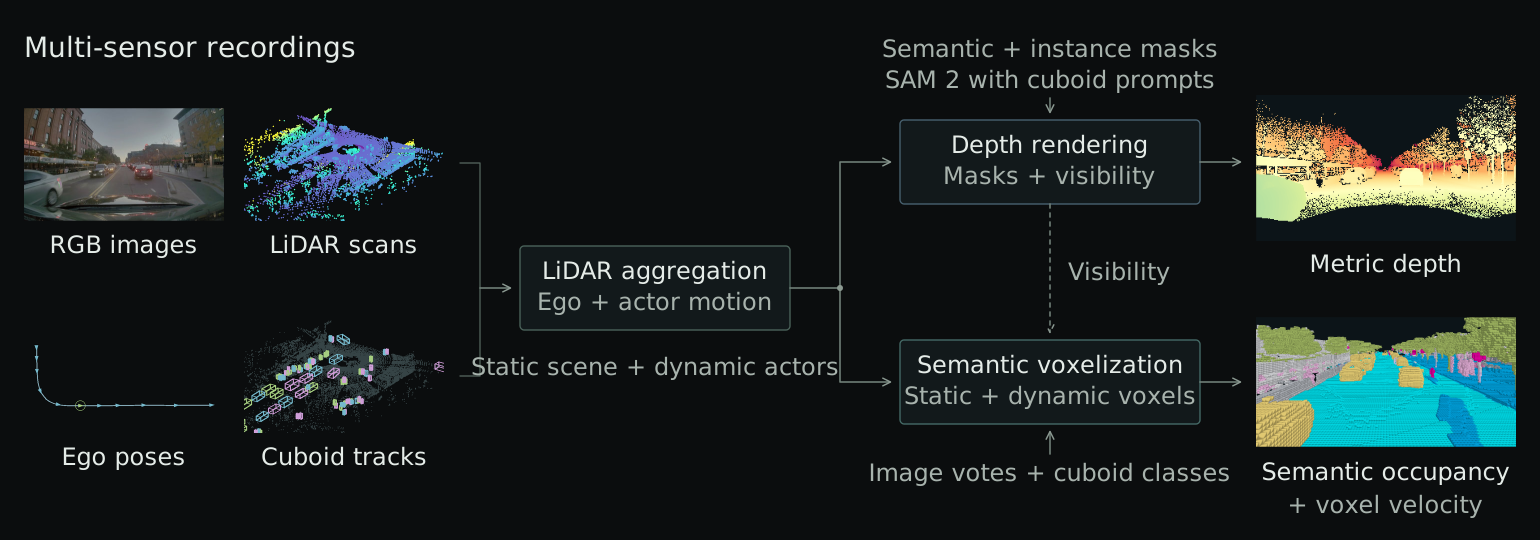
Application to LiDAR-free NuRec
Foundation4D supplies camera trajectories, dense geometry and actor tracks for NuRec. With multi-camera video and GPS/IMU trajectories, NuRec optimizes a dynamic Gaussian scene for novel-view rendering without LiDAR.
Bottom row: LiDAR-free NuRec reconstruction
Drag either divider to compare.