
PSNR (dB)
NuRecDenseSelective
NVIDIA
3D simulation platforms are critical for autonomous driving because they enable end-to-end policy evaluation, thereby reducing development costs and improving safety. In recent years, neural simulation has become predominant, with methods such as NuRec playing a central role; however, these methods remain relatively slow and typically require per-scene tuning. In this work, we present Instant NuRec, a feed-forward neural reconstruction model that turns a short multi-view driving log into a fully simulatable 3D Gaussian Splatting (3DGS) world in a single forward pass. The model accepts multi-view input from a calibrated camera rig and emits a layered output consisting of static and dynamic 3DGS layers, a sky cubemap, and per-camera ISP corrections, while providing native support for non-pinhole camera models via 3DGUT. It reconstructs a 10–20-second multi-camera scene in roughly 1.5 seconds and achieves a PSNR on the Waymo Open Dataset that is 2.01 dB above the strongest evaluated baseline. Instant NuRec is deeply integrated into NuRec and is compatible with AlpaSim for closed-loop simulation.
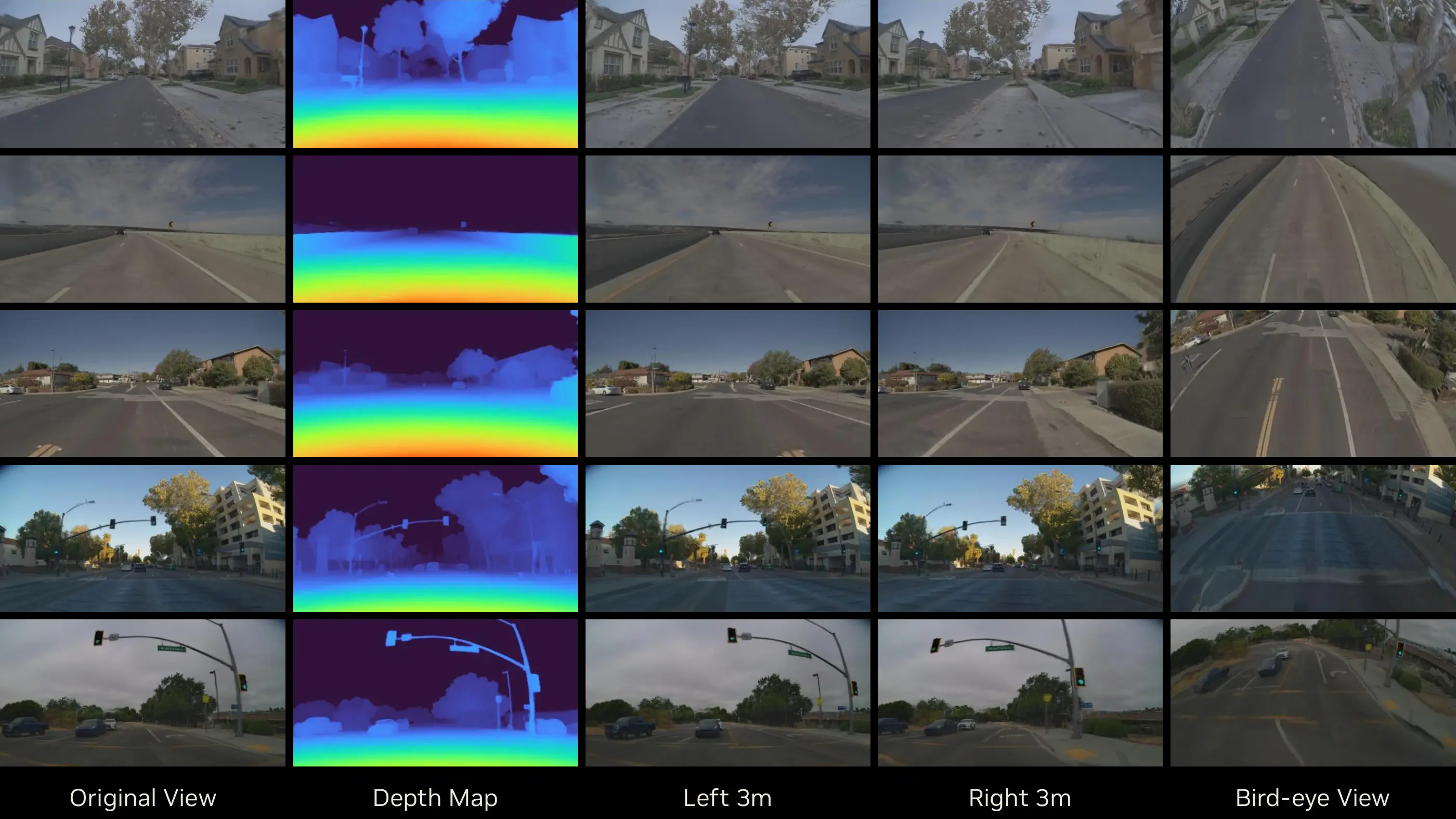
Bird's-eye-view reconstructions across diverse road layouts, weather conditions, and times of day.
Long-clip reconstruction around a race track, shown from rendered and top-down viewpoints.
Closed-loop simulation rollouts in AlpaSim using Instant NuRec reconstructions.
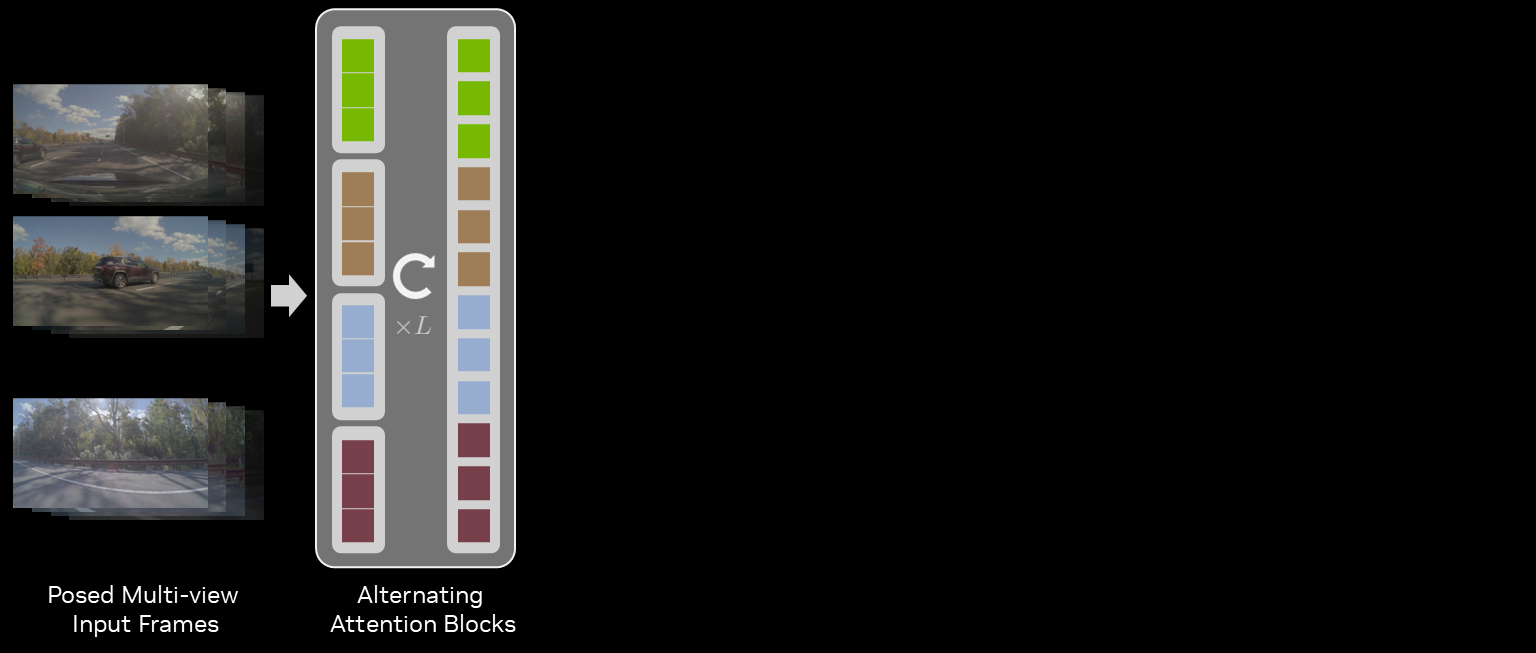
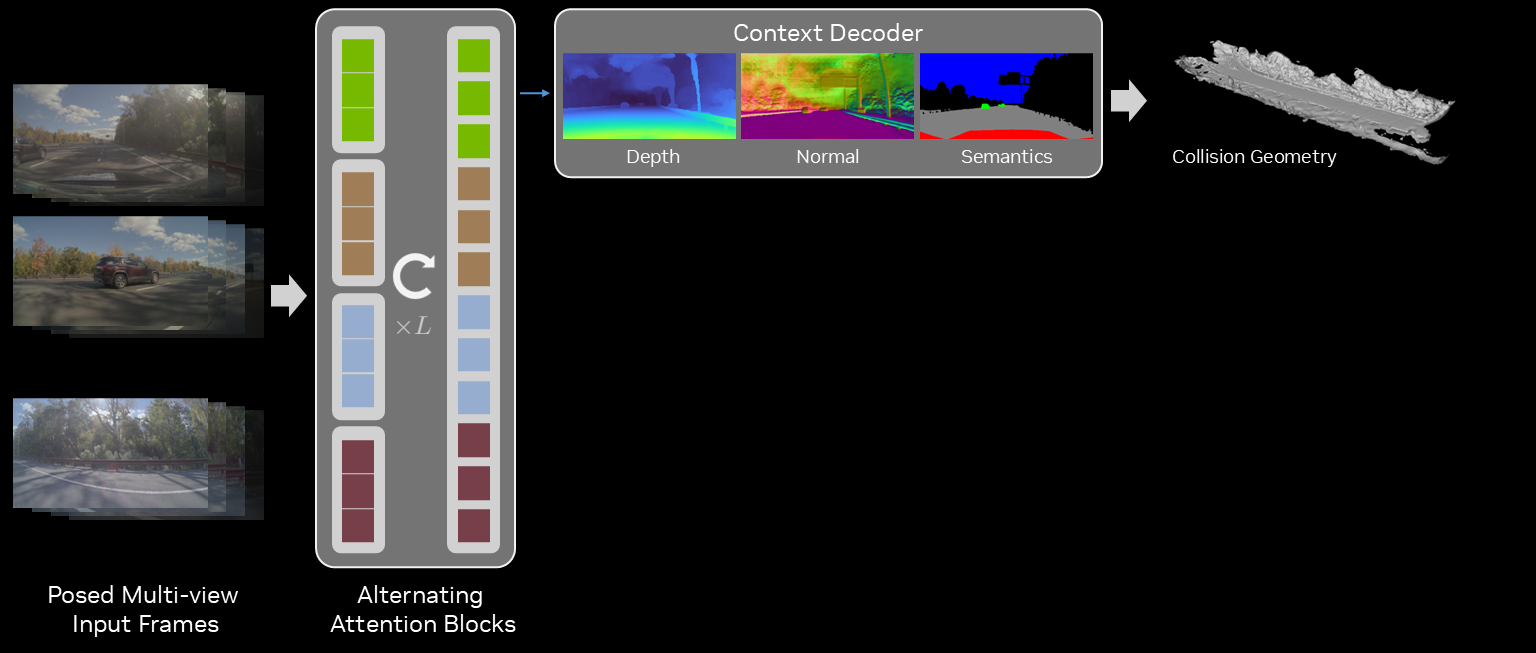
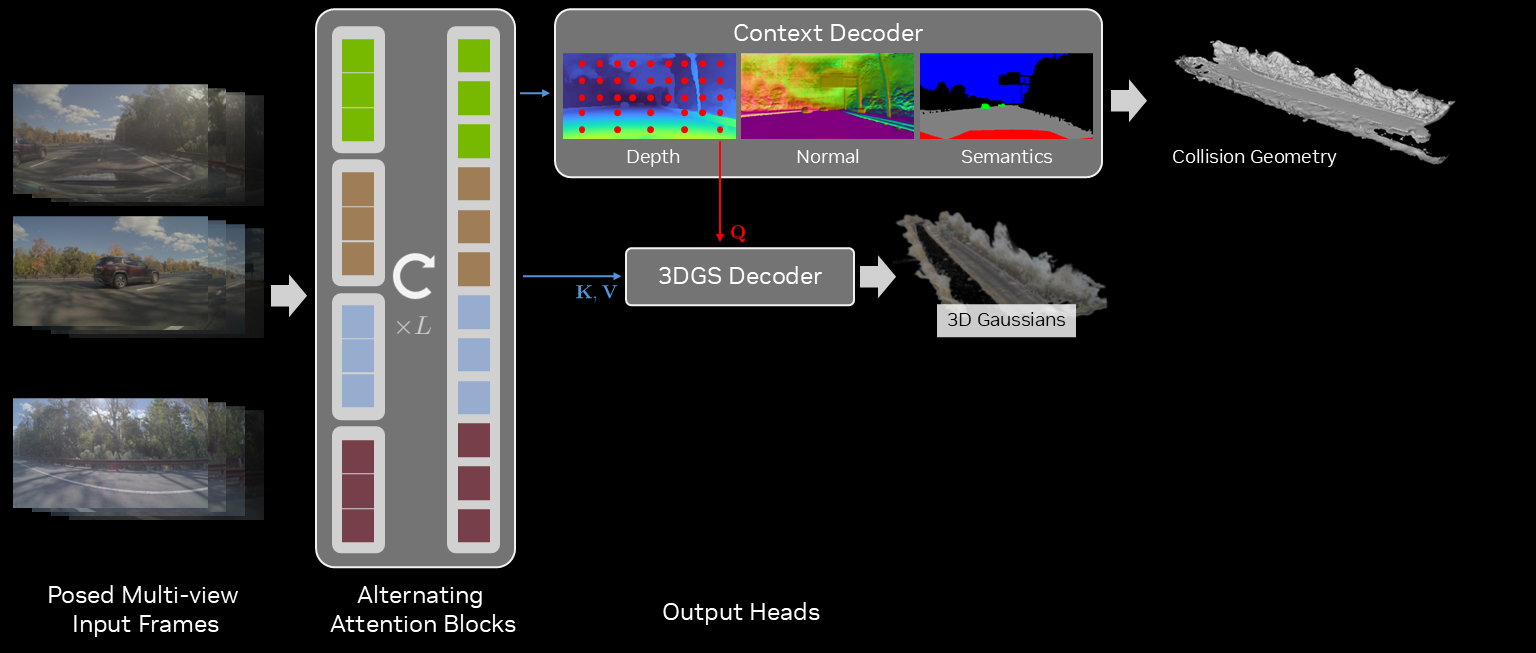
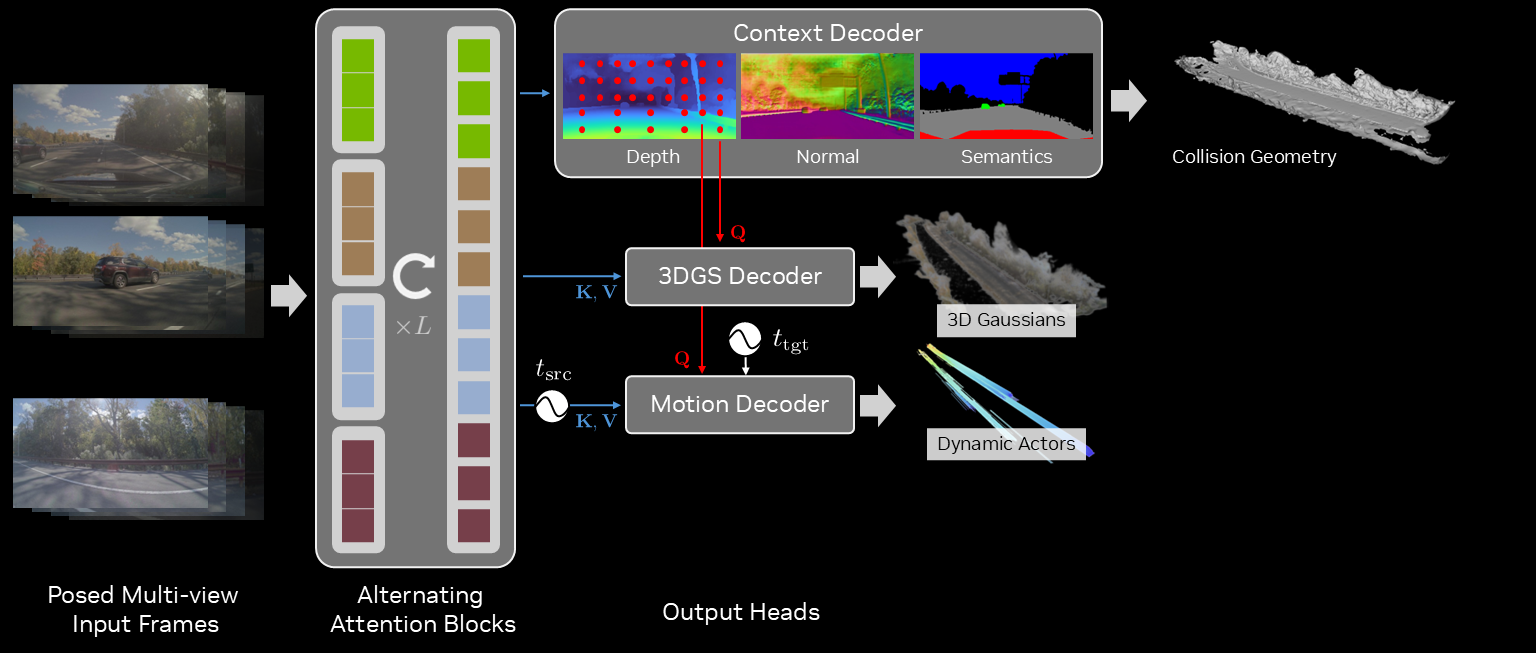
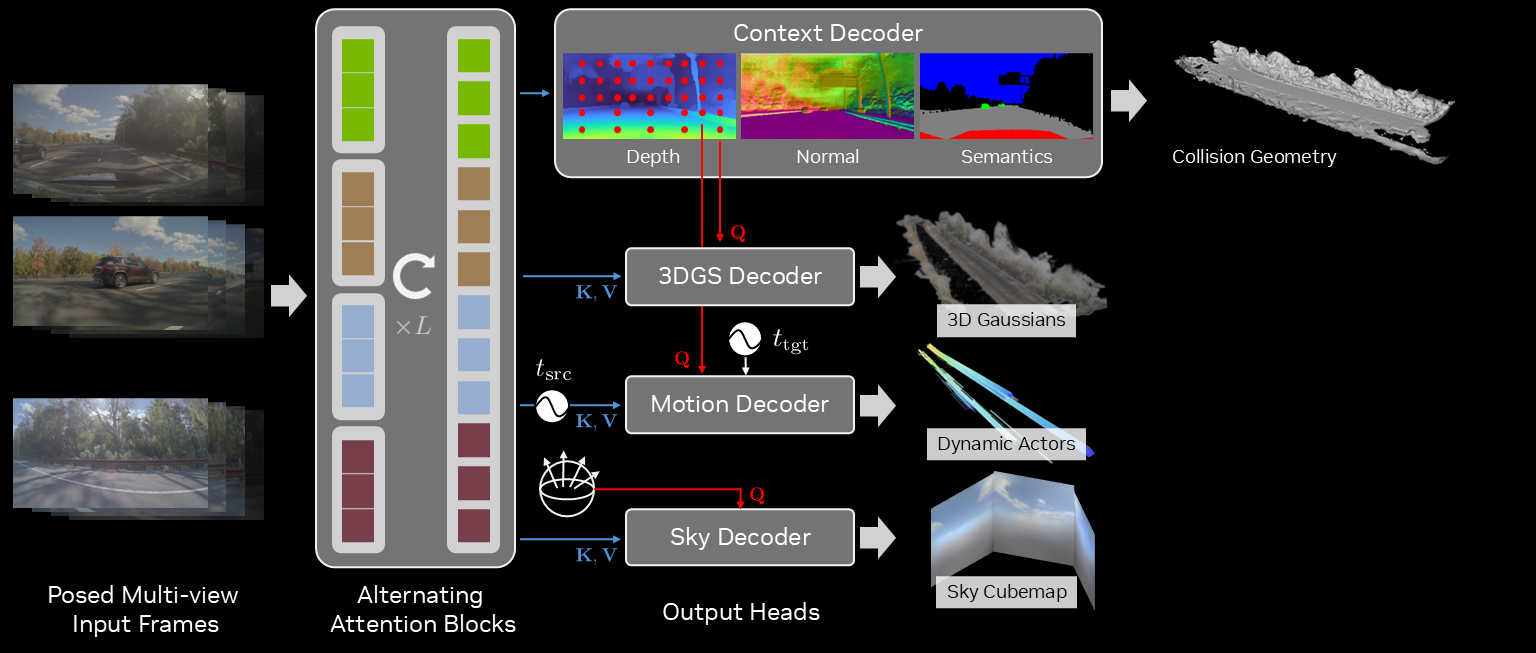
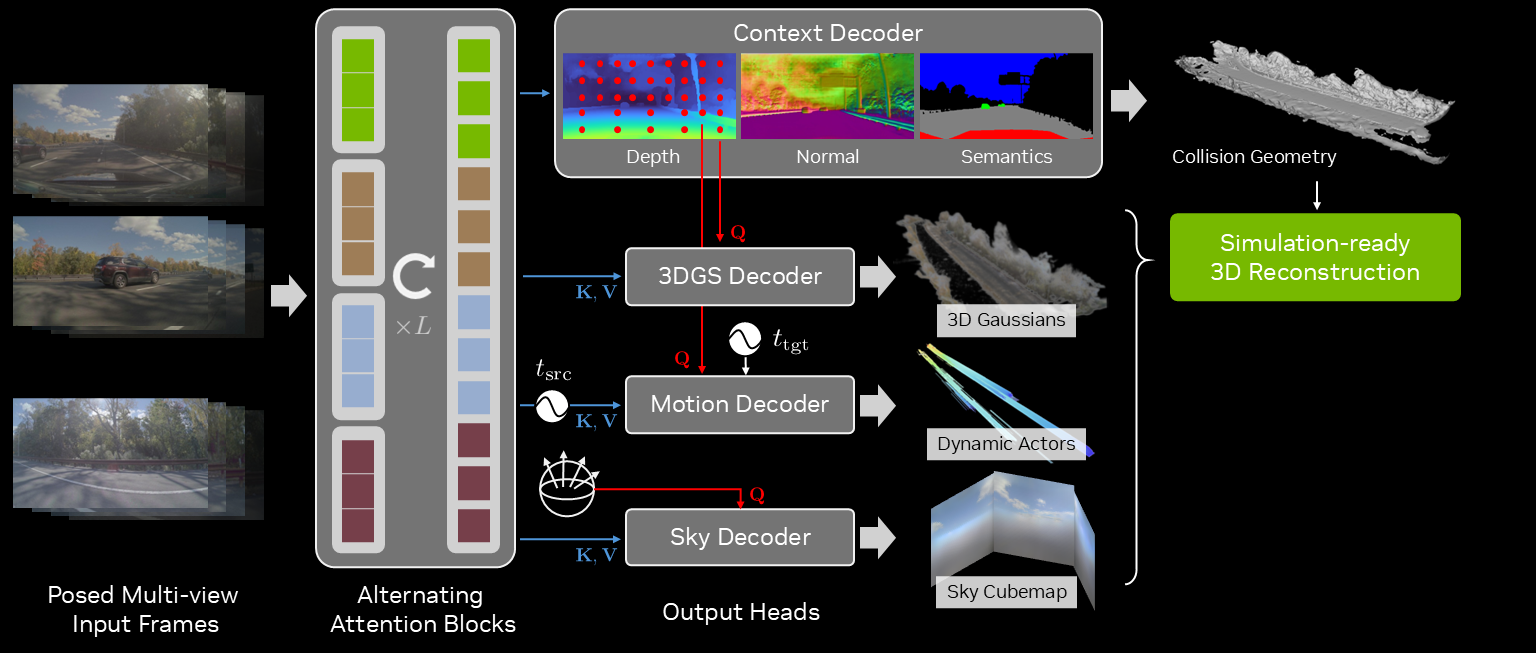
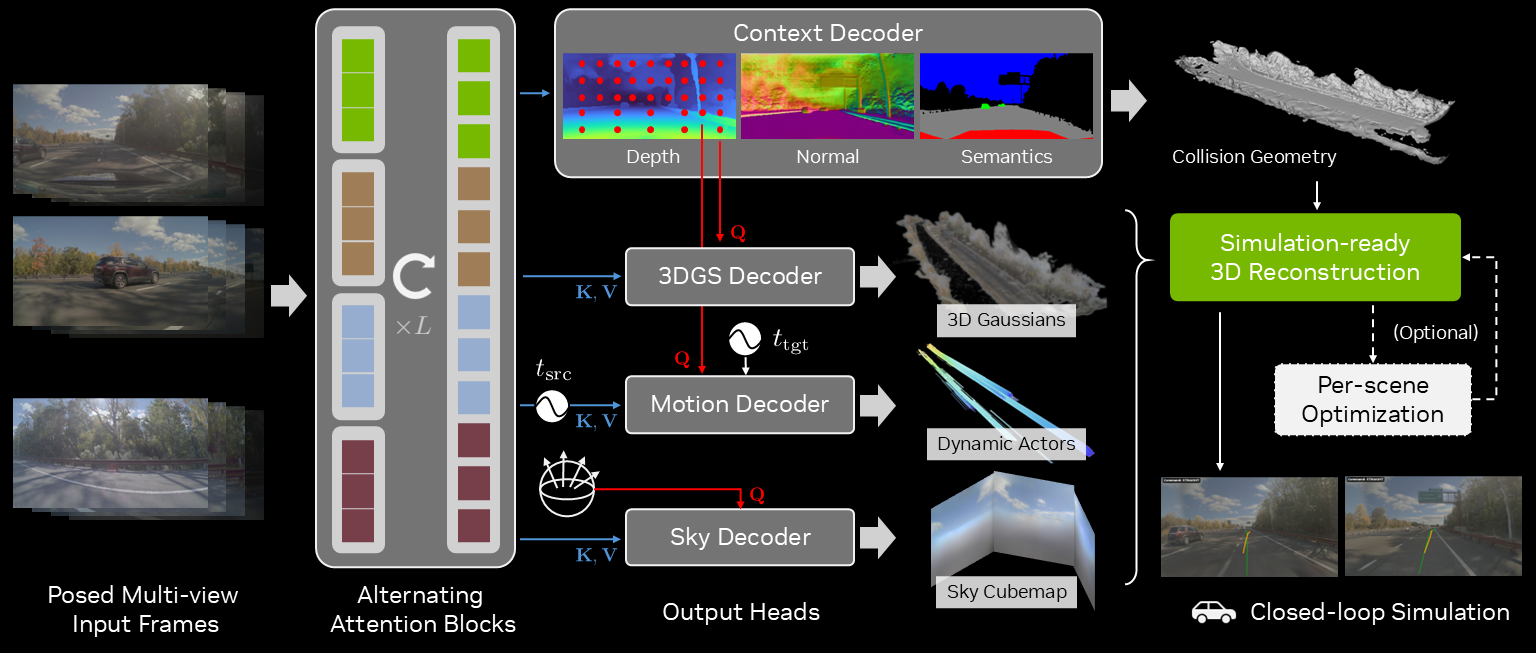
Multi-view driving images are tokenized into patches and processed by an alternating-attention ViT encoder. Several decoder heads share the resulting latent features and produce depth maps, semantic labels, motion estimates, a sky cubemap, and 3DGS attributes. Optionally, the output can be further optimized on a per-scene basis and used for downstream simulation tasks.
Compare reconstruction quality and downstream policy evaluation results from the paper.
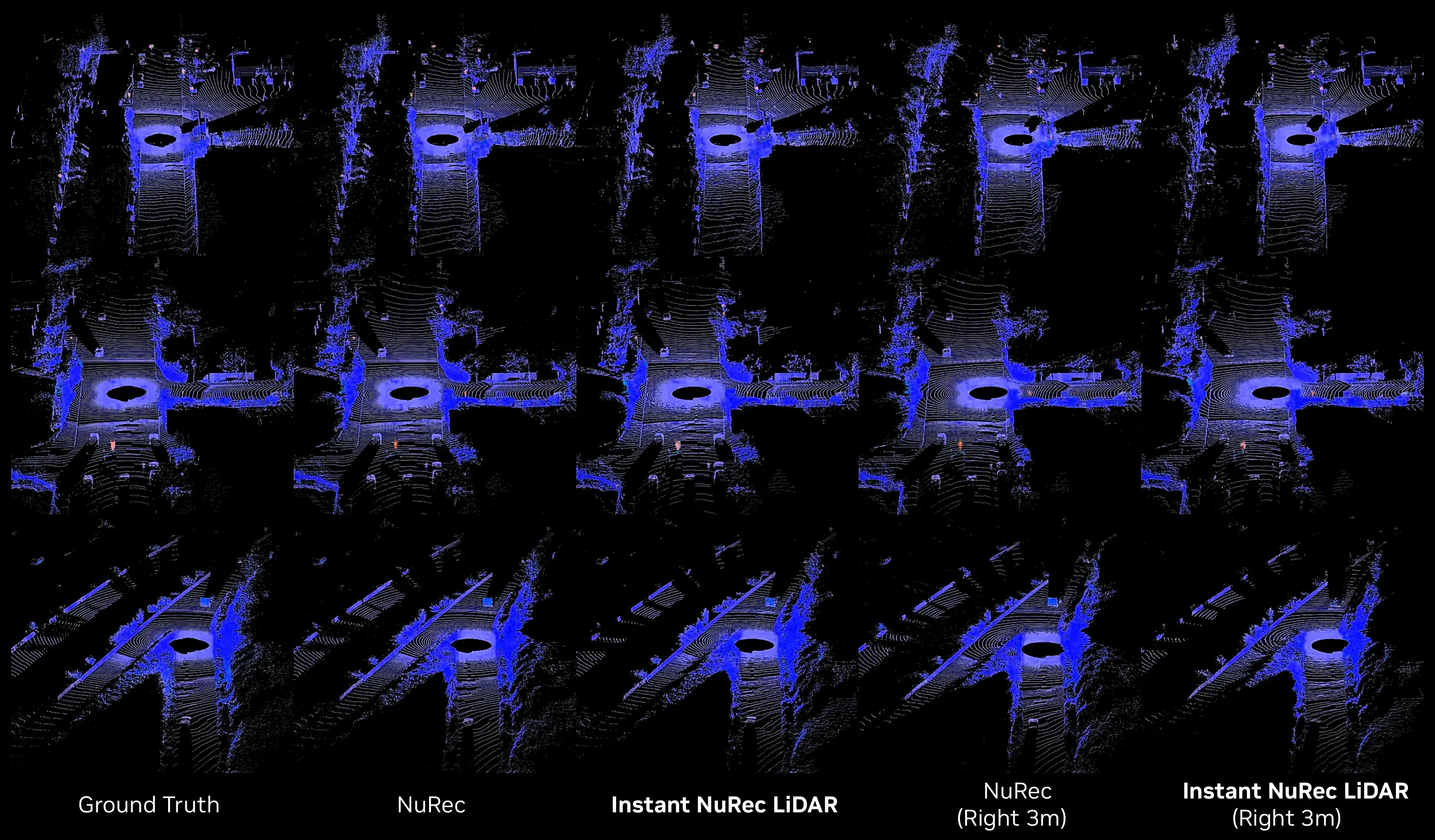
Instant NuRec reconstructs a scene in roughly 1.5 seconds while retaining strong image and detection quality.
Policy ordering is preserved between optimized NuRec and Instant NuRec across the evaluated policies.
We greatly appreciate the contributions of the following individuals:
Alessandro Burzio, Alex Perec, Bingxin Ke, Daniel Dworakowski, Despoina Paschalidou, Emmanuel Attia, Jun Gao, Katarina Tothova, Lei Zhang, Lucrezia Shen, Murat Arar, Naveen Kumar Rai, Nicolas Moenne-Loccoz, Rodolfo Lima, Sangeetha Grama Srinivasan, Sean Pieper, Sergio Agostinho, Sherwin Bahmani, Shikhar Solanki, Sipeng Zhang, Tianchang Shen, Tobias Fischer, Weihua Zhang, Xuanchi Ren, Yixin Cao.