 Spatial Intelligence Lab
NVIDIA Research
Video world models synthesize photorealistic observations in response to user actions but struggle to remain consistent over long interactions. Coding agents and text-to-3D models instead generate explicit 3D worlds whose geometry and state persist by construction, but whose appearance falls far short of photorealism. Recent methods combine the strengths of both by rendering such worlds into coarse proxies that guide a video model. However, since these proxies only specify where things are, the renderer must invent what they look like as the world is explored, and anything it forgets is reinvented when a surface reappears. Our key insight is that a mesh identifies which surface each pixel shows, across frames and views, even as objects move, allowing it to serve as an address for what the renderer generates. We propose M2R (Mesh to Remember), a few-step causal video renderer that stores its own features on the surfaces they depict, in each object's frame, and retrieves them by rasterizing the mesh whenever those surfaces come back into view. Appearance thus travels with objects wherever they move, persists across revisits, and is shared by every agent that observes it, while memory grows with the surfaces seen instead of the number of frames. Trained only on synthetic data, M2R transfers zero-shot to real indoor scans and to worlds authored by coding agents. It outperforms state-of-the-art methods in consistency across static, dynamic, and multi-agent benchmarks, more than doubling object permanence and nearly doubling cross-agent consistency, while rendering 720p video in real time (40 FPS).
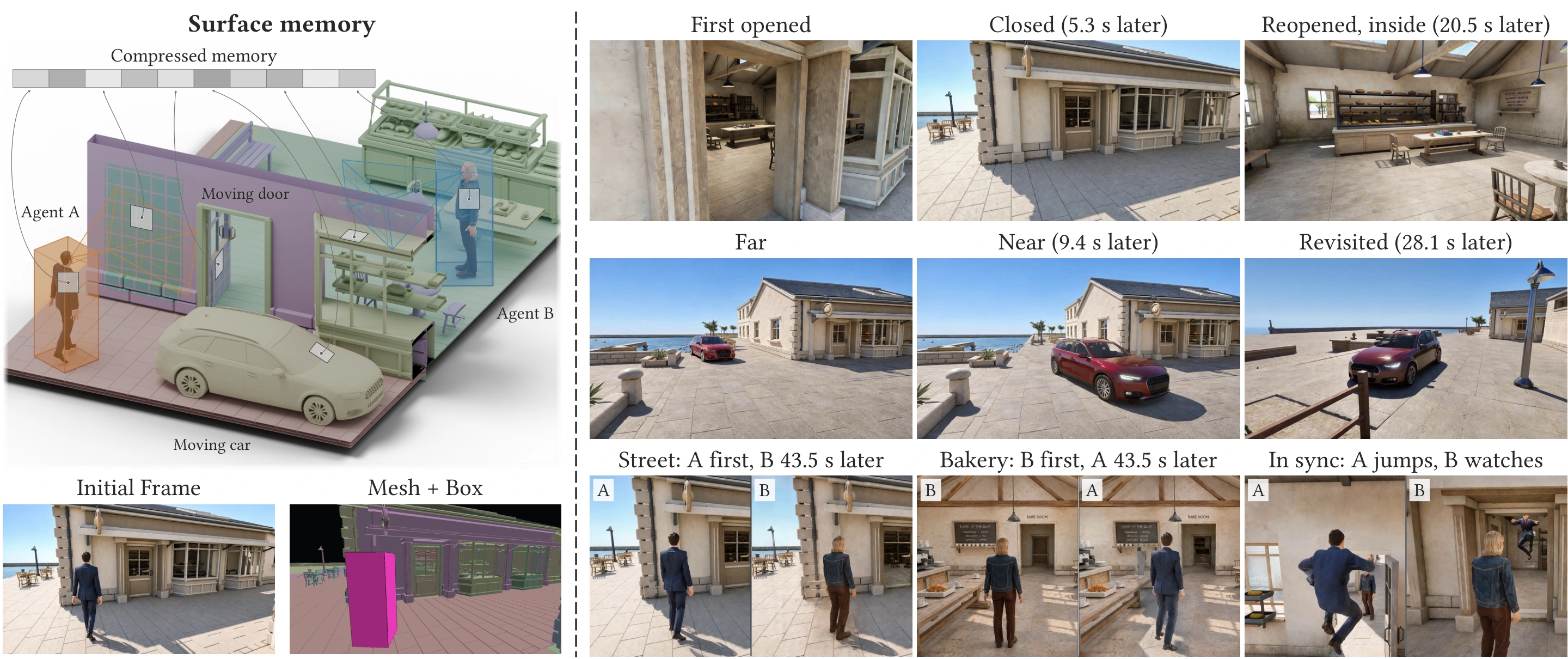
M2R stores the features it generates on the mesh surfaces they depict, in a memory that all agents share (left). Appearance thus persists behind a reopened door, on a moving car, and across agents, long after leaving the model's context (right).
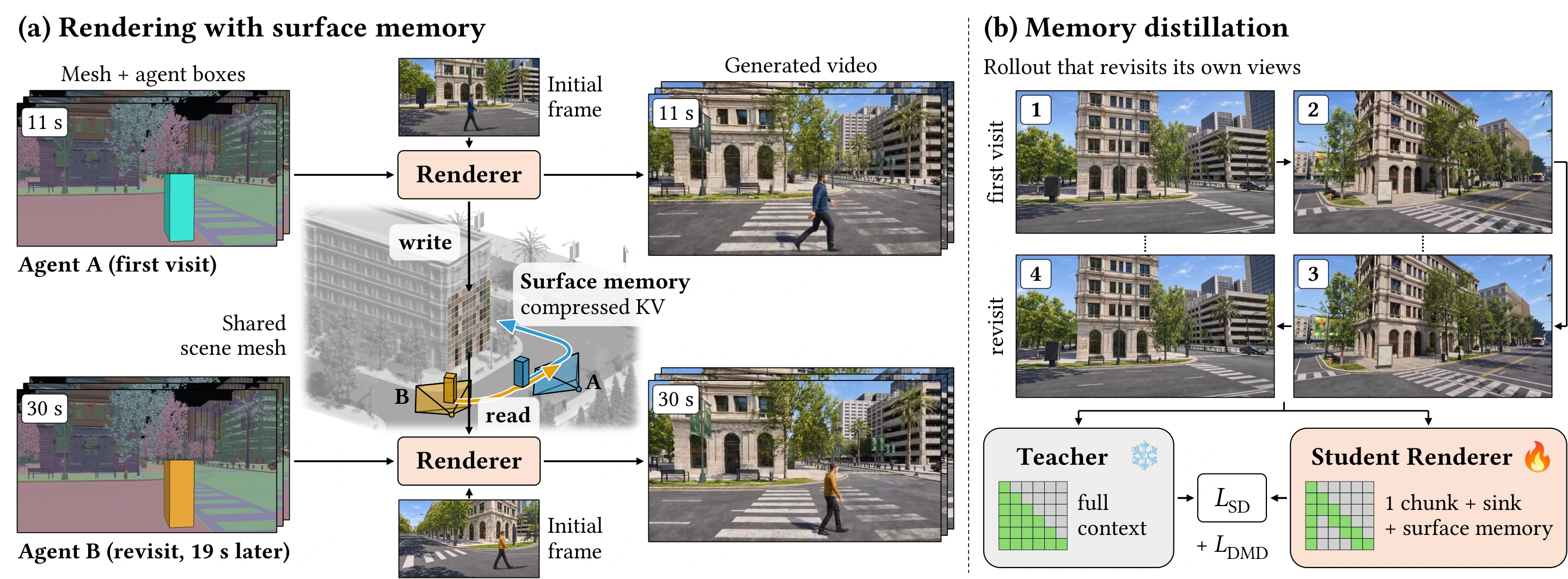
M2R renders each agent's view from the initial frame and renderings of a shared scene mesh. As agent A explores, it stores generated keys and values in a surface memory, indexed by the mesh surfaces they depict. When agent B encounters the same surfaces, it retrieves and renders them as agent A saw them (a). We train our renderer on rollouts that revisit earlier views. With a one-chunk window, it must render each revisit from the memory it wrote, supervised by a frozen teacher that sees the full past (b).
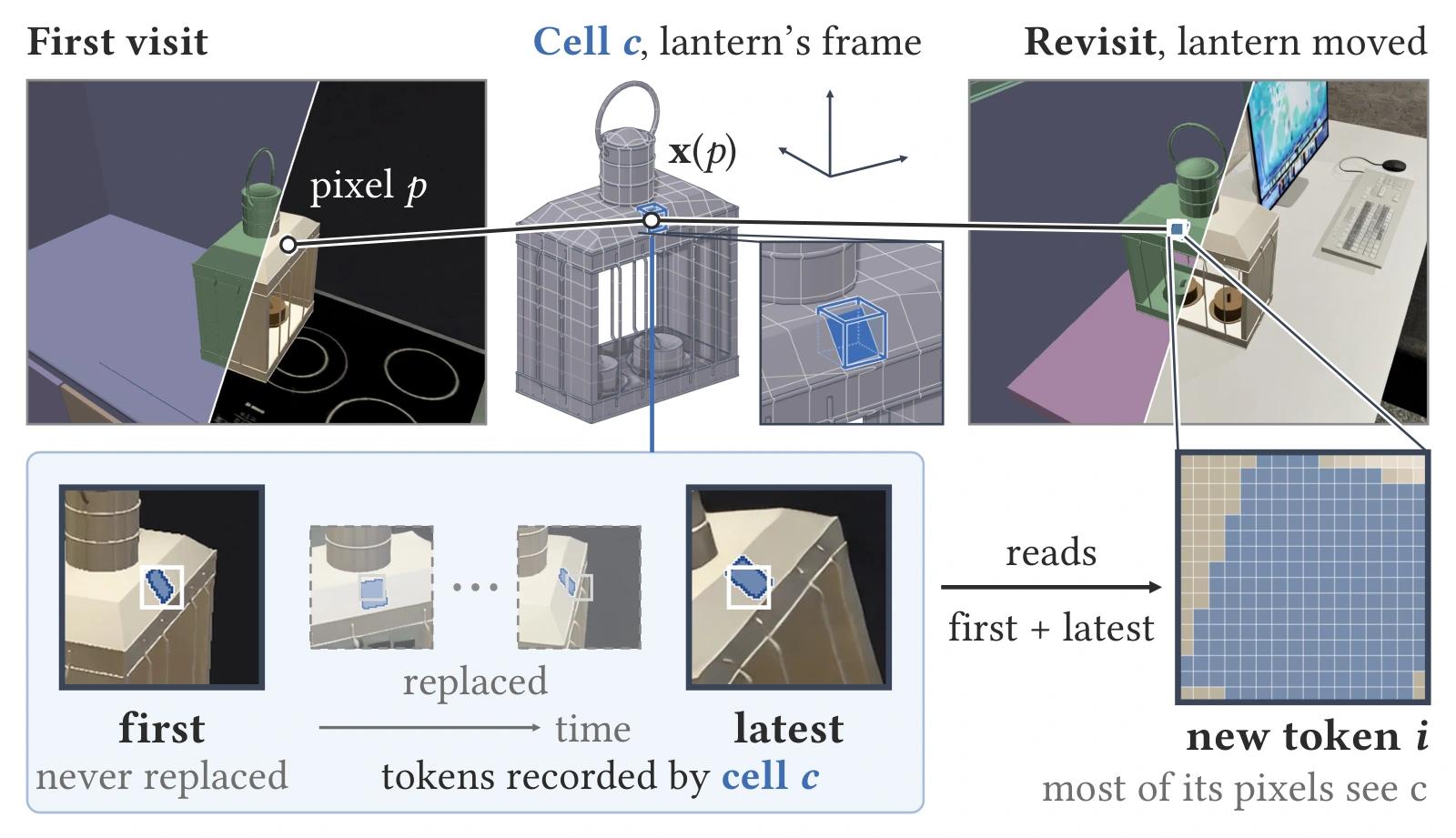
We assign each pixel p to the cell c that contains its surface point x(p) in the object's coordinate frame (top). After each chunk, we record the token that best covers each visible cell, keeping only the first and latest (bottom left). When we revisit the lantern after it has moved, each new token i reads the past tokens that most of its pixels point to (bottom right).
The last example of each case plays every method's full rollout.
We show rollouts in which a drawer is reopened. AgentGarten and Code World Model replace its contents. M2R is the only method to preserve them.
We show rollouts in which an object is moved while out of view. As M2R defines cells in each object's frame, the object keeps its appearance and appears only at its new location.
We show rollouts in which two agents share a world, each rendered from its own camera. AgentGarten and Code World Model generate each agent's video separately, and thus give a new appearance to what the other agent has already seen. M2R is the only method to share appearance between agents.
Appearance travels with objects wherever they move and persists when they return or are reopened.
We show rollouts with two and four agents, each rendered from its own camera. Each agent keeps its own temporal cache, while all agents read from and write to the same surface memory, allowing each to render what only others have seen.
Each row shows one mesh rendered from three initial frames along the same camera path.
In each, appearance persists when the camera returns.
We show an 8,001-frame rollout (4 min 27 s) at 8× speed. Whenever the camera returns to a place, the video pauses and shows the previous visit in red.
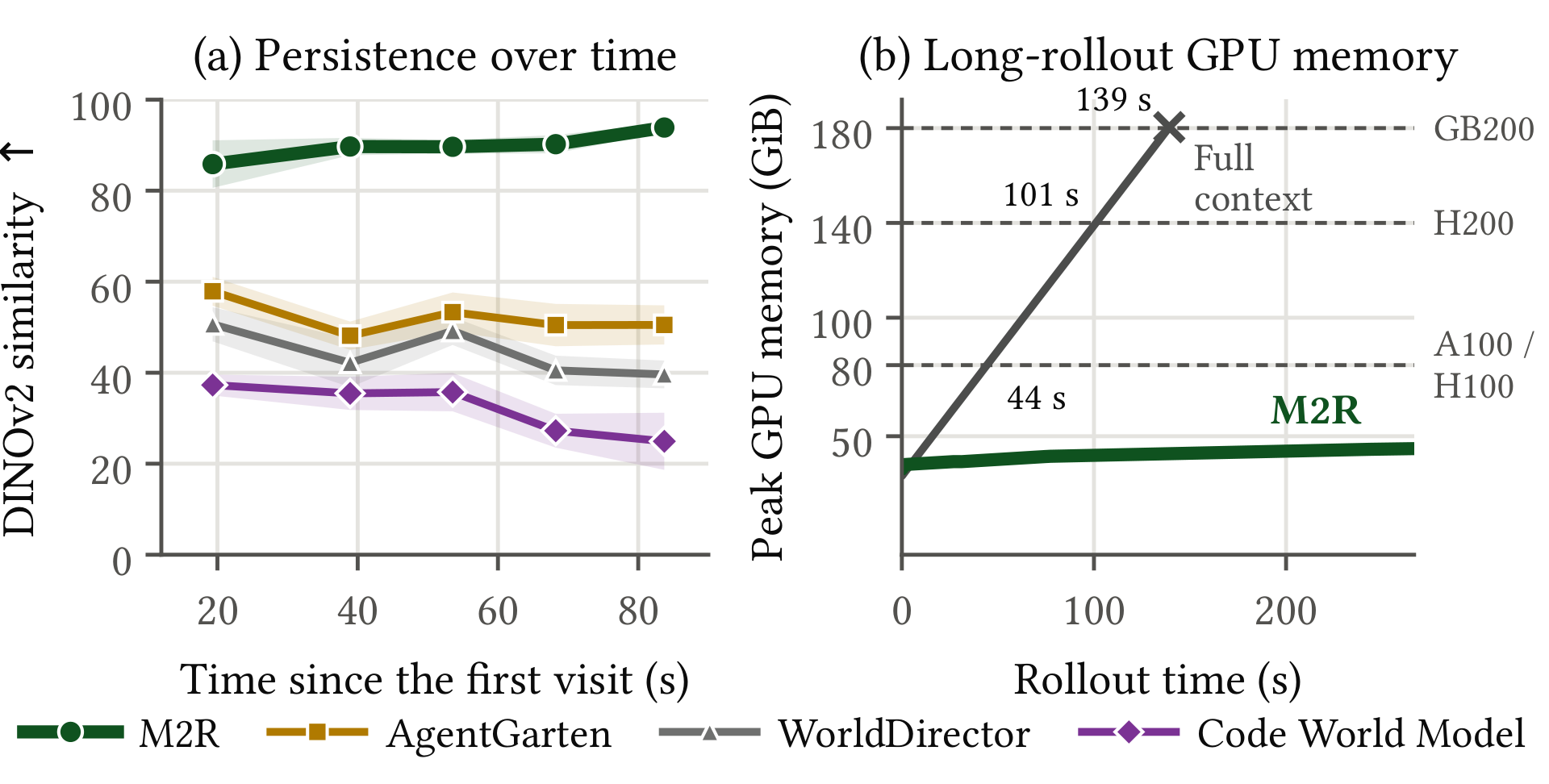
We plot DINOv2 similarity between the first and later openings of drawers and doors on HSSD (a) and peak GPU memory over an 8,001-frame rollout (b). Unlike the baselines, our memory does not fade with time. M2R stays below 45 GiB, whereas attending to every past chunk runs out of memory after 139 s.
@article{shin2026m2r,
  title={A Mesh to Remember: Persistent Appearance for Interactive Video Worlds},
  author={Joonghyuk Shin and Alex Trevithick and Katarína Tóthová and Liyuan Zhu and
          Shengyu Huang and Jaesik Park and Shalini {De Mello} and Laura Leal-Taixé and
          Riccardo de Lutio and Haithem Turki},
  journal={arXiv preprint arXiv:2611.32445},
  year={2026},
}