Spatial Intelligence Lab (SIL)
NVIDIA Research
Spatial Intelligence Lab (SIL)
NVIDIA Research
Large-scale deep learning models for physical AI applications depend on diverse training data collection efforts. These models and correspondingly, the training data, must address different evaluation criteria necessary for the models to be deployable in real-world environments. Data selection policies can guide the development of the training set, but current frameworks do not account for the ambiguity in how data points affect different metrics.
We propose Mixture Optimization via Scaling-Aware Iterative Collection (MOSAIC), a general data selection framework that operates by: (i) partitioning the dataset into domains; (ii) fitting neural scaling laws from each data domain to the evaluation metrics; and (iii) optimizing a data mixture by iteratively adding data from domains that maximize the change in metrics. We apply MOSAIC to autonomous driving, where an end-to-end planner model is evaluated on the Extended Predictive Driving Model Score (EPDMS). MOSAIC outperforms a diverse set of baselines on EPDMS with up to 80% less data.
MOSAIC turns dataset growth into a structured allocation over mixtures of data subsets that individually obey scaling laws. It groups the pool into domains that reflect different driving contexts, estimates how performance scales when clips are added from each domain, and then iteratively collects from the cluster with the largest predicted marginal gain.
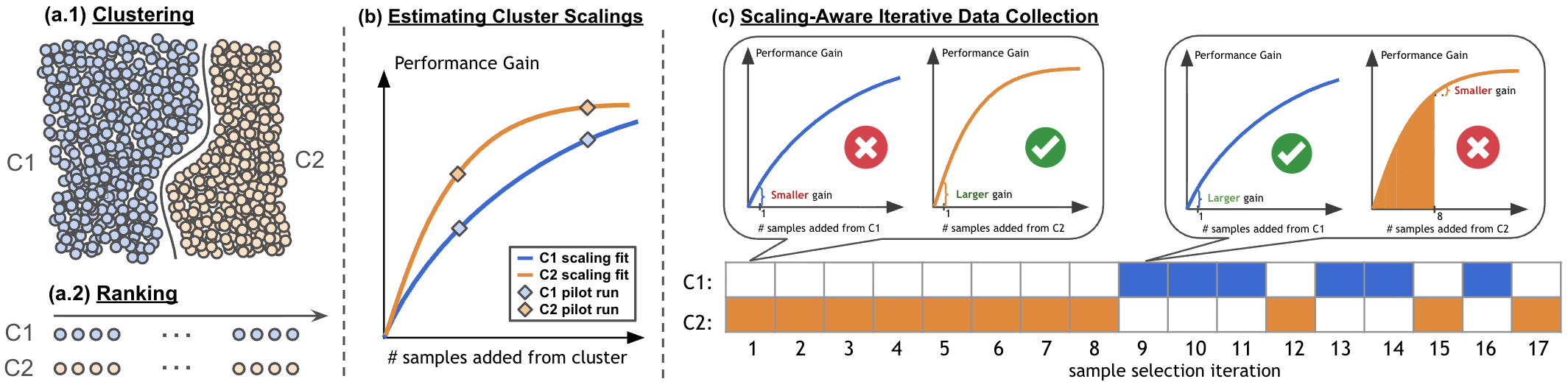
MOSAIC clusters the data pool, ranks samples within each cluster, fits cluster-wise scaling laws from pilot runs, and iteratively selects the next sample from the domain with the largest expected utility gain.
Partition the available clips into structured domains that capture different driving contexts, then prioritize the most informative samples within each domain.
Estimate how much EPDMS improves as more data is added from each cluster, rather than assuming every source contributes at the same rate.
At each step, collect from the cluster whose next clip is predicted to yield the strongest gain on the aggregate driving objective.
We evaluate MOSAIC on OpenScene and Navtrain by clustering data from VLM-generated captions and training on Hydra-MDP. We compare against multiple baselines from scaling laws, mixtures, and active learning. Our results show: (a) MOSAIC consistently outperforms all baselines; behavior across clusters produces stronger EPDMS and substantially better data efficiency; (b) each of the components of clustering and ranking data within MOSAIC are necessary; and (c) MOSAIC can learn the impact of heterogenous data scaling at different budgets.
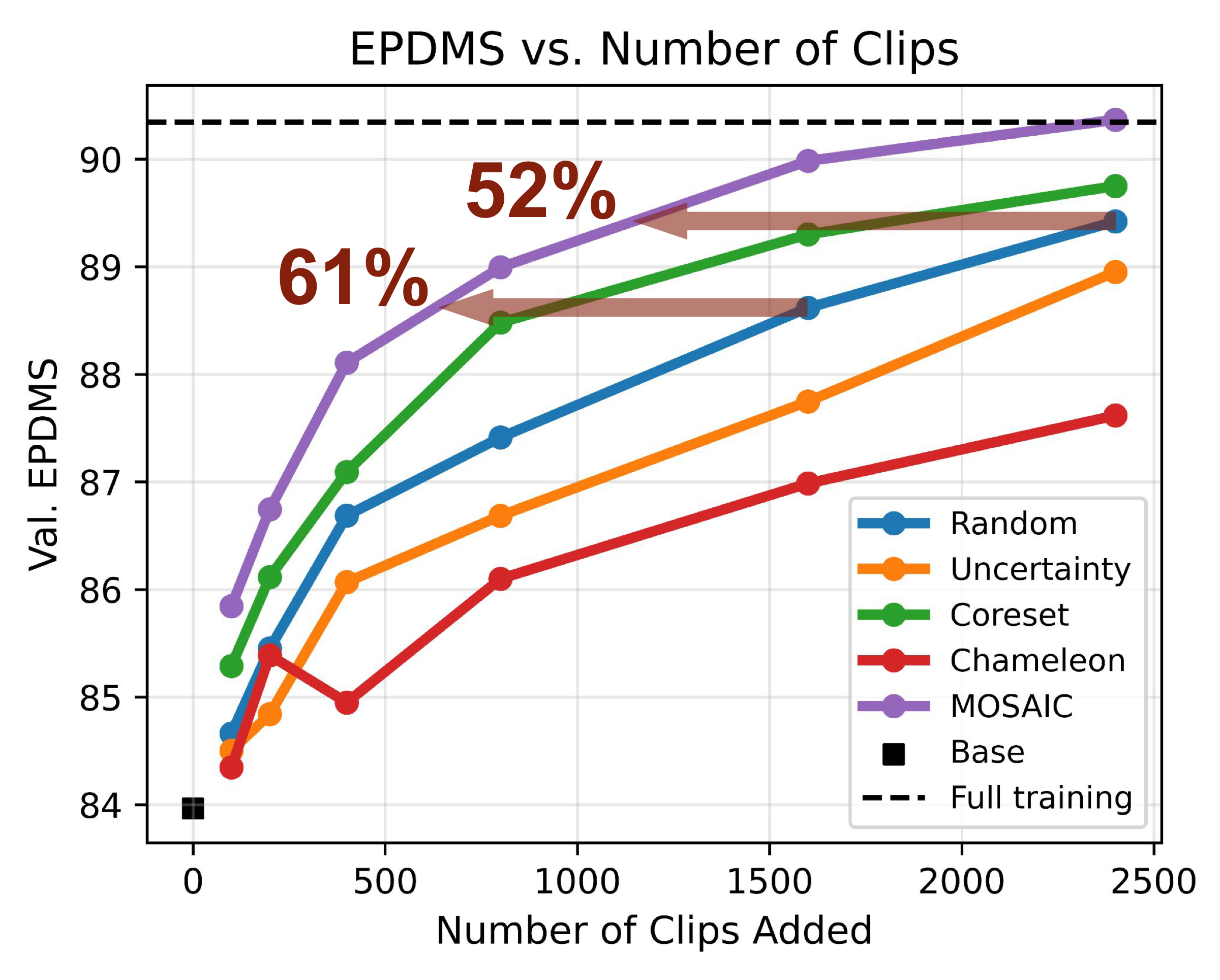
Under caption-based clustering, MOSAIC remains strongest across budgets, requires 61% and 52% fewer clips than random selection to match its performance at 1,600 and 2,400 clips, and reaches full-training performance with 42% fewer samples.
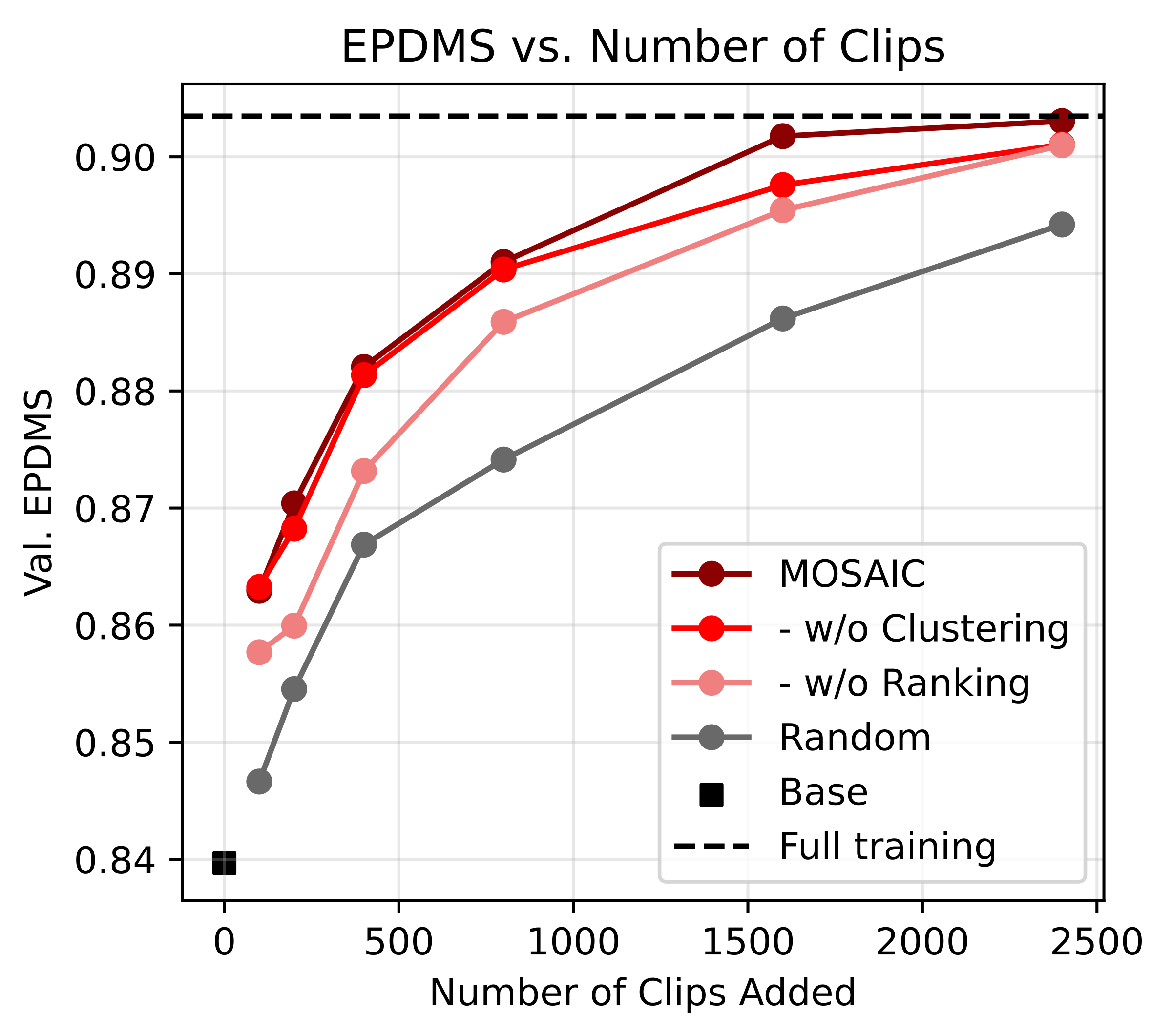
Ranking helps in the low-data regime, but the full combination of clustering, ranking, and scaling-aware allocation is what sustains the lead as the collection budget grows.
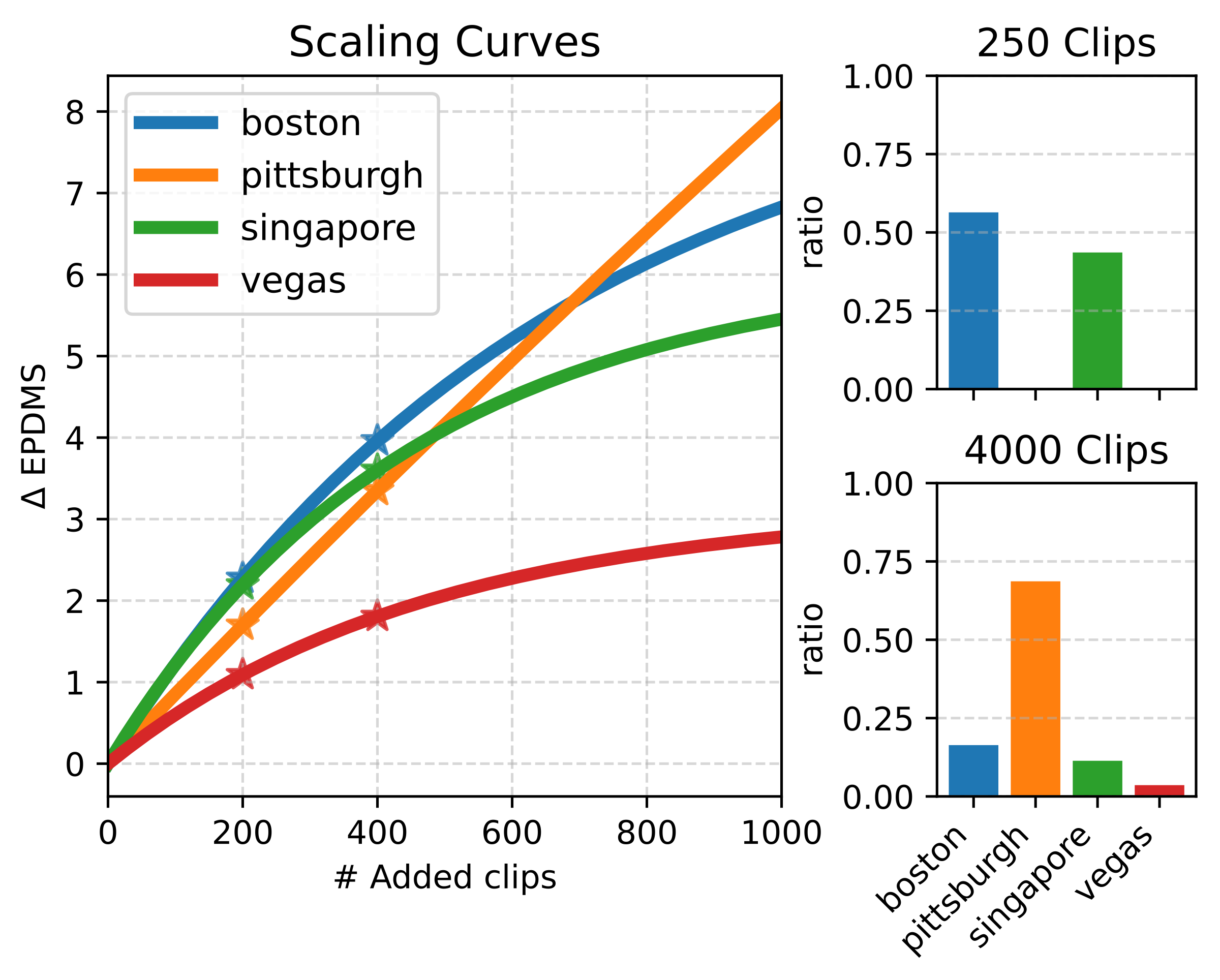
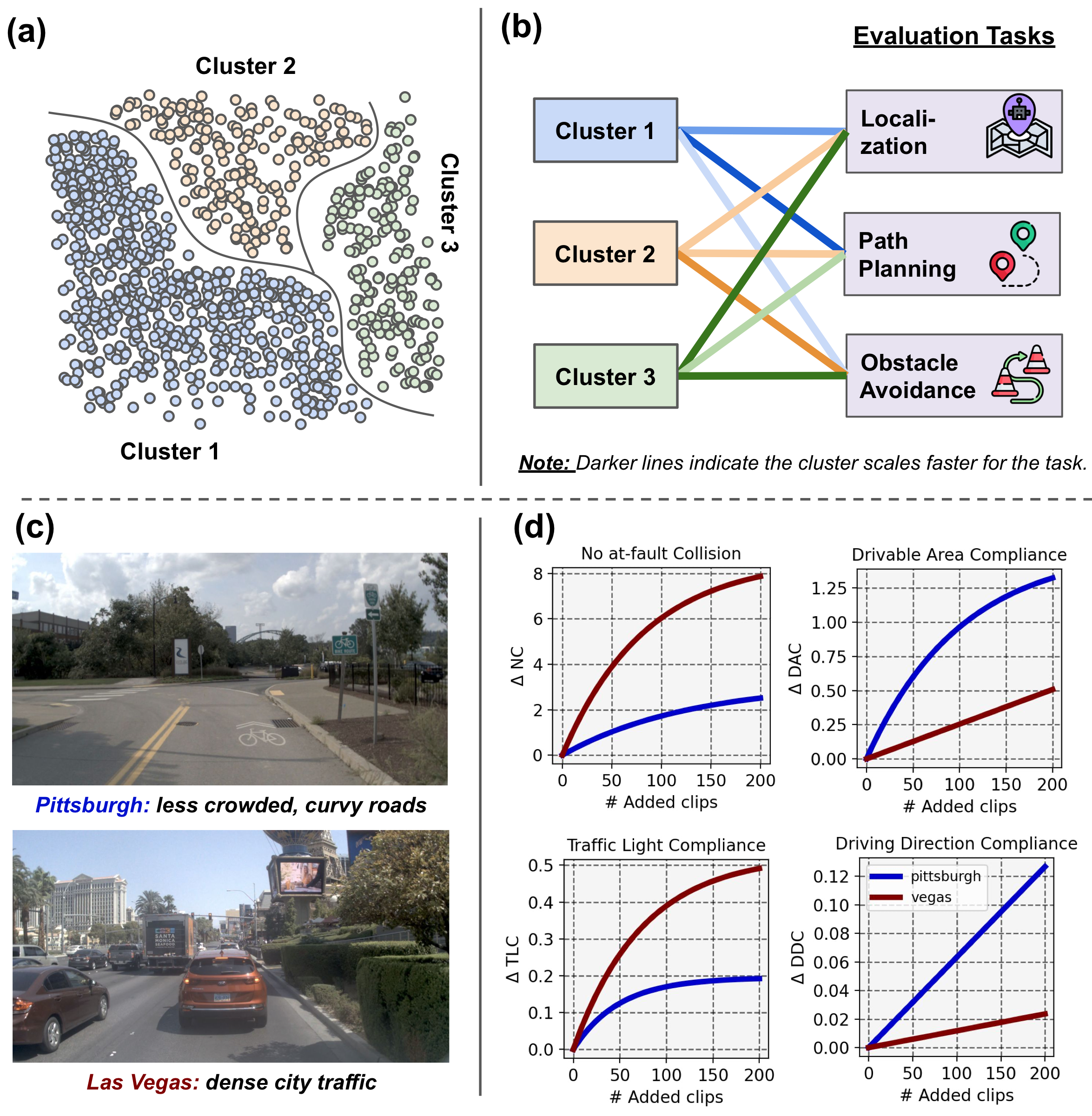
In the geolocation-based OpenScene setting, Boston and Singapore provide the strongest gains early, Pittsburgh improves more steadily at larger budgets, and Las Vegas saturates earlier. MOSAIC exploits those heterogeneous curves to move the budget across domains as the marginal gains change.
@misc{dimlioglu2026scalingaware,
  title         = {Scaling-Aware Data Selection for End-to-End Autonomous Driving Systems},
  author        = {Tolga Dimlioglu and Nadine Chang and Maying Shen and Rafid Mahmood and Jose M. Alvarez},
  year          = {2026},
  eprint        = {2604.08366},
  archivePrefix = {arXiv},
  url           = {https://arxiv.org/abs/2604.08366},
}