
Test-Time Coverage: Test-Conditioned Data Curation for Deployment-Aware Learning
Key Results
Abstract
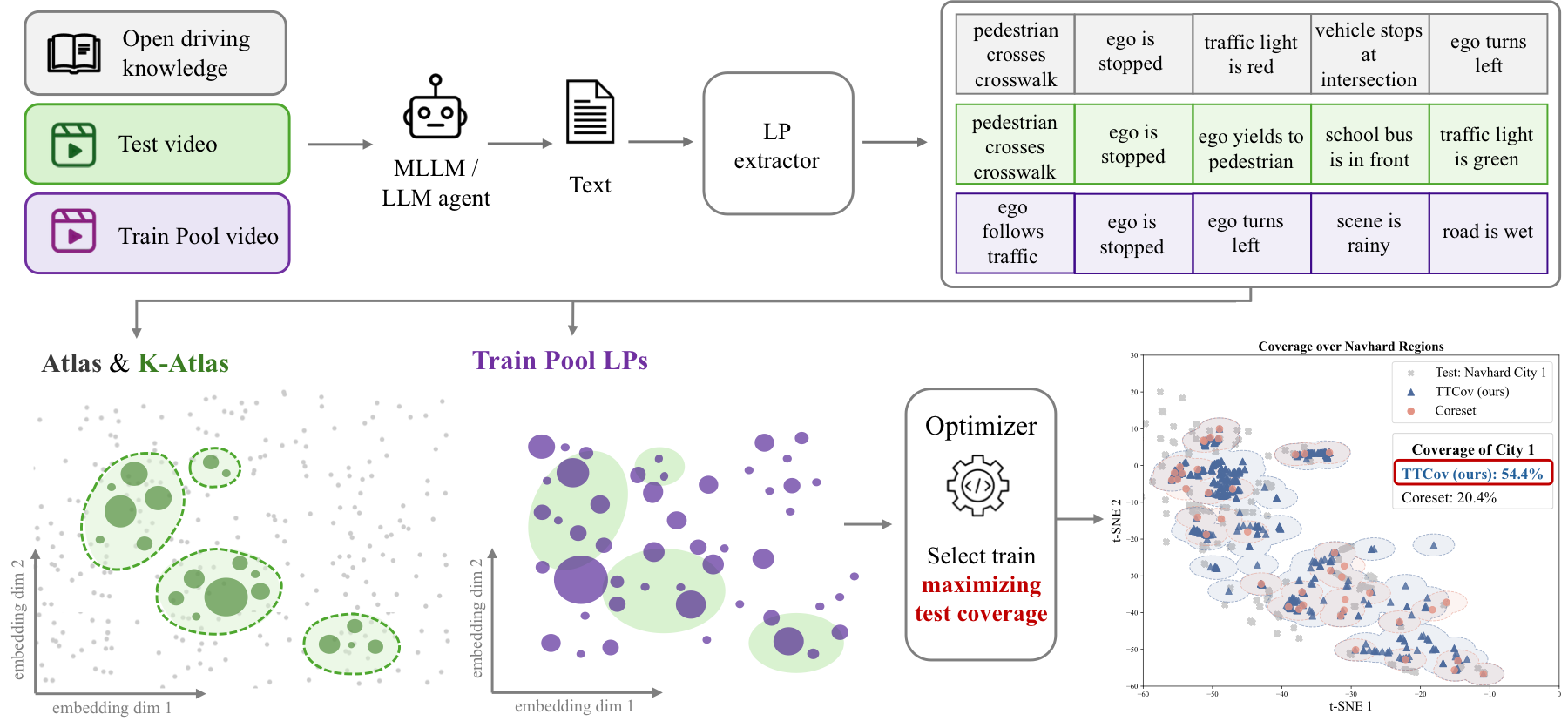
Deployed AI systems are often trained from broad candidate data pools, necessitating data curation towards the deployment test distribution. However, standard data curation methods score training-side criteria rather than directly optimizing deployment match. We introduce TTCov (Test-Time Coverage), a data-level test-conditioned curation method that uses test-side information before training instead of updating model weights at inference. TTCov decomposes deployment-conditioned curation into coverage and distribution. To represent coverage, it builds a task Atlas, a collection of LLM-based atomic propositions (L-APs) describing deployment-relevant concepts, seeded from open task knowledge and expanded with unmatched L-APs extracted from unlabeled deployment samples. To represent distribution, it instantiates the matched deployment L-APs with their frequencies, yielding a Knowledge Atlas (K-Atlas) that operationalizes the deployment distribution as a curation target. TTCov then selects a budgeted training set whose deployment L-AP distribution approximates this target. We apply TTCov towards autonomous driving (AD), keeping adaptation off the inference path while selecting data with greater deployment-relevant coverage, closer K-Atlas matching, and stronger downstream end-to-end driving performance than data-curation baselines, including seamless adaptability to novel domains via city-to-city expansion.
From Deployment Videos to Targeted Training Data
Videos become atomic propositions
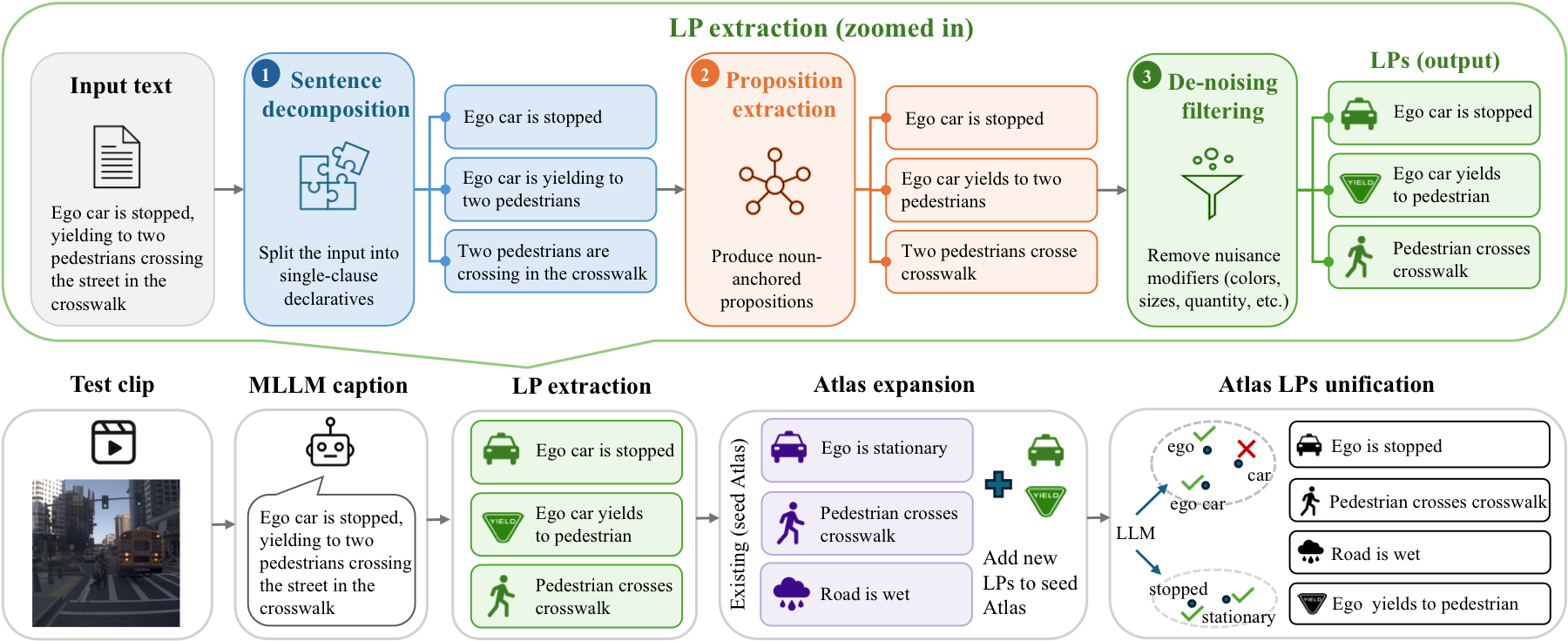
TTCov avoids collapsing a clip into one caption or embedding. Each video becomes an unordered L-AP set describing scenes, agents, actions, rules, relations, and conditions. These L-APs can then be matched, counted, and composed across the dataset.
A frequency-weighted task map
TTCov combines open driving knowledge with deployment-video L-APs to build the Atlas. Counting matched Atlas concepts across the deployment set yields the K-Atlas, a target distribution over what the training data should cover.
Select clips against the target
Candidate clips are mapped into the same L-AP vocabulary. Under a budget, TTCov greedily selects clips that reduce the gap between the selected-set distribution and the deployment K-Atlas. The L-AP map also exposes coverage gaps and supports traversal by scenario, agent, action, and condition.
Results
TTCov is evaluated on autonomous-driving curation for Navhard, using OpenScene as the unlabeled pool and Latent Transfuser in NAVSIM for EPDMS. Across budgets, TTCov improves K-Atlas matching and outperforms random, Coreset, and SSE baselines.
End-to-end driving performance
| Method | 0.5x | 0.75x | 1x | 1.25x | 1.5x |
|---|---|---|---|---|---|
| Navtrain (oracle) | -- | -- | 24.70 | 1.00 | -- | -- |
| Random | 18.95 | 0.77 | 18.76 | 0.76 | 20.15 | 0.82 | 21.95 | 0.89 | 22.95 | 0.93 |
| Coreset | 20.77 | 0.84 | 21.48 | 0.87 | 23.63 | 0.96 | 24.55 | 0.99 | 25.89 | 1.05 |
| SSE | 18.44 | 0.75 | 22.29 | 0.90 | 23.45 | 0.95 | 24.77 | 1.00 | 26.03 | 1.05 |
| TTCov (ours) | 20.62 | 0.83 | 23.00 | 0.93 | 24.42 | 0.99 | 25.49 | 1.03 | 26.40 | 1.07 |
Coverage after adding a city
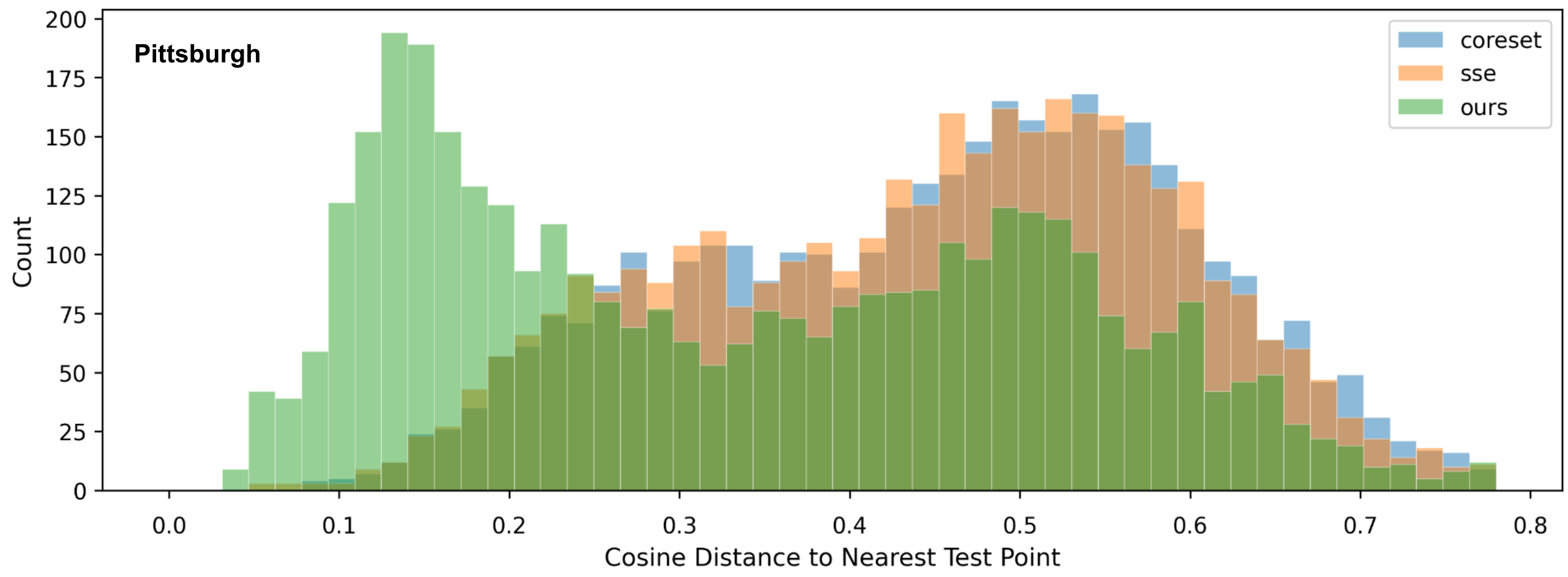
When deployment expands to a new city, TTCov covers 54.4% of its target test regions versus 20.4% for Coreset.
K-Atlas distribution match
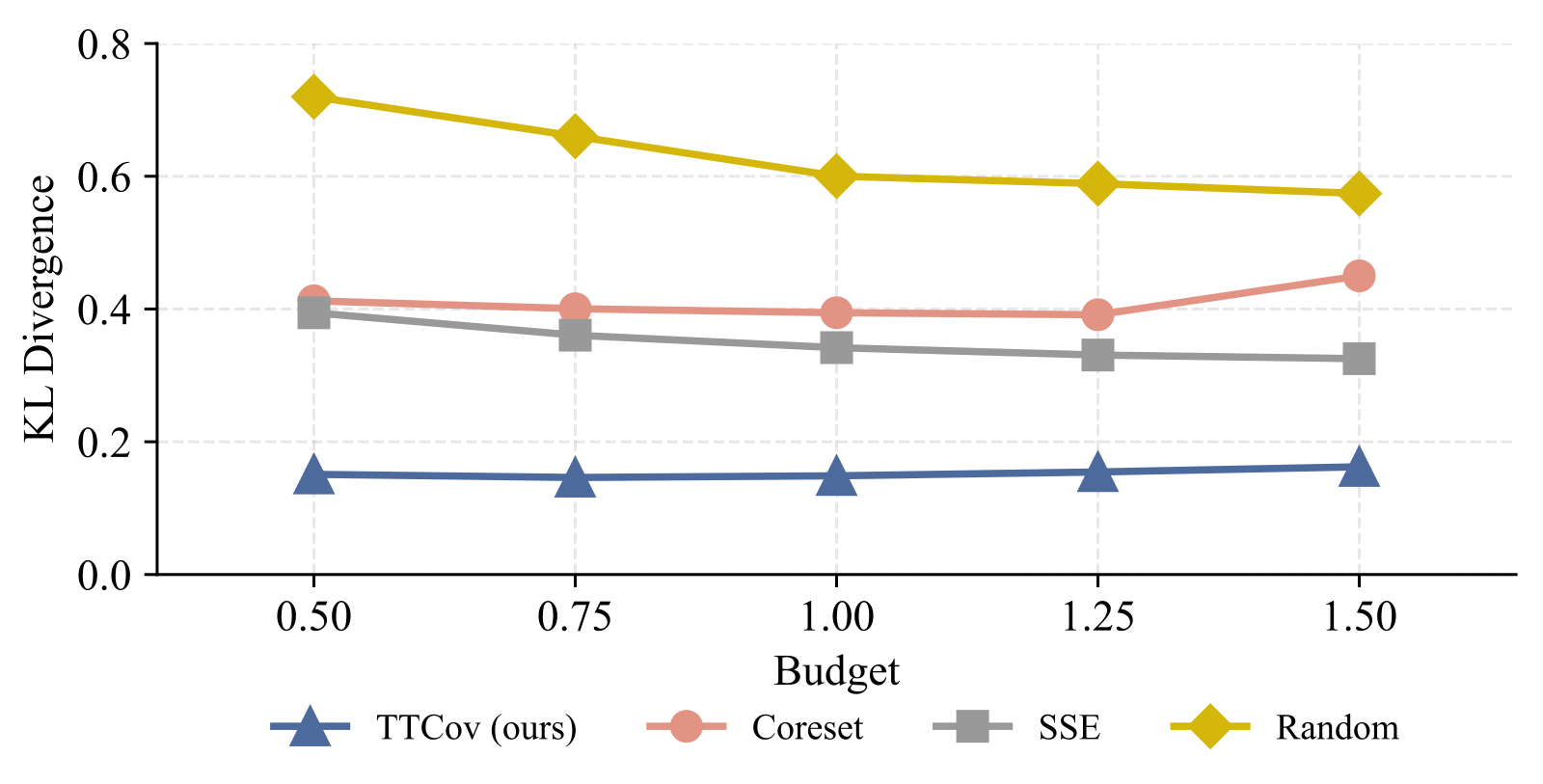
TTCov stays closest to the target K-Atlas across budgets.
Selected data examples
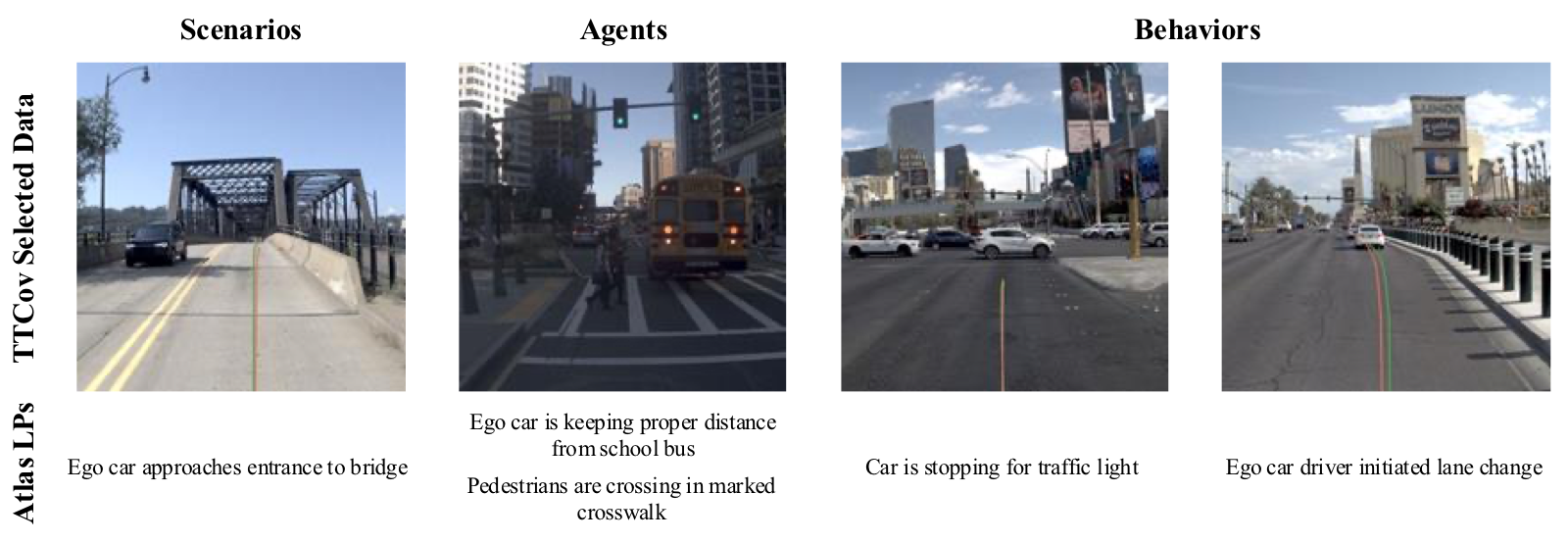
Caption-level retrieval can mix a requested x + y + z with unrelated factors. Atomic L-APs retrieve and compose the axes that matter, such as scenario, action, and agent.
BibTeX
@misc{chang2026testtimecoverage,
  title = {Test-Time Coverage: Test-Conditioned Data Curation for Deployment-Aware Learning},
  author = {Chang, Nadine and Shen, Maying and Diao, Shizhe and Wang, Jialiang and Chen, Jingde and Breuel, Thomas and Molchanov, Pavlo and Mahmood, Rafid and Alvarez, Jose M.},
  year = {2026},
}