CANTO
CAD-Native Transformer Operators for AI-Aided Engineering
Predict aerodynamic fields directly from parametric CAD, then use gradients to improve the design.
Editable CAD
Use exact CAD, without meshing or sampling the input.
Physics fields
Predict continuous fields where needed.
Better design
Refine the same CAD through its design parameters.
The representation gap
Closing the gap between design and analysis.
Engineering designs begin as exact parametric CAD, but simulation and learned surrogates typically begin from a sampled proxy: a mesh, point cloud, or voxel grid.
Creating that proxy can be costly, brittle and labor intensive, and it separates the model used for design from the representation used for analysis. CANTO connects the CAD parameters engineers edit directly to predicted physics, so the same model can evaluate a shape and provide gradients for improving it.
Read the paper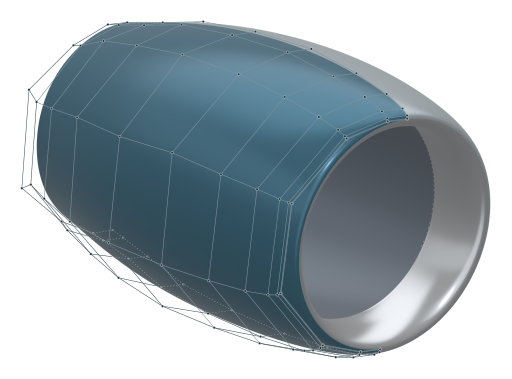
Method
How CANTO works
CANTO learns to tokenize native NURBS surfaces into a reusable geometry representation, then predicts surface and volume fields at requested locations.
Read the native CAD
Each parametric surface is defined by its control points, rational weights, and knot vectors—without first sampling it into a point cloud.
Encode the CAD once
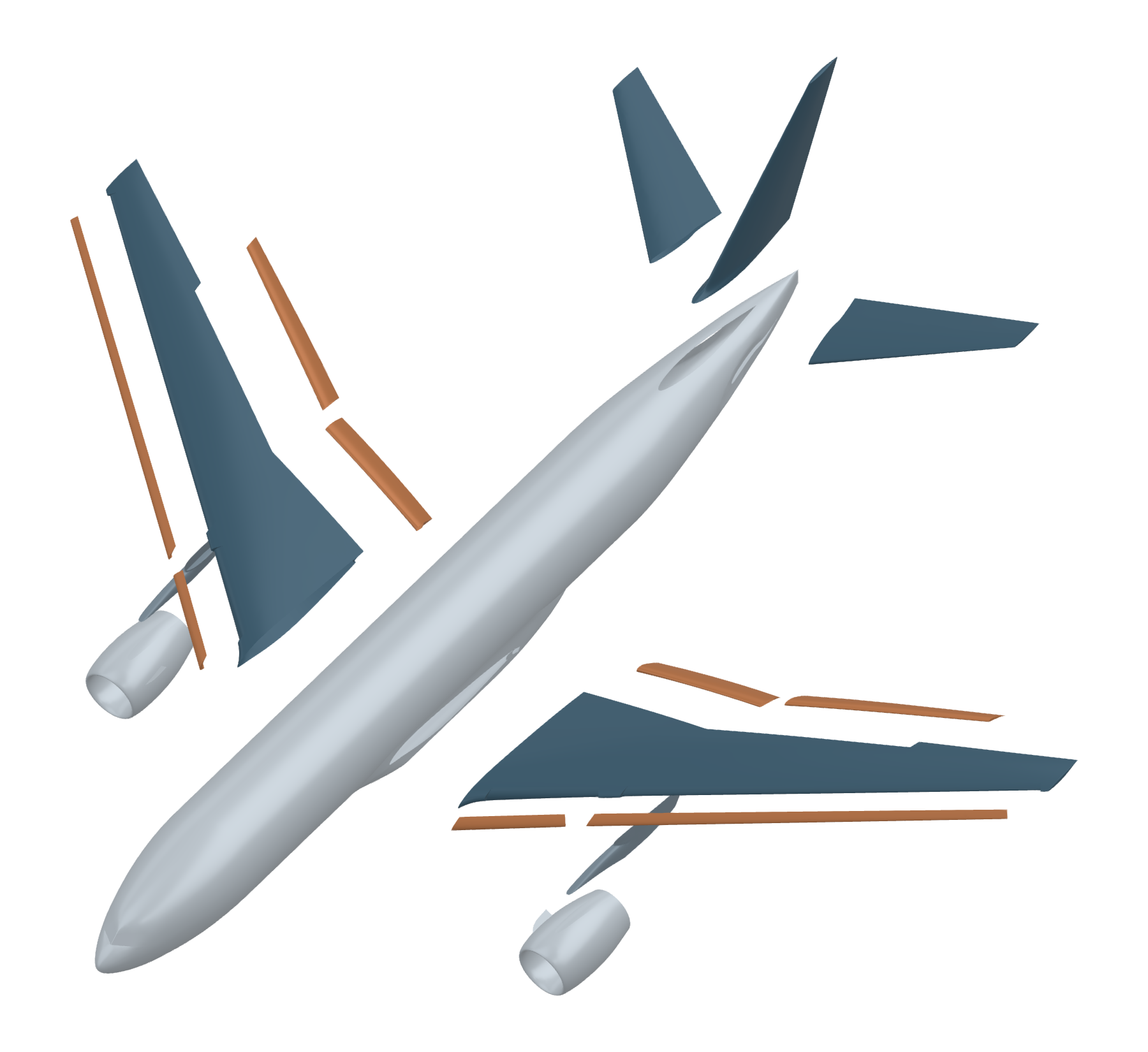
CANTO turns each surface into a compact token and combines the tokens into one reusable representation of the complete geometry.
Wall shear
Vorticity
Evaluate fields where needed
Specify surface or volume query locations to evaluate the predicted fields without re-encoding the geometry.
Evaluation
Accuracy across cars and aircraft.
CANTO achieves state-of-the-art accuracy on most evaluated surface and volume tasks across four aerodynamics benchmarks, spanning automotive and aircraft geometries.
Optimization and inverse design
CANTO for inverse design
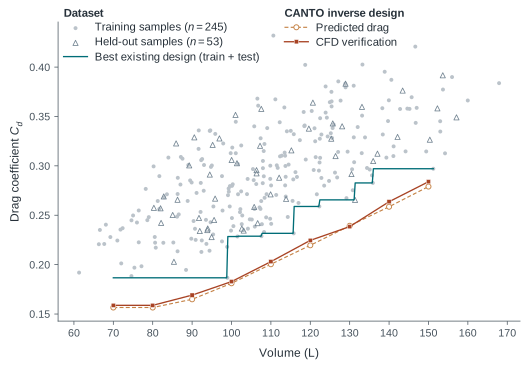
On AhmedML, CANTO found designs with lower drag than the best eligible dataset designs under matching volume and lift constraints. The improvements were verified with CFD.
Results apply to the paper’s six-parameter design family. CFD evaluation confirms the lift constraint at every reported volume threshold.
CAD parameters
Six bounded design variables
CANTO
Predict drag and lift
Minimize drag
Volume ≥ minimum · Lift ≤ limit
Volume is computed directly from CAD. Final designs are verified with CFD.
Paper and authors
CAD-Native Transformer Operators for AI-Aided Engineering
NVIDIA · September 2026 · arXiv:2609.36806
Citation BIBTEX
@article{leibovici2026canto,
  title = {CAD-Native Transformer Operators for AI-Aided Engineering},
  author = {Leibovici, Daniel and Kovachki, Nikola Borislavov and Ahn, Dawon and Ohana, Ruben and Shokar, Ira J. S. and Ghasemi, Abouzar and Akkurt, Semih and Ranade, Rishikesh and Ashton, Neil and Kautz, Jan and Kossaifi, Jean},
  journal = {arXiv preprint arXiv:2609.36806},
  year = {2026},
  doi = {10.48550/arXiv.2609.36806},
  url = {https://arxiv.org/abs/2609.36806}
}