Binary Delegation
An external judge examines the task trajectory at every step and determines whether the local SLM should continue execution or delegate the next step to the cloud LLM based on its estimated difficulty and importance.
1NVIDIA 2Rutgers University
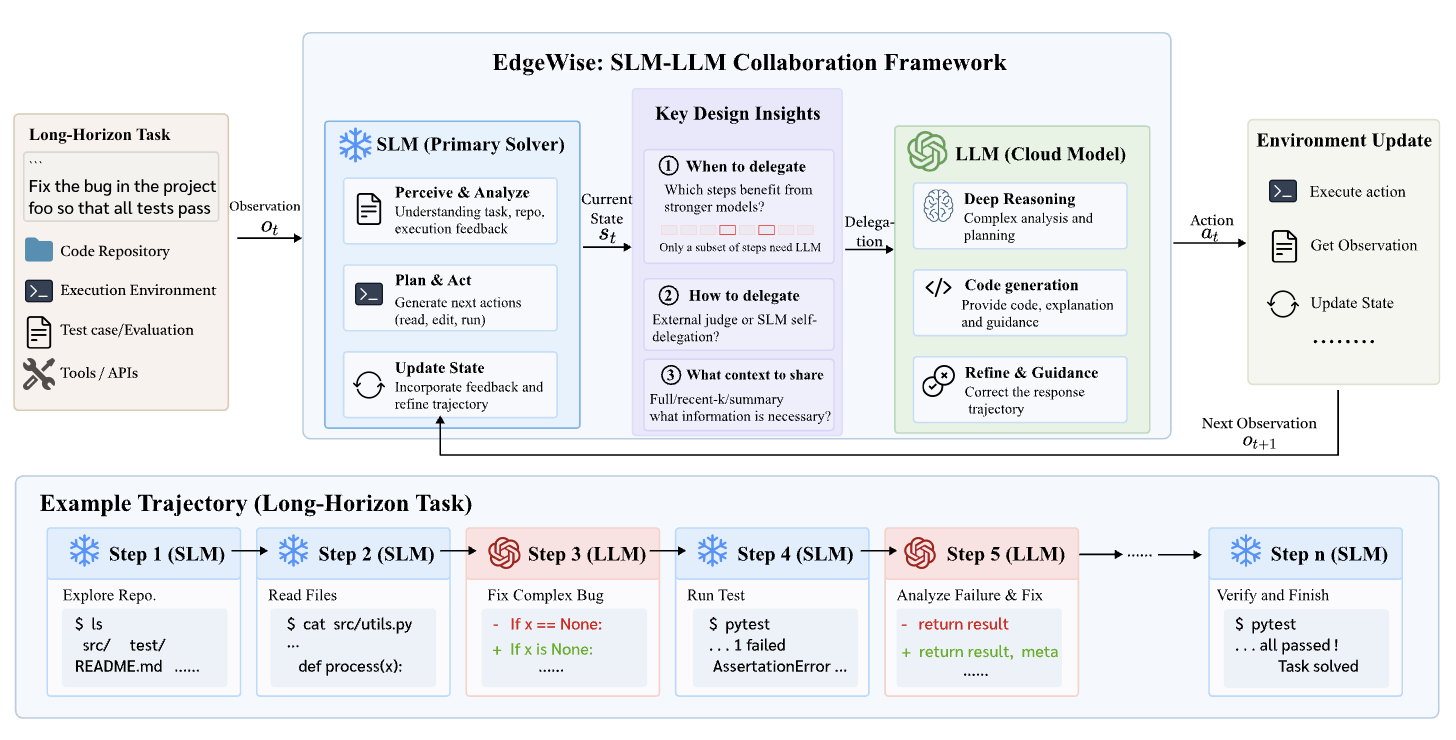
EdgeWise trains a local model to solve long-horizon tasks and selectively seek cloud-LLM help at critical steps. Its self-delegation capability is learned through step-level RL, generalizes across agent harnesses, and achieves cloud-level performance at substantially lower cost.
Complex and long-horizon agent tasks often rely on frontier models deployed in the cloud to achieve strong performance. However, using these models for every step of a long-horizon trajectory incurs substantial inference cost, even though not all steps may require the same level of model capability. In this paper, we find that allocating the LLM to only a small subset of key steps can achieve performance comparable to full LLM execution while significantly reducing inference cost. Motivated by this observation, we propose EdgeWise, an edge-cloud collaboration framework that deploys an SLM on the local device as the primary solver and selectively delegates critical steps to a cloud LLM when stronger model capacity is needed. To enable autonomous delegation without additional models at inference time, we introduce a step-level RL method that jointly optimizes task solving and delegation, with fine-grained credit assignment for individual delegation decisions. We also introduce an external judge-based delegation strategy and use it to systematically investigate key design choices in edge-cloud collaboration, including when to delegate, how delegation decisions should be made, what context should be shared, and how frequently the cloud LLM should be invoked. Experiments show that EdgeWise matches or outperforms pure-LLM execution while reducing inference cost up to 62% on SWE-Rebench and 34% on Terminal-Bench 2.1. We further deploy EdgeWise on a local workstation, demonstrating comparable cost savings in a practical edge-cloud setting.
EdgeWise is an edge–cloud collaboration system that uses a local SLM as the primary solver and selectively delegates critical steps to a powerful cloud LLM. It provides two delegation strategies: binary delegation with an external judge and self-delegation learned through step-level reinforcement learning. It also explores context management strategies that determine what information should be shared between the local model, cloud model, and external judge.
An external judge examines the task trajectory at every step and determines whether the local SLM should continue execution or delegate the next step to the cloud LLM based on its estimated difficulty and importance.
Through SFT and step-level reinforcement learning, the local SLM internalizes the ability to jointly solve the task and autonomously request cloud assistance at critical steps, without requiring an external routing model during inference.
EdgeWise controls what trajectory information is provided to the judge and cloud LLM, balancing contextual completeness against inference cost; full interaction history generally provides the strongest performance.
Self-delegation maintains comparable pass@3 to pure-cloud execution, with an average decrease of 0.0% across two cloud models and two long-horizon coding benchmarks.
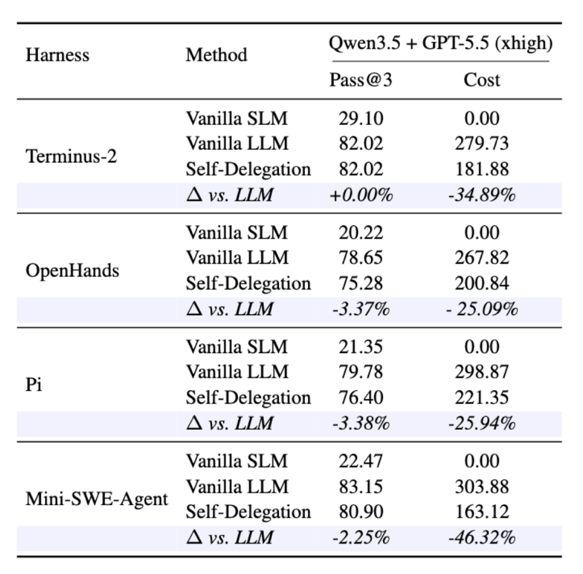
Self-delegation reduces average inference cost by 45.16% across two cloud models and two coding benchmarks, and by 33.04% across the four agent harnesses.
Self-delegation generalizes well across all four agent harnesses—Terminus2, OpenHands, Pi, and mini-swe-agent—bringing selective cloud assistance to different agent workflows.
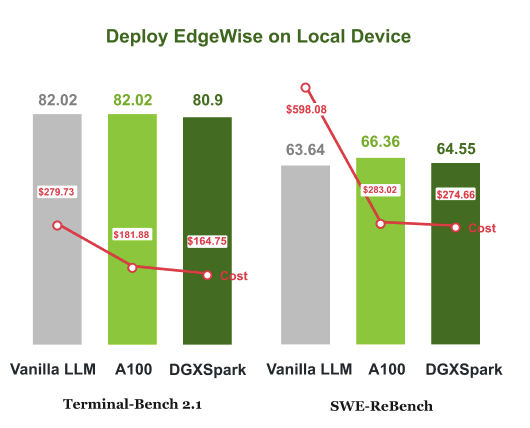
EdgeWise transfers directly to DGX Spark / RTX Spark, preserving substantial inference cost savings and comparable pass@3 in a practical edge–cloud deployment.
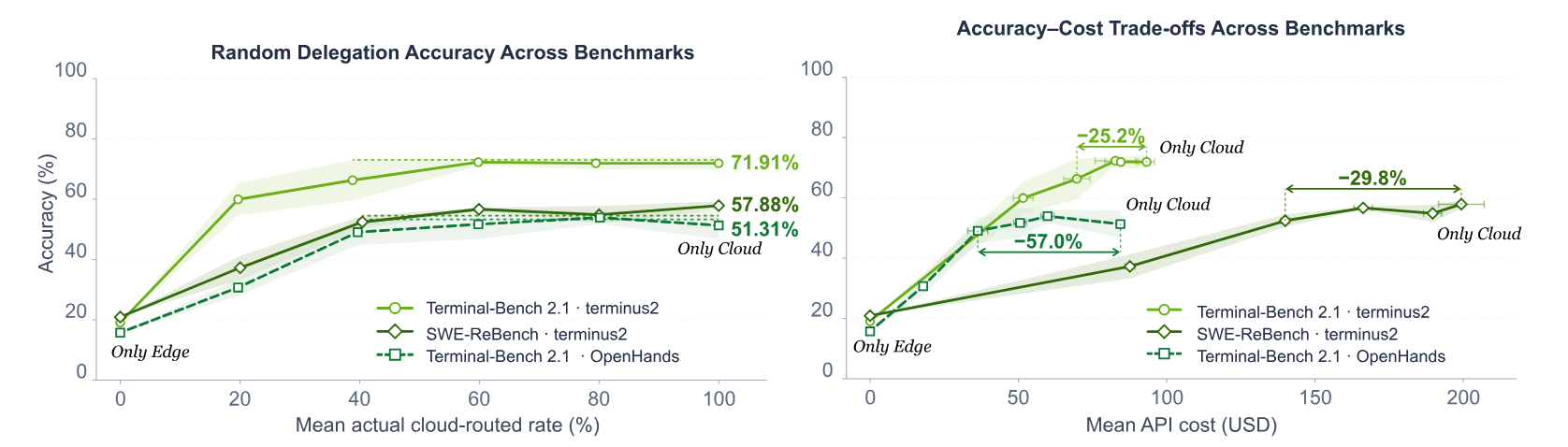
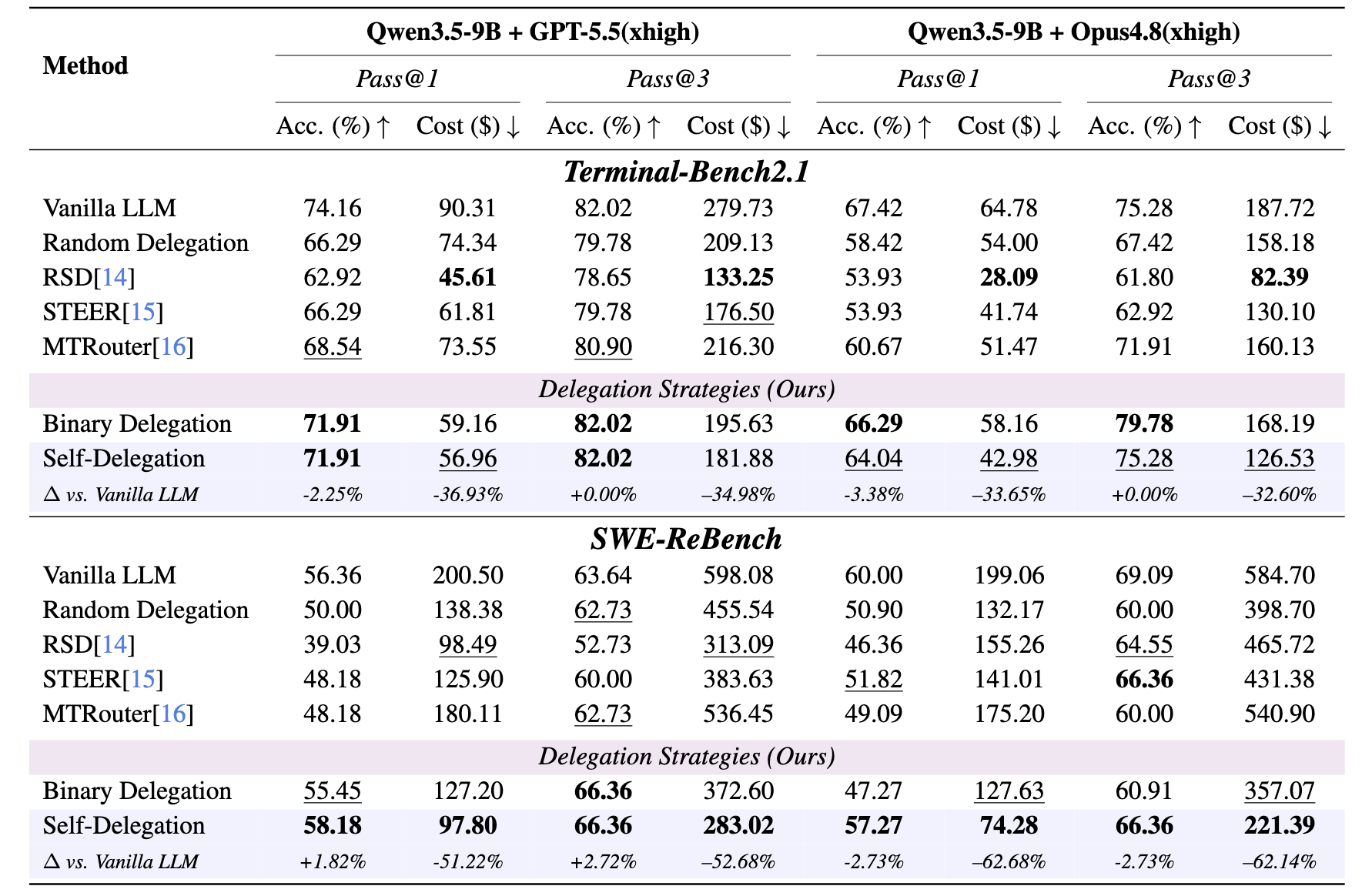
We evaluate on Terminal-Bench 2.1 and SWE-ReBench with a maximum of 80 turns. We report Pass@1, Pass@3, and inference cost in Table 1. Cost is computed from cloud LLM API usage based on input and output token pricing; local SLM computation is excluded, while judge API cost is included for binary delegation. Our methods consistently achieve better performance–cost trade-offs than the baselines. In particular, self-delegation reduces Pass@3 cost by 53%/63% on SWE-ReBench and 35%/33% on Terminal-Bench 2.1 with GPT-5.5/Opus 4.8, respectively, while maintaining performance comparable to LLM-only.
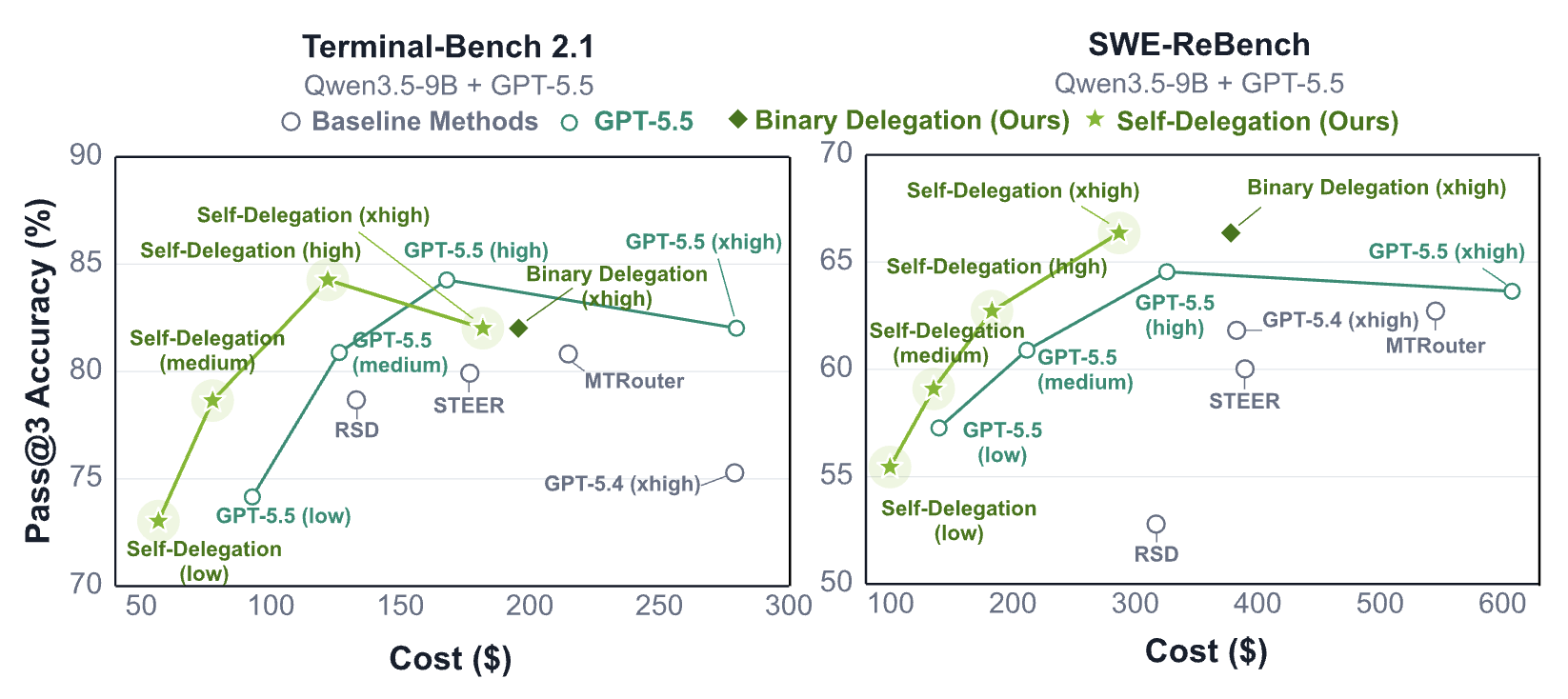
The figures illustrate the trade-off between Pass@3 performance and inference cost for our method and the baselines across different settings and reasoning efforts. Across these efforts, our self-delegation model achieves performance comparable to pure-cloud models while substantially reducing inference cost.
Although our self-delegation model is trained exclusively with the Terminus2 harness, it maintains Pass@3 performance comparable to the vanilla LLM when transferred to all three unseen harnesses, while reducing inference costs by at least 25%.
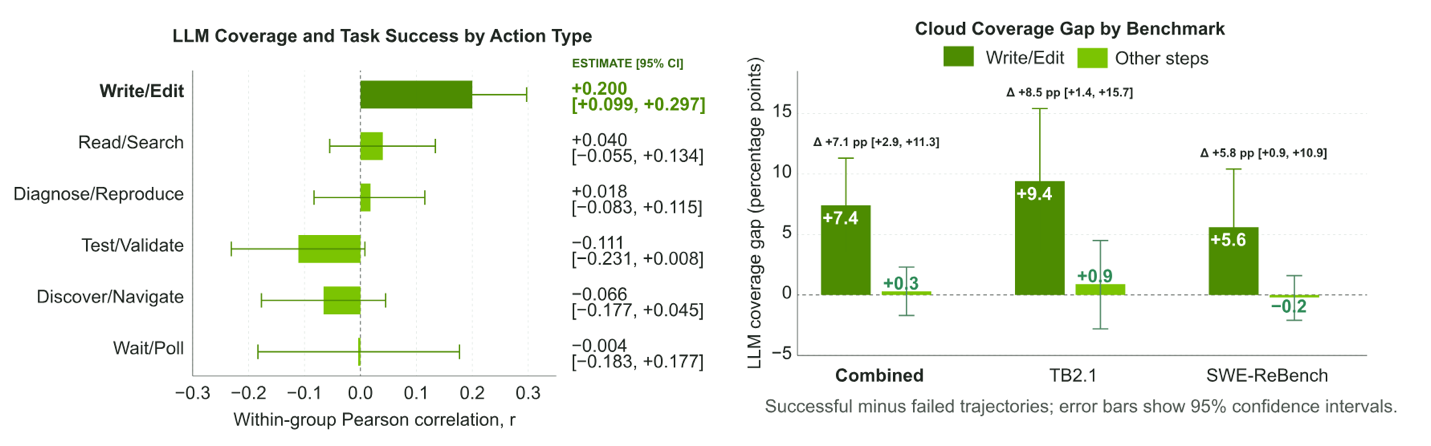
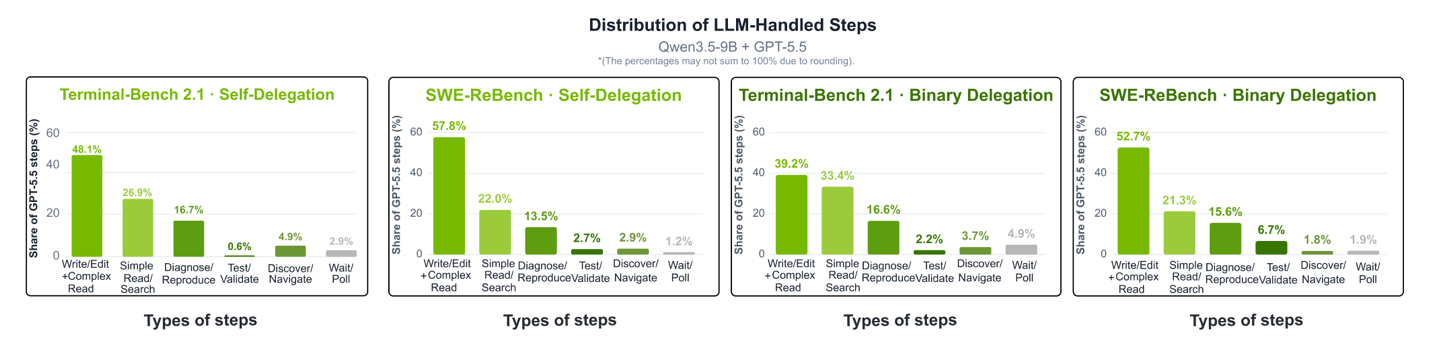
Across both benchmarks, self-delegation and binary delegation exhibit similar patterns: GPT-5.5 is primarily invoked for challenging write/edit and complex read/search steps that require codebase-level reasoning and cross-file understanding. Both methods therefore concentrate cloud-model usage on critical operations while leaving simpler steps to the local SLM.
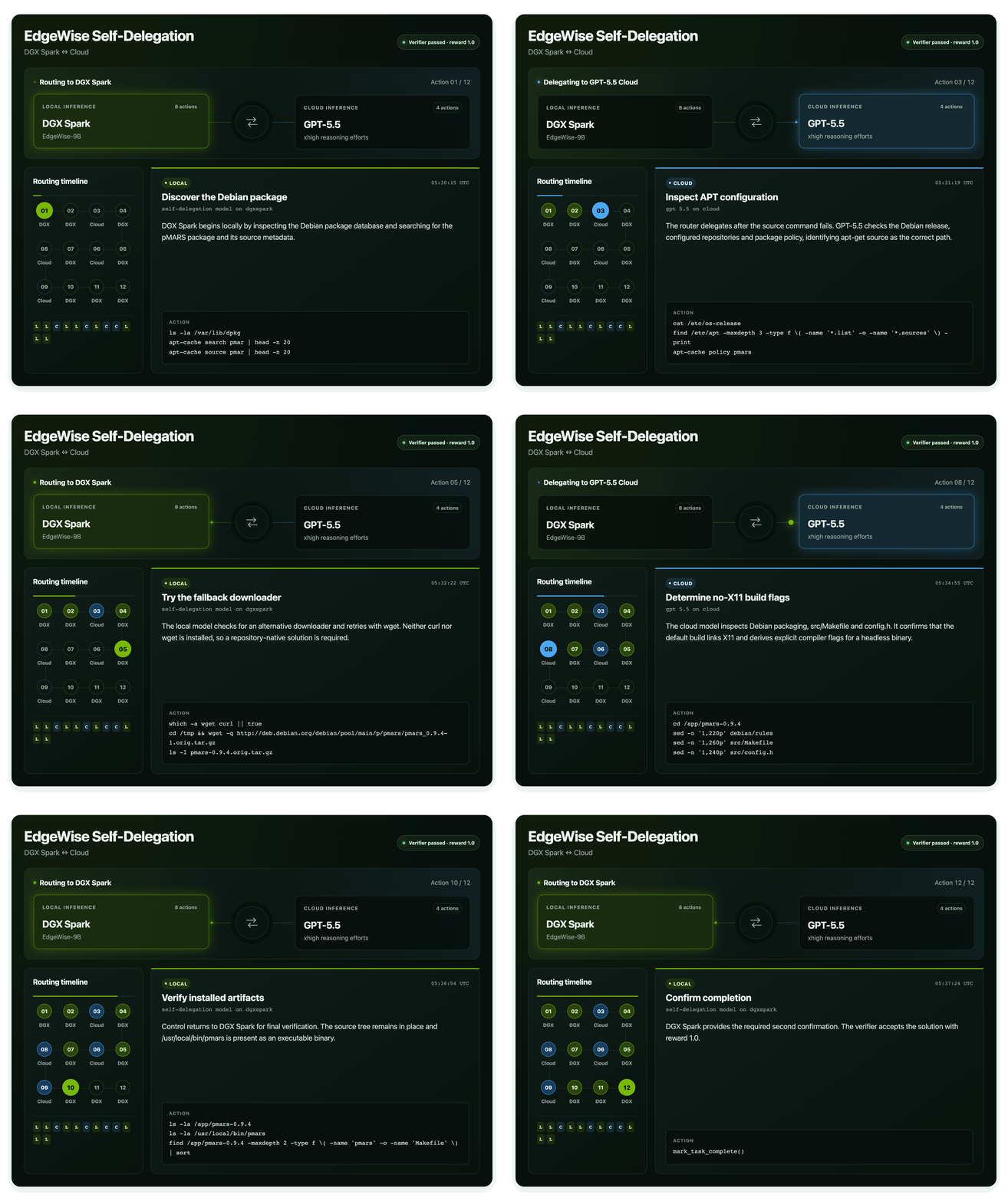
EdgeWise’s self-delegation model is deployed on an NVIDIA DGX Spark, solving tasks locally while selectively delegating difficult steps to a cloud LLM. It achieves Pass@3 performance comparable to the A100 setup while reducing inference cost by approximately 50% compared with the vanilla cloud model.
@article{shi2026edgewise,
  title={EdgeWise: Bringing Long-Horizon Agents to the Edge via Selective Cloud Delegation},
  author={Shi, Zeru and Jiang, Jindong and Hachiuma, Ryo and Fu, Yonggan and Lee, Byung-Kwan and Belcak, Peter and Muralidharan, Saurav and Agarwal, Ayush and Tang, Ruixiang and Dantrey, Ambrish and Molchanov, Pavlo and Patney, Anjul and Radhakrishnan, Subhashree},
  journal={arXiv preprint arXiv:2610.17560},
  year={2026}
}