Split-RL: Local Conflict Resolution in Reinforcement Learning
Abstract
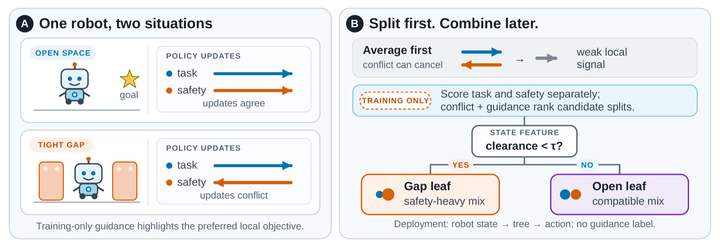
Reinforcement learning (RL) policies are often trained by mixing contradictory feedback that is localized in space and time. For example, a robot may prioritize speed in open areas versus precision in tight gaps. We introduce Split-RL, a Gradient Boosting Trees (GBT) RL algorithm that uses guidance labels to locally isolate these conflicting signals. Neural networks (NNs) lack the structural mechanism to do this, as their parameters share feedback from all sources. While GBT provides the inductive bias to explicitly partition the state-space per objective, standard tree-fitting procedures aggregate contradictory gradient signals before they reach the leaves. Split-RL leverages this bias to integrate guidance labels into tree construction, routing these updates into disjoint state-space regions and preventing signal interference. Such labels can arise from heuristics, sensor-derived events, or existing rule-based systems, allowing Split-RL to incorporate rule-derived structure while retaining a learned policy. We theoretically show how early gradient aggregation loses objective-specific information and characterize when the Split-RL score isolates conflicting updates. We focus on constrained RL and offline RL with mixed datasets, each balancing two objectives that conflict locally. Across domains with spatial, rare-event, and temporal conflicts, Split-RL consistently outperforms existing methods by achieving low-cost, feasible solutions while maintaining competitive rewards. In offline settings, Split-RL localizes the tradeoff between imitation and policy improvement, outperforming other methods and achieving near-expert performance across varying dataset sizes.
arXiv paper and project page: coming soon.