Abstract
ReSTIR [Bitterli et al. 2020] efficiently reduces path tracing noise by reusing samples spatiotemporally. Recent ReSTIR methods [Liu et al. 2025] improve temporal reuse from prior frame primary hits. But disocclusions still invalidate some pixel histories, degrading quality with spatially varying noise.
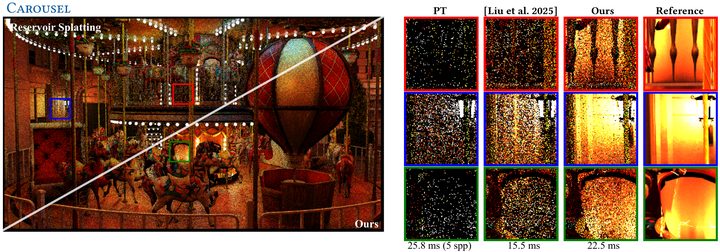
We address disocclusions in ReSTIR by introducing multiple screen-space layers, using reservoir splatting to shift samples between layers. This reuses previously occluded samples that become visible again, reducing noise in disoccluded regions. While shifting samples across layers typically requires tracing multiple rays, we introduce depth ranges and redefine the integration domain to eliminate many ray queries, improving performance. To minimize costs for maintaining many layers, we selectively track only active domains propagated from previous frames.
We validate across multiple scenes, showing greatly reduced disocclusion noise while incurring only a small incremental cost.