Spatial Intelligence Lab (SIL)
NVIDIA Research
Spatial Intelligence Lab (SIL)
NVIDIA Research
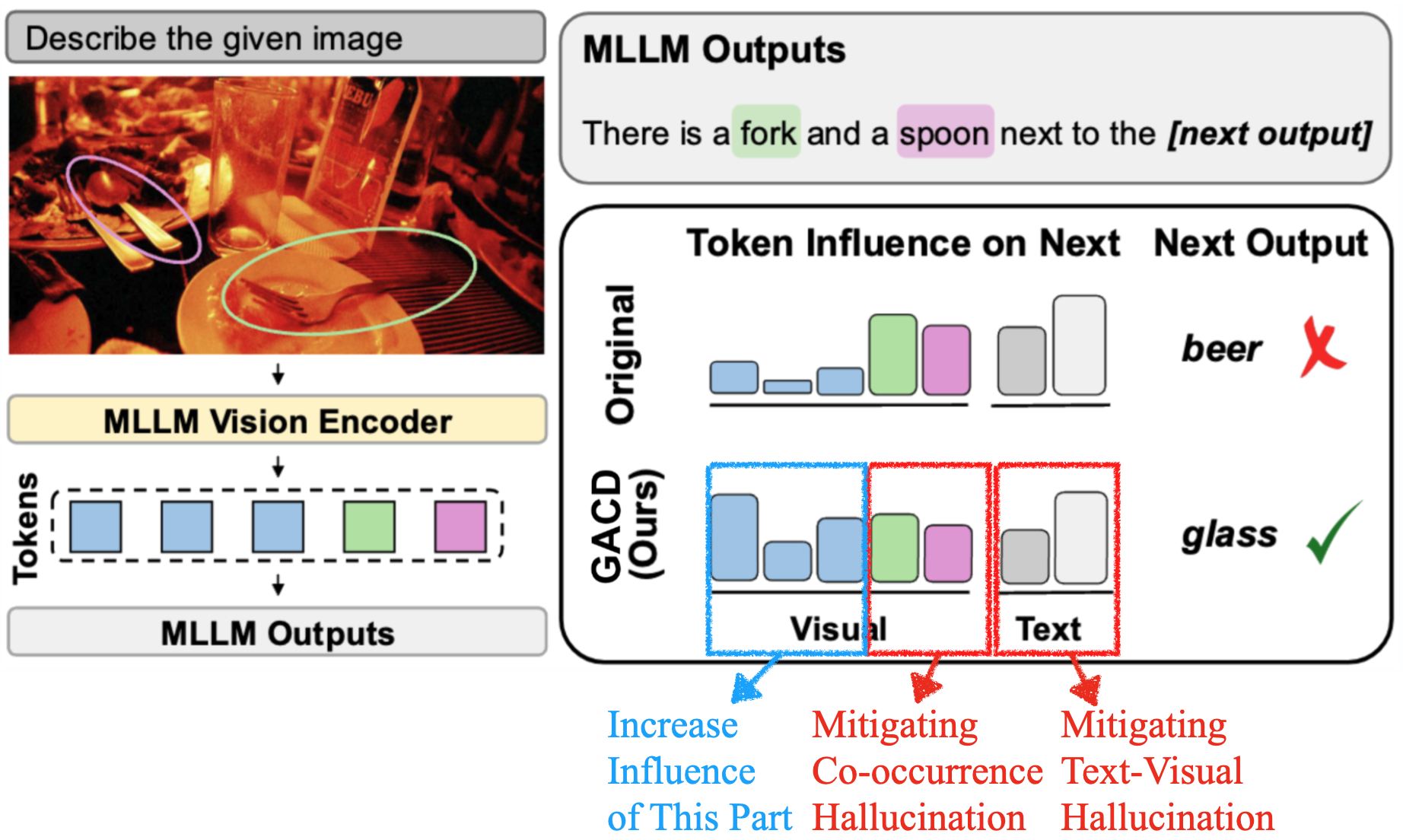
What are hallucinations? Outputs that are not grounded in the provided visual inputs are typically caused by:
Text–Visual Bias: Overreliance on text inputs (prompts or past outputs) over visual information, which becomes more severe in longer generations.
Co-occurrence Bias: Models hallucinate objects because they often appear together in the training data.
Multimodal large language models (MLLMs) achieve strong performance across diverse tasks but remain prone to hallucinations, where outputs are not grounded in visual inputs. This issue can be attributed to two main biases: text–visual bias, the overreliance on prompts and prior outputs, and co-occurrence bias, spurious correlations between frequently paired objects. We propose Gradient-based Influence-Aware Constrained Decoding (GACD), an inference-based method that addresses both biases without auxiliary models and is readily applicable to existing models without finetuning. The core of our approach is bias estimation, which uses first-order Taylor gradients to understand the contribution of individual tokens—visual features and text tokens—to the current output. Based on this analysis, GACD mitigates hallucinations through two components: (1) suppressing spurious visual features correlated with the output objects, and (2) rebalancing cross-modal contributions by strengthening visual features relative to text. Experiments across multiple benchmarks demonstrate that GACD effectively reduces hallucinations and improves the visual grounding of MLLM outputs.
We propose using a first-order Taylor expansion to estimate token influence, defined as the sum of the Manhattan norms of gradients from different contexts (visual inputs, prompts, and past outputs), formulated as:
where:
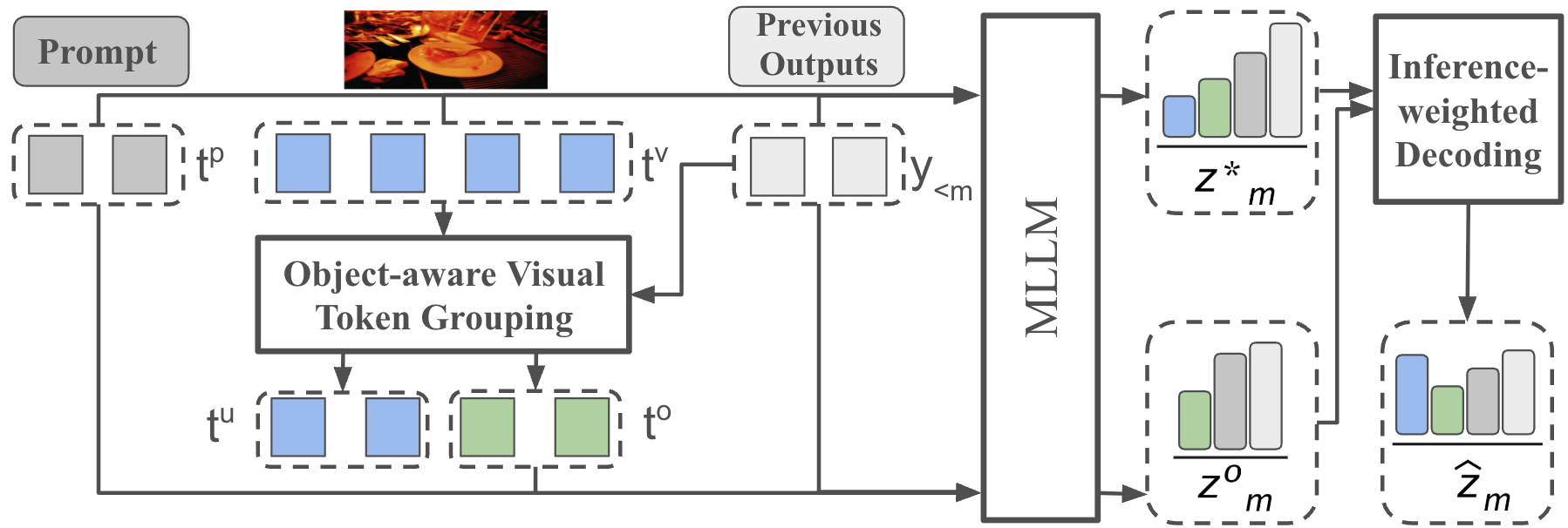
GACD consists of two core components:
Strong and Consistent Improvements: GACD improves performance across all evaluated MLLMs and achieves the best AMBER Score compared with existing SOTA methods.
| Method | LLaVA v1.5 | InstructBLIP | mPLUG-Owl2 | LLaVA v1.6 | Qwen2-VL | InternVL2 |
|---|---|---|---|---|---|---|
| Base | 83.5 | 86.5 | 84.0 | 88.5 | 90.1 | 90.0 |
| RLAIFv | 89.0 | 87.1 | 88.6 | 88.6 | 90.4 | 90.1 |
| VCD | 83.8 | 86.7 | 86.6 | 88.0 | 90.0 | 89.6 |
| M3ID | 84.7 | 86.9 | 86.8 | 88.4 | 90.2 | 89.6 |
| AVISC | 85.5 | 87.2 | 87.5 | 88.3 | 90.1 | 89.4 |
| Ours | 90.2 | 88.1 | 89.6 | 89.2 | 91.1 | 90.3 |
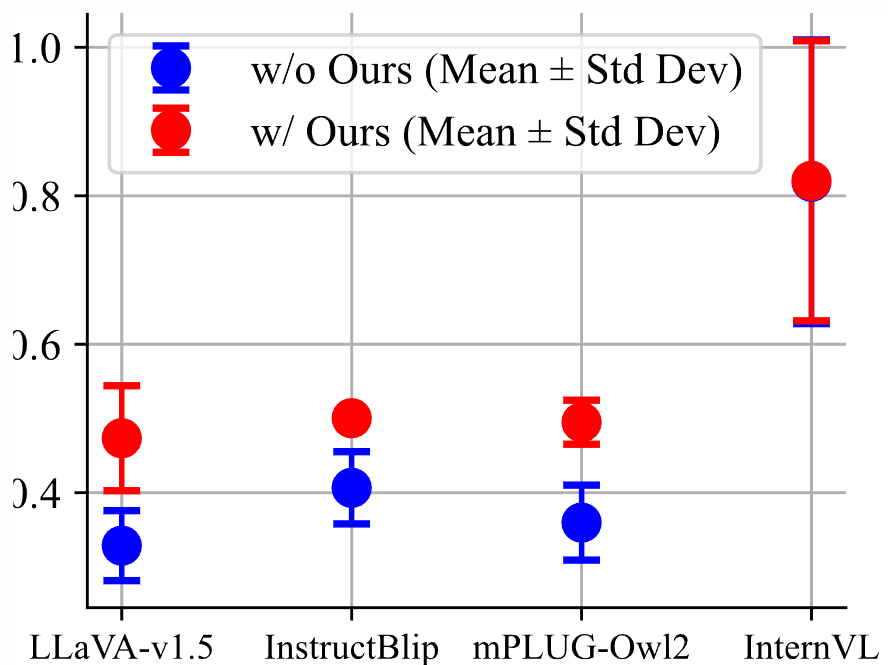
Adaptive Visual Enhancement: GACD strengthens visual influence only when the model relies too little on visual information (below 50%). This avoids unnecessary changes when visual grounding is already strong, such as in InternVL2.
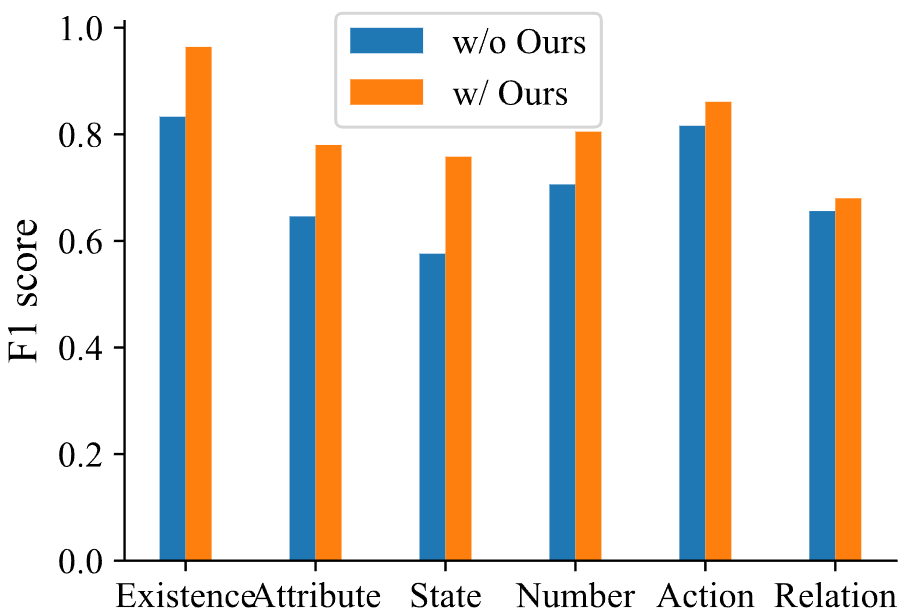
Category Gains: GACD consistently improves F1 scores across categories, with the largest gains on direct visual errors.
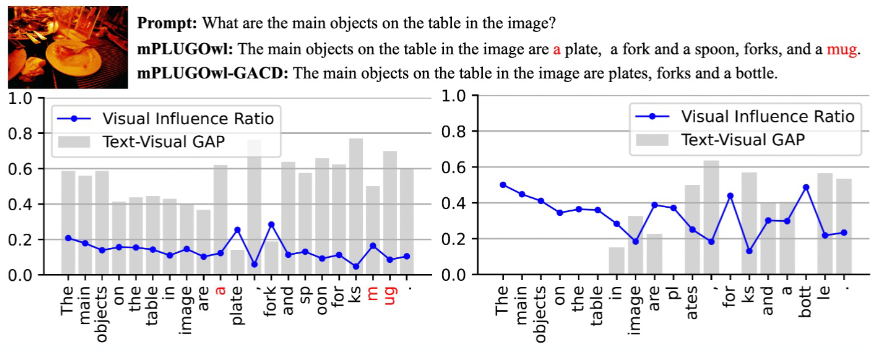
(Left) Without GACD: The model relies too little on visual information, with
visual influence ratio averaging only about 20%.
Hallucinations often appear when visual influence is low.
(Right) With GACD: GACD increases overall visual influence and prevents it from dropping
as generation continues, leading to fewer hallucinations.
Analysis Insight: Our token influence helps analyze MLLMs. It naturally shows that
punctuation and suffix tokens depend less on visual input, and also reveals how visual reliance
decreases as the output becomes longer.
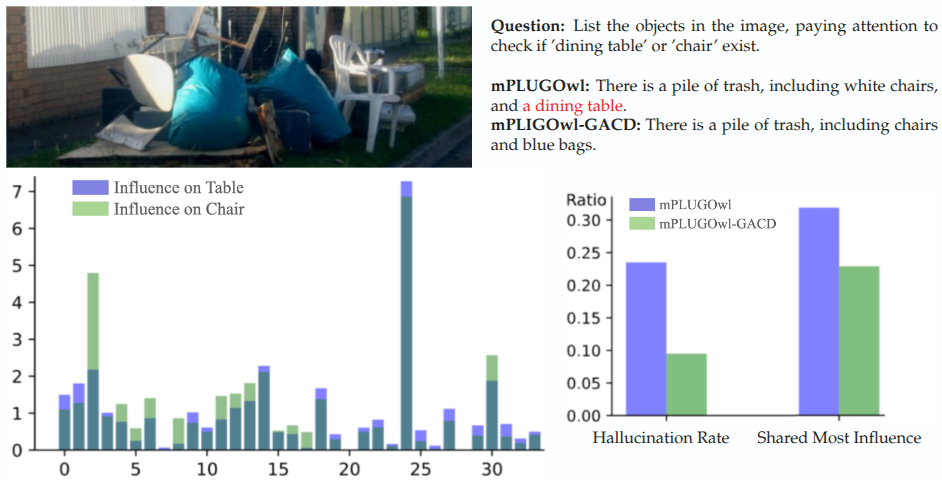
(Left) Within the visual tokens, the influence distributions for the prediction
Chair and the hallucinated Table are highly correlated; notably, the visual token
contributing most to Table also contributes most to Chair.
(Right) Shared most influential tokens are common in hallucinated Table predictions,
while GACD reduces this issue and lowers hallucination rates.
@inproceedings{wang2026mitigating,
  title={Mitigating Multimodal Hallucinations via Gradient-based Self-Reflection},
  author={Wang, Shan and Shen, Maying and Chang, Nadine and Nguyen, Chuong and Li, Hongdong and Alvarez, Jose M},
  booktitle={Proceedings of the IEEE/CVF Conference on Computer Vision and Pattern Recognition (CVPR)},
  year={2026}
}