Look Where You Say You’re Looking
Self-Grounded Attention for Visual Reasoning
1NVIDIA Research 2University of Melbourne 3The Hebrew University of Jerusalem 4Bar-Ilan University
TL;DR
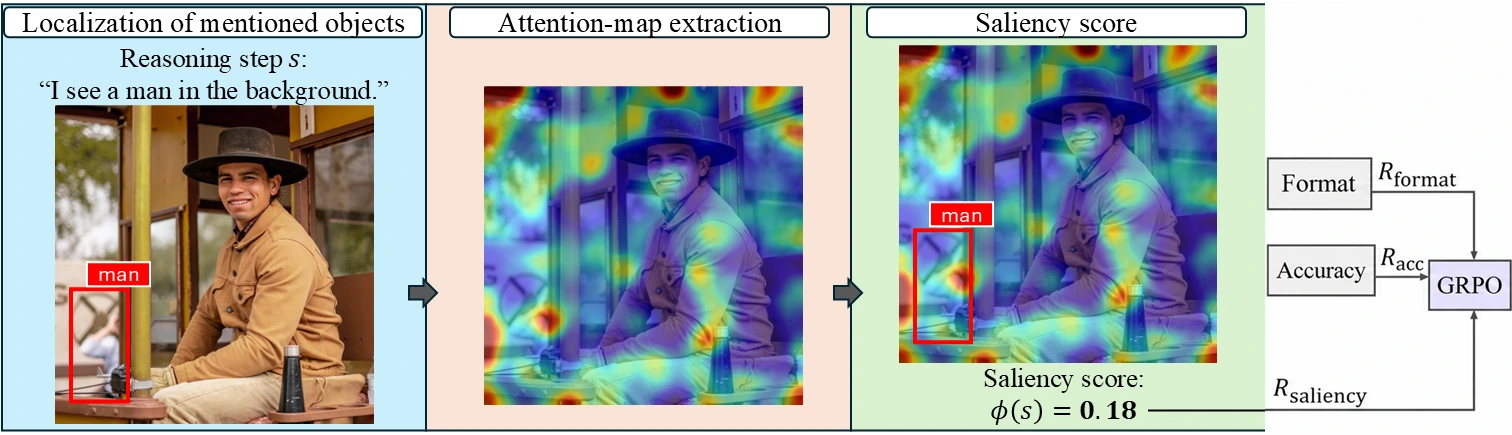
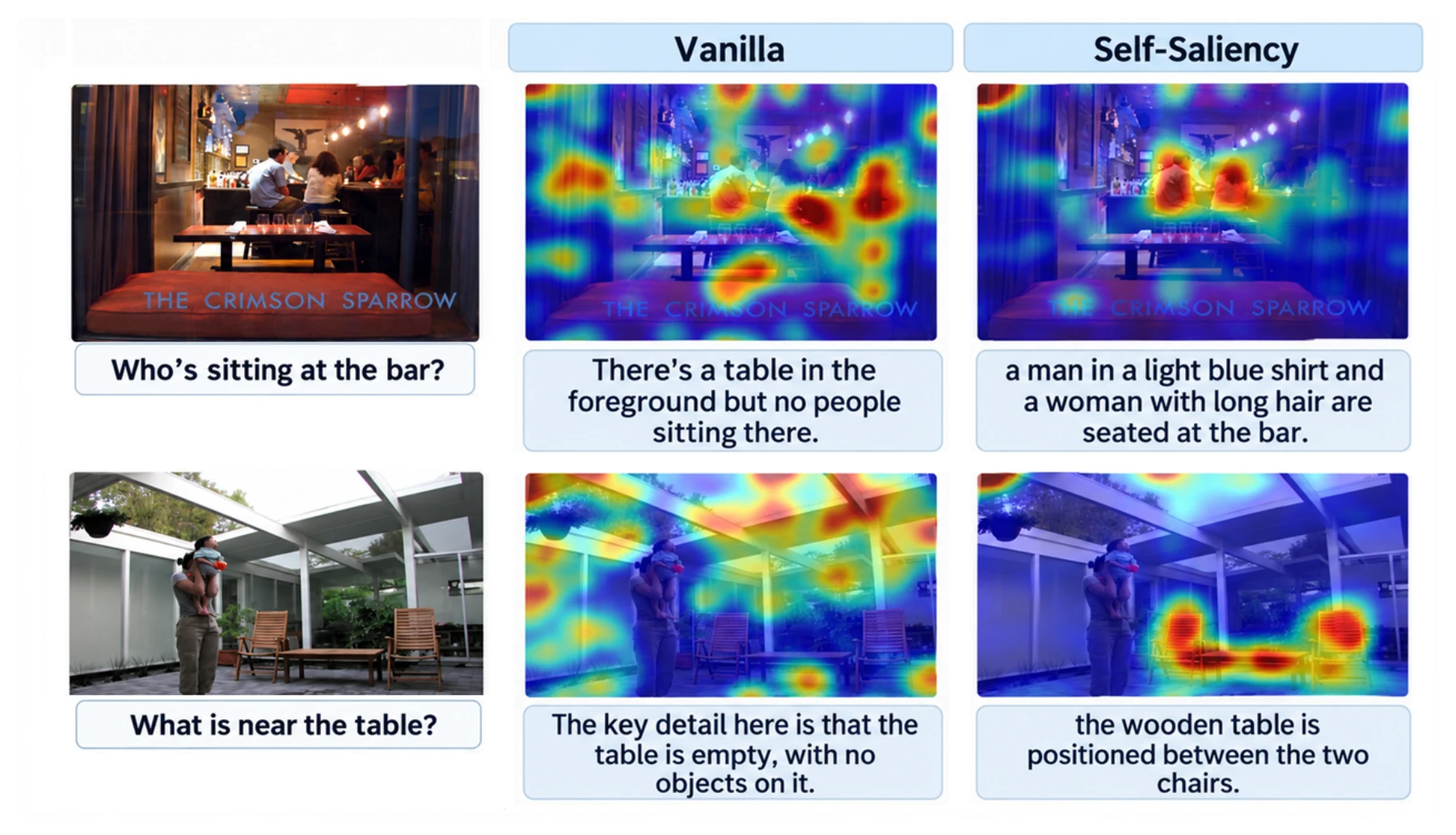
We introduce Self-Saliency, a method for aligning where a model looks with what it talks about. Self-Saliency uses a grounding model to localize the objects mentioned in each reasoning step, and treats the resulting regions as supervision for the model's visual attention. Across a broad suite of 25 visual reasoning benchmarks, Self-Saliency surpasses all previous baselines and outperforms the vanilla model by 3.2 points on average.
Method
Results
| No attention intervention | Prior work | Ours | |||||
|---|---|---|---|---|---|---|---|
| Benchmark | Qwen3-VL 8B-Instruct |
+SFT | +Vanilla GRPO | VGA | Saliency-R1 | EASE | Self-Saliency |
| Mean score ↑ | 61.1 | 62.7 | 63.5 | 61.2 | 63.6 | 62.9 | 64.3 |
| Mean rank ↓ | 4.42 | 4.64 | 3.68 | 4.48 | 3.26 | 4.50 | 3.02 |
| Wins ↑ | 4 | 0 | 3 | 3 | 6 | 0 | 9 |
| HR-Bench 8K | 74.1 | 72.9 | 72.0 | 74.2 | 76.0 | 72.8 | 74.5 |
| DailyClue | 35.4 | 32.4 | 34.2 | 34.2 | 32.0 | 32.7 | 31.2 |
| ChartQA | 85.0 | 88.8 | 89.4 | 84.9 | 89.7 | 88.9 | 90.0 |
| CV-Bench | 86.0 | 83.4 | 84.9 | 86.1 | 83.8 | 84.2 | 85.9 |
| HallusionBench | 63.2 | 59.7 | 57.1 | 62.0 | 58.3 | 62.6 | 55.7 |
| MathVision | 29.6 | 33.5 | 37.5 | 31.2 | 33.9 | 35.9 | 41.5 |
| MME | 2375.9 | 2371.7 | 2376.1 | 2379.8 | 2395.7 | 2395.4 | 2355.1 |
| MMK12 | 68.2 | 63.1 | 62.3 | 67.9 | 61.1 | 63.1 | 62.0 |
| HR-Bench 4K | 78.0 | 76.9 | 77.4 | 78.1 | 78.9 | 76.9 | 79.5 |
| MathVerse | 34.4 | 51.0 | 52.8 | 33.8 | 49.5 | 50.4 | 50.9 |
| SalBench | 43.3 | 60.7 | 59.8 | 43.3 | 62.7 | 58.6 | 64.7 |
| MathVista | 73.5 | 69.5 | 71.8 | 73.8 | 71.0 | 70.0 | 70.4 |
| LogicVista | 52.5 | 54.9 | 55.1 | 51.3 | 56.5 | 52.9 | 56.2 |
| MME-RealWorld | 63.7 | 64.2 | 66.7 | 63.8 | 66.4 | 65.1 | 68.7 |
| IllusionVQA | 40.0 | 41.9 | 41.5 | 40.1 | 43.8 | 40.5 | 43.5 |
| MMMU-Pro | 40.4 | 48.6 | 48.6 | 41.9 | 47.7 | 47.1 | 48.4 |
| AlgoPuzzleVQA | 32.8 | 36.9 | 39.9 | 34.3 | 38.7 | 36.4 | 41.4 |
| RealWorldQA | 68.5 | 67.1 | 67.8 | 68.4 | 68.8 | 67.5 | 68.2 |
| OmniSpatial | 47.4 | 50.3 | 48.2 | 46.8 | 50.2 | 50.2 | 51.0 |
| V* | 84.3 | 79.6 | 79.6 | 85.3 | 80.6 | 81.2 | 82.7 |
| WeMath | 69.4 | 68.6 | 74.3 | 68.2 | 73.8 | 71.1 | 75.5 |
| ScienceQA-IMG | 94.4 | 96.3 | 97.2 | 94.4 | 97.6 | 96.2 | 97.4 |
| VisuLogic | 26.6 | 24.9 | 24.8 | 26.4 | 24.9 | 24.4 | 24.4 |
| POPE | 88.8 | 87.4 | 88.2 | 88.8 | 88.5 | 88.5 | 88.9 |
| MMStar | 64.0 | 69.8 | 70.9 | 64.7 | 69.9 | 69.5 | 69.6 |
Analysis
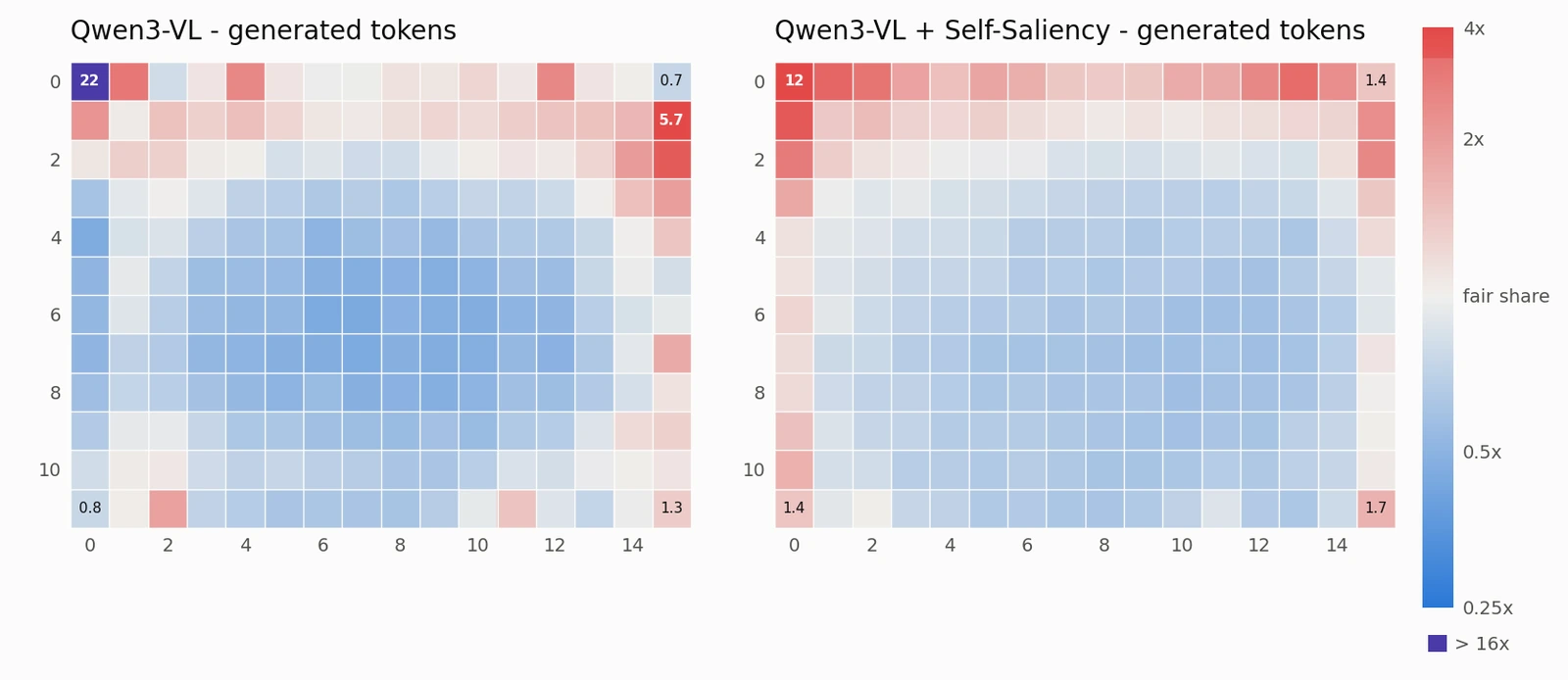
Training changes the text at the selected heads, and the attention across all of layer 22
We asked how training raises the reward: (1) by changing where visual attention goes, or (2) by changing the generated text.
Text. The model generates shorter completions, which refer to larger portions of the image.
Attention. When we trained Self-Saliency, we computed the reward on two selected heads (layer 22, heads 28 and 31). On the selected heads, the fraction of attention in referred regions stays the same after training. Across all the heads of layer 22, however, that fraction increases significantly.
| Text-related | Attention-related | |||
|---|---|---|---|---|
| Completion length * |
Referred portion of image ** |
Fraction of attention in referred regions (selected heads) |
Fraction of attention in referred regions (mean across layer-22 heads) *** |
|
| Vanilla | 230.0 | 0.533 | 0.462 | 0.611 |
| Self-Saliency | 149.6 | 0.566 | 0.462 | 0.622 |
** p = 0.00009, Wilcoxon signed-rank test
*** p ≪ 0.00001, Wilcoxon signed-rank test
Attention piles up on the image border
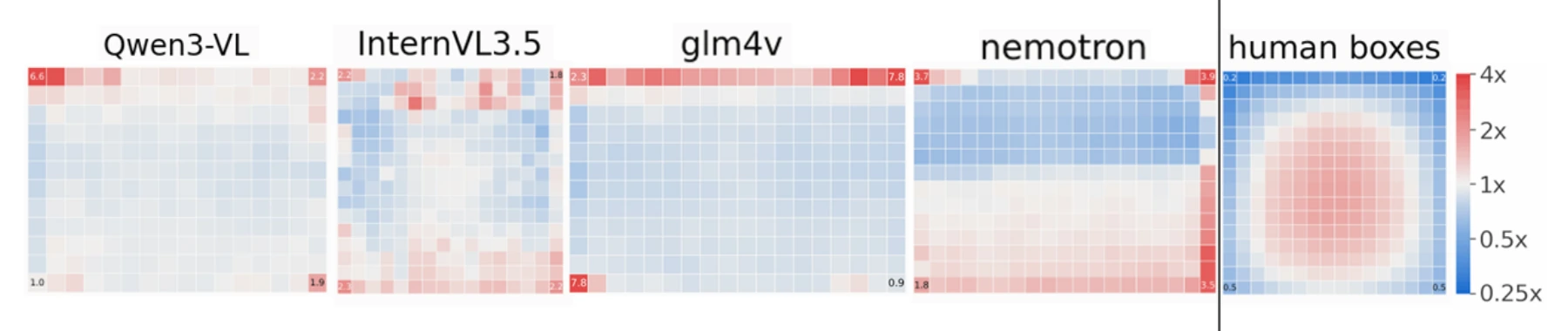
Across VLMs, visual attention concentrates on the geometric border of the image. Moreover, the most attended patch sits in a corner. In contrast, human annotators marked the center as the important region of the image.
Ablations
We run two ablations.
One explanation for Self-Saliency's gain is that it merely shifts attention toward the center of the image. To rule this out, we replace the grounding model's boxes with a fixed rectangle at the center, and train on that. We name this variant Center rect.
Another explanation is that response-specific grounding does not matter. Under this hypothesis, any boxes relevant to the image supply the same supervision. To rule this out, we give the grounding model the input question, and use the resulting boxes as supervision. We name this variant Question boxes.
Self-Saliency beats both ablations. Grounding the model's own response contributes meaningful feedback for training.
| Qwen3-VL-8B Instruct |
+SFT | +Vanilla GRPO | Center rect | Question boxes | Self-Saliency | |
|---|---|---|---|---|---|---|
| Mean score ↑ | 61.14 | 62.69 | 63.47 | 63.39 | 63.33 | 64.26 |
| Mean rank ↓ | 3.90 | 4.06 | 3.34 | 3.68 | 3.38 | 2.64 |
| Wins ↑ | 7 | 0 | 3 | 2 | 5 | 9 |
BibTeX
@article{berger2026selfsaliency,
  title   = {Look Where You Say You're Looking:
             Self-Grounded Attention for Visual Reasoning},
  author  = {Berger, Uri and Chechik, Gal and Dalal, Gal},
  journal = {arXiv preprint arXiv:2610.05023},
  year    = {2026}
}