Z++: Temporal, Non-Uniform, and 3D Z Sampling
Abstract
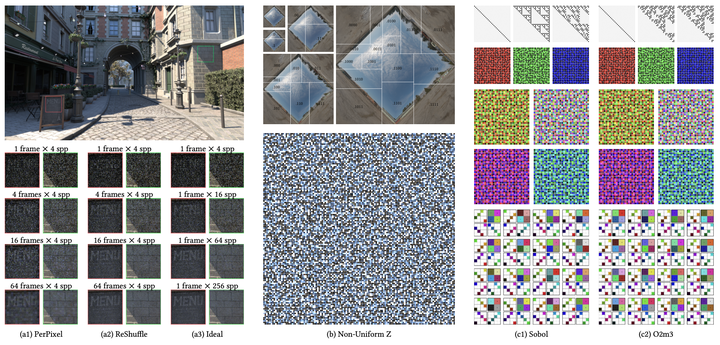
Z sampling redistributes Monte Carlo error in screen space by assigning consecutive low-discrepancy sub-sequences to Z-ordered pixels, using differently shuffled 1D or 2D sequences for the individual constituent domains of a light-transport path. We first analyze the reasons that Z sampling is effective and distill a set of practical design guidelines for Z sampling algorithms. We then propose extensions to Z sampling in two complementary directions: temporally across frames, and spatially to non-uniform and higher-dimensional constituent domains. Our approach thus improves temporal frame accumulation by assigning negatively correlated samples to consecutive frames, without additional memory or runtime cost, while preserving individual-frame quality. It further allows applying Z sampling to non-uniform, importance-sampled distributions, via a tabulated hierarchical equal-mass subdivision of the importance map. For 3D constituent integration domains, we also introduce a novel low-discrepancy sequence that simultaneously maintains high uniformity in the full 3D domain, along each coordinate axis, and across each pairwise 2D projection. The proposed sequence is quaternary (base-4) structured, hence optimal stratification is attained only for power-of-four sample counts. We empirically demonstrate the advantage of our approach over the common practice of splitting a 3D constituent domain into a 1D–2D pair, and evaluate it against existing 3D sampling alternatives.