

Volumetric data is everywhere The amount of volumetric data collected is growing as industry continues to deploy robots, autonous vehicles, and industrial automation solutions.
With this growth in data, there is a parallel growth in demand to operationalize this data with spatial intelligence, i.e. machine learning algorithms which can reason about the physical world.
To satisfy this demand, deep learning on volumetric data has grown into a mainstream area of academic research.
Deep learning on volumetric data is hard. However, unlike deep learning on images and text, volumetric data is often too big to fit in ram,
sparse, and non uniform (different inputs have different sizes and can't be stacked into a tensor easily).
In practice, volumetric data collected in the real world is very large in spatial scale and resolution.
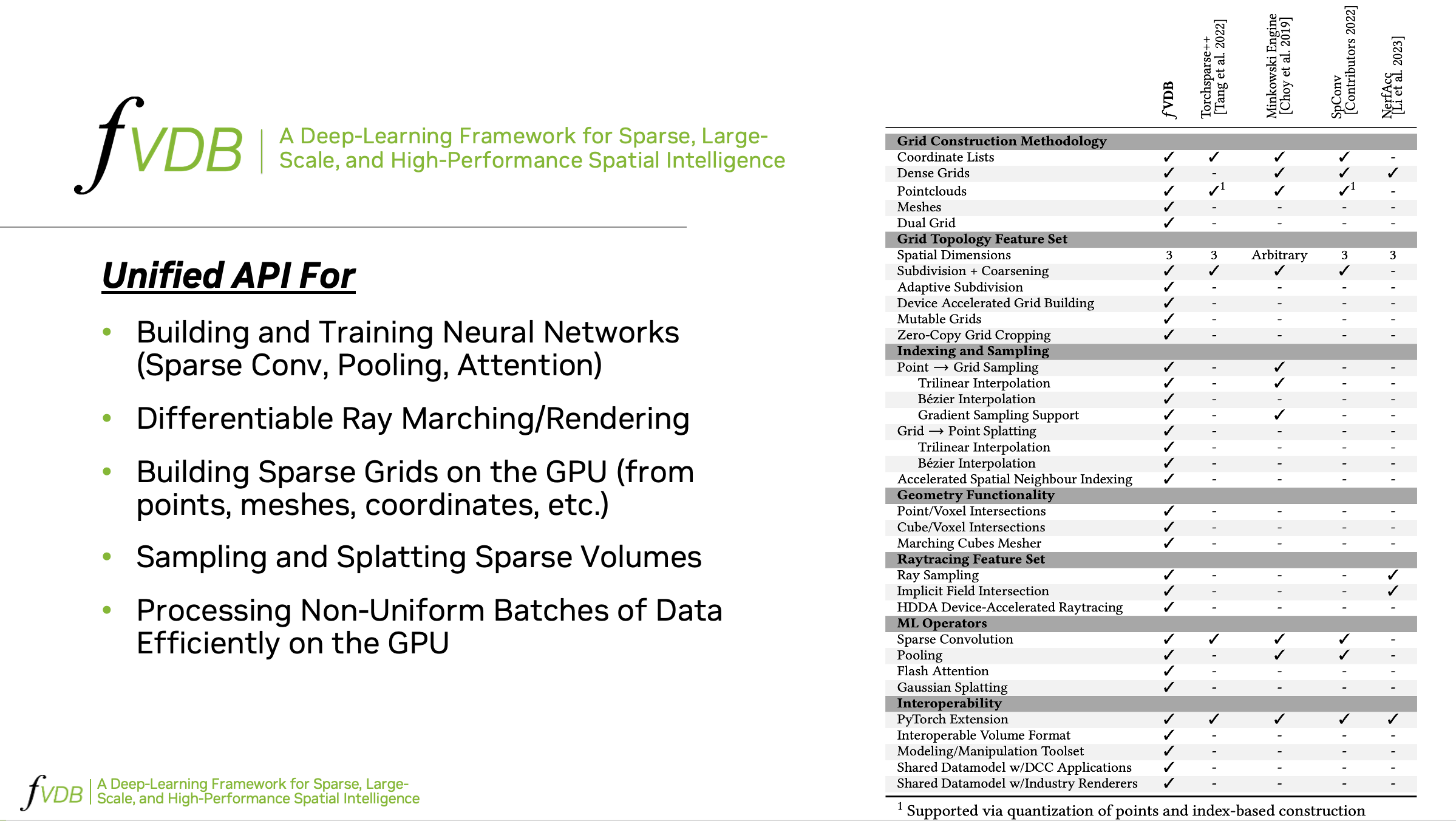
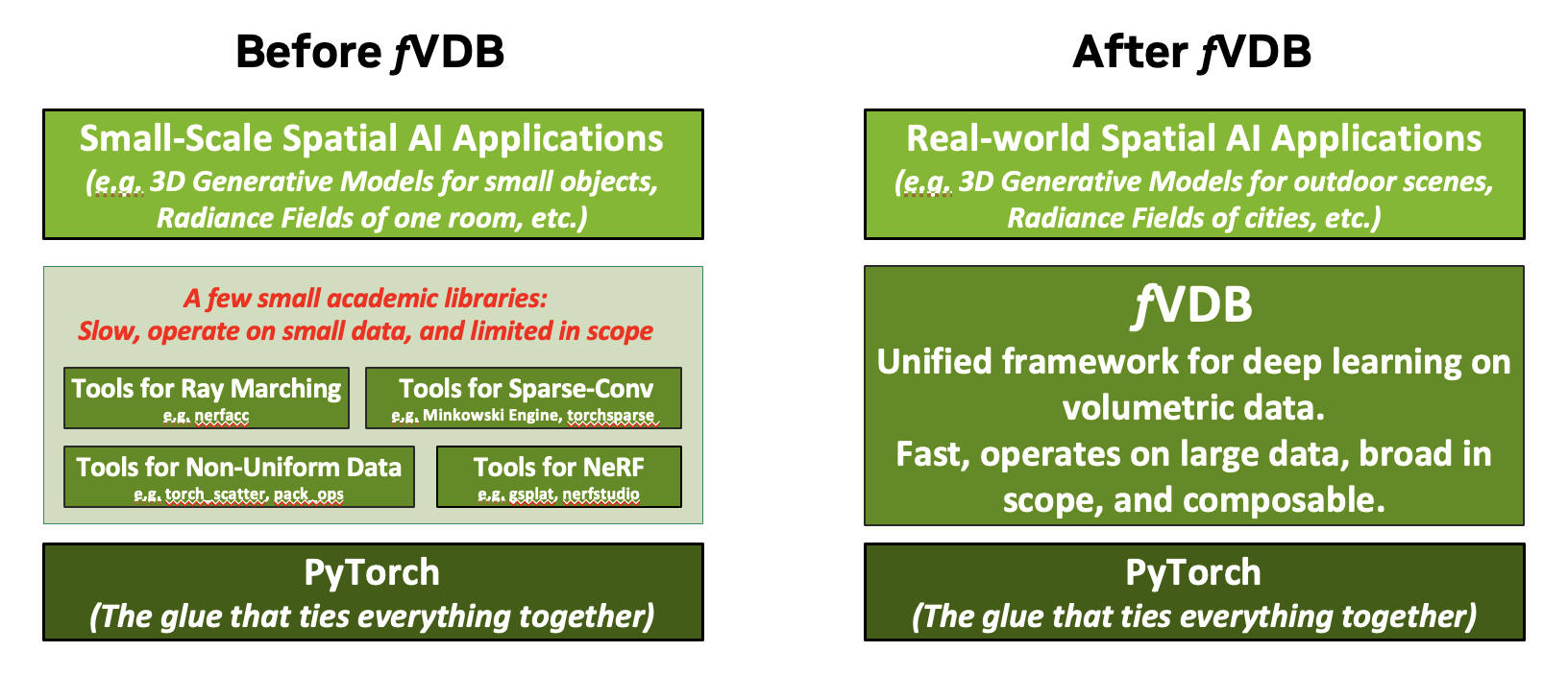
Lack of tooling for 3D Deep Learning: Current deep learning pipelines for volumetric data are implemented by duct taping together a
suite of small academic libraries that have incompatible APIs, and sub-optimal performance. The result is that algorithms developed by researchers
can't be deployed on real world data.
Surface Reconstruction from Sparse Points: fVDB is used by NKSR to reconstruct 3D meshes from oriented point clouds.
3D Generative AI: fVDB is used by XCube to build a generative model for 3D shapes and scenes. The objects in the video below are all AI generated.
Generative 3D Scene Reconstruction: fVDB is used by SCcube to reconstruct millions of Gaussians with a range of 102.4m x 102.4m in 20 seconds from sparse views (only 3 images).
Unbounded driving scene generation: fVDB is used by InfiniCube to generate unbounded dynamic driving scenes from world models.
Accelerating city-scale radiance fields: fVDB is used by NeRF-XL to raytrace city-scale radiance fields accross multiple GPUs.