Abstract
Radiance fields, including their recent efficient forms such as 3D Gaussian Splatting and Sparse Voxels, have revolutionized photorealistic 3D scene visualization by enabling high-fidelity reconstruction of complex environments, making them a natural match for light field displays. However, integrating these technologies presents significant computational challenges, as light field displays require many high-resolution renderings from slightly shifted viewpoints, while radiance fields rely on computationally intensive volume rendering, which is intractable to achieve real-time speeds even with efficient scene representations. In this paper, we propose a unified and efficient framework for real-time radiance field rendering on light field displays. Rather than re-rendering each view independently, our method converts the input radiance field into shared intermediate sweeping planes that can be efficiently composited into dense light-field views in a single pass. Our method prioritizes shared, non-directional plane caching for real-time performance, trading fine view-dependent color effects for a modest increase in intermediate memory usage. Our framework generalizes across different scene representations without retraining and avoids repeated computation across views. We further demonstrate a real-time interactive application on a Looking Glass display, achieving 200+ FPS at 512p across 45 rendered views and enabling seamless, immersive 3D interactive viewing experiences. On standard benchmarks, our method achieves up to 22× speedup compared to independently rendering each view, while largely preserving image quality.
Results
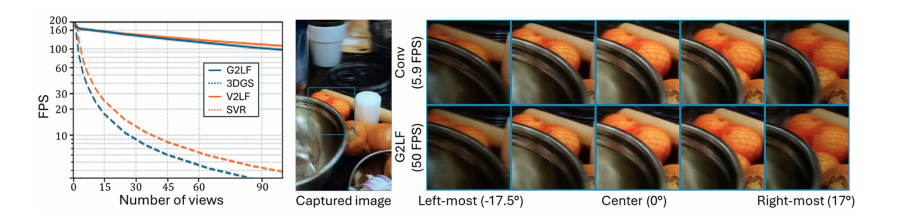
Render speed vs. number of views on Mip-NeRF-360 (512p, RTX 5090): G2LF and V2LF (solid) stay real-time where native 3DGS and SVR (dashed) collapse — up to 22× faster. Right: captured on a Looking Glass at 5.9 FPS (conventional) vs. 50 FPS (G2LF) across viewpoints.
How It Works
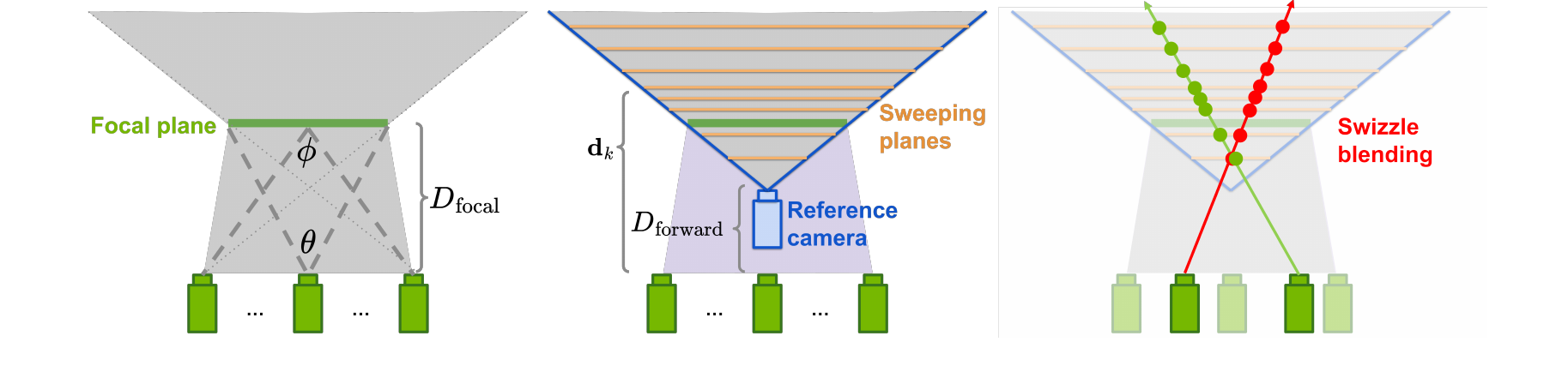
The display's focal-plane setup (left); the scene rasterized once into forward sweeping planes from a reference camera (center); and swizzle blending compositing those shared planes along each view's rays into every light-field view in a single pass (right).
Real-Time Interactive Demo
Live G2LF rendering on a Looking Glass display (single RTX 5090).
Free-viewpoint 3D navigation, rendered in real time.
Code
We release G2LF (OpenGL), the reference real-time renderer, at
github.com/NVlabs/g2lf. Point it at any 3D Gaussian
Splatting .ply and toggle the plane-sweep acceleration on and off to see the speedup live — 200+ FPS
at 512p across 45 views on a Looking Glass display. Released under the NVIDIA (non-commercial) License.
Citation
@article{kim2026realtime,
    author    = {Kim, Jonghyun and Sun, Cheng and Stengel, Michael and Chan, Matthew and
                 Russell, Andrew and Jung, Jaehyun and Braithwaite, Wil and Luebke, David and
                 De Mello, Shalini},
    title     = {Real-time 3D Visualization of Radiance Fields on Light Field Displays},
    journal   = {Proceedings of the ACM on Computer Graphics and Interactive Techniques},
    volume    = {9},
    number    = {4},
    articleno = {56},
    numpages  = {19},
    year      = {2026},
    publisher = {Association for Computing Machinery},
    doi       = {10.1145/3820023}
}
This website is based off of the EG3D website.