
Effects of Frame Rates up to 500 Hz on First Person Shooter Game Players
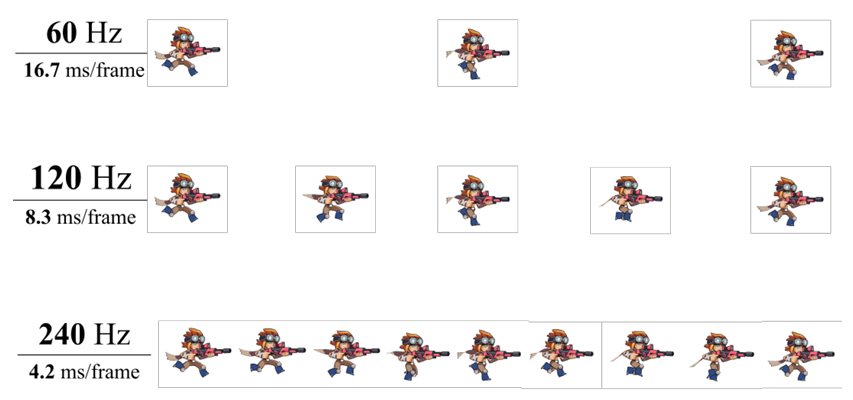
Computer games – and computer game players – often drive technology improvements, with graphics cards and monitors pushing the limits of display technologies. High frame rates, in particular, promise to provide lower latencies and smoother game visuals to gamers, especially important for competitive first-person shooter (FPS) game players. What is not well-known is to what extent gamers benefit from ultra-high frame rates in terms of player performance and quality of experience. This paper studies the effects of frame rates – especially high frame rates – on FPS game players. We developed a custom FPS game that provides a consistent delivery of frame rates from 7 f/s to 500 f/s, while recording objective (performance) and subjective (smoothness) measures. Analysis of data from a 44-person user study shows player performance (e.g., score and accuracy) improves sharply from 7+ f/s, but levels out after about 90 f/s. However, users’ perception benefits over the full range of frame rates studied, rising sharply from 7+ f/s, and continuing to improve through 500 f/s. In addition, we compare our results with prior work assessing the effects of frame rates across multiple controlled game tasks, finding common trends in the low-to-mid frame rate ranges for most tasks, with a few notable differences.
Publication Date
Research Area
External Links
Uploaded Files
Copyright
Copyright by the Association for Computing Machinery, Inc. Permission to make digital or hard copies of part or all of this work for personal or classroom use is granted without fee provided that copies are not made or distributed for profit or commercial advantage and that copies bear this notice and the full citation on the first page. Copyrights for components of this work owned by others than ACM must be honored. Abstracting with credit is permitted. To copy otherwise, to republish, to post on servers, or to redistribute to lists, requires prior specific permission and/or a fee. Request permissions from Publications Dept, ACM Inc., fax +1 (212) 869-0481, or permissions@acm.org. The definitive version of this paper can be found at ACM's Digital Library http://www.acm.org/dl/.