
TCBP+JOBS: GPU-Accelerated Quantum Error Correction Decoding and Noise Learning with Near-Optimal Accuracy
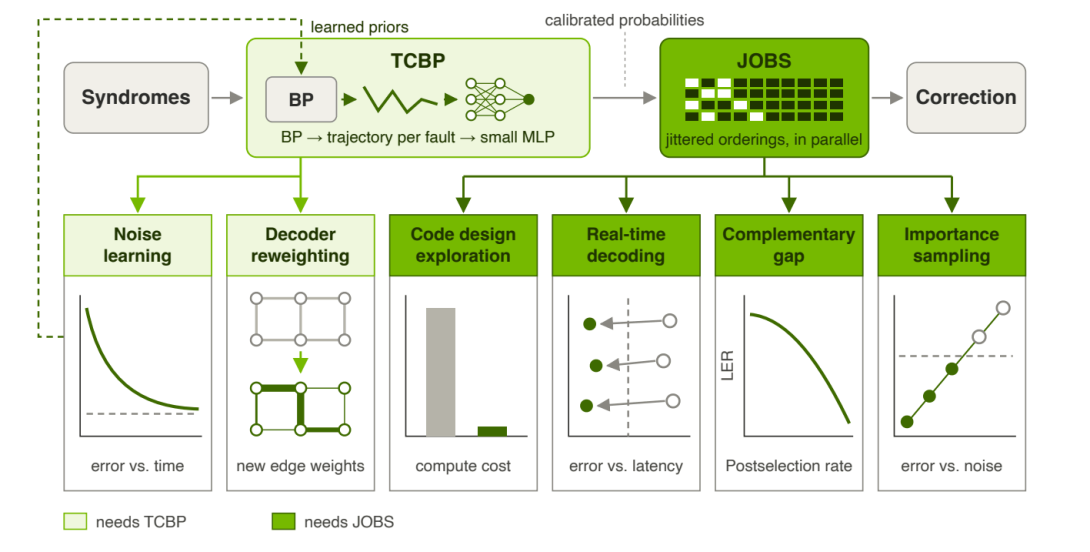
Achieving near-optimal quantum error correction (QEC) decoding accuracy often requires computationally expensive searches that limit both large-scale simulation and real-time operation. We introduce trajectory-calibrated belief propagation (TCBP), which learns calibrated fault probabilities from BP trajectories, and jittered OSD beam search (JOBS), which uses these probabilities to guide parallel GPU searches. Across surface, color and bivariate-bicycle code memory and surgery circuits, TCBP-JOBS achieves logical error rates comparable to those of the Tesseract most-likely-error decoder, and up to 4.5x lower on the largest codes. Serial speedups over Tesseract’s sparsified presets range from 10x to 7,400x, and against unsparsified long-beam Tesseract they reach 13,000x on the bivariate-bicycle codes, at logical error rate ratios of 0.97 to 1.57. Batched execution accelerates offline simulation for rapid, efficient exploration of large-scale QEC design spaces. For QPUs with longer logical clock cycles, our serial memory and logical-surgery experiments demonstrate near-optimal decoding accuracy while meeting the millisecond-scale latency requirements of online feed-forward operation. Beyond memory and logic decoding, we demonstrate using TCBP-JOBS for confidence scores for postselection in memory and magic-state cultivation, enabling end-to-end color code cultivation. Together, these methods provide a GPU framework for accelerating QEC research via accurate decoding, noise estimation, and confidence assessment.