
Hunting CUDA Bugs at Scale with cuFuzz
GPUs play an increasingly important role in modern software. However, the heterogeneous host-device execution model and expanding software stack make GPU programs prone to memory-safety and concurrency bugs that evade static analyses. While fuzz-testing, combined with dynamic error checking tools, offers a plausible solution, it remains underutilized for GPUs. In this work, we identify three main obstacles limiting prior GPU fuzzing efforts: (1) kernel-level fuzzing leading to false positives, (2) lack of device-side coverage-guided feedback, and (3) incompatibility between coverage and sanitization tools. We present cuFuzz, the first CUDA-oriented fuzzer that makes GPU fuzzing practical by addressing these obstacles.
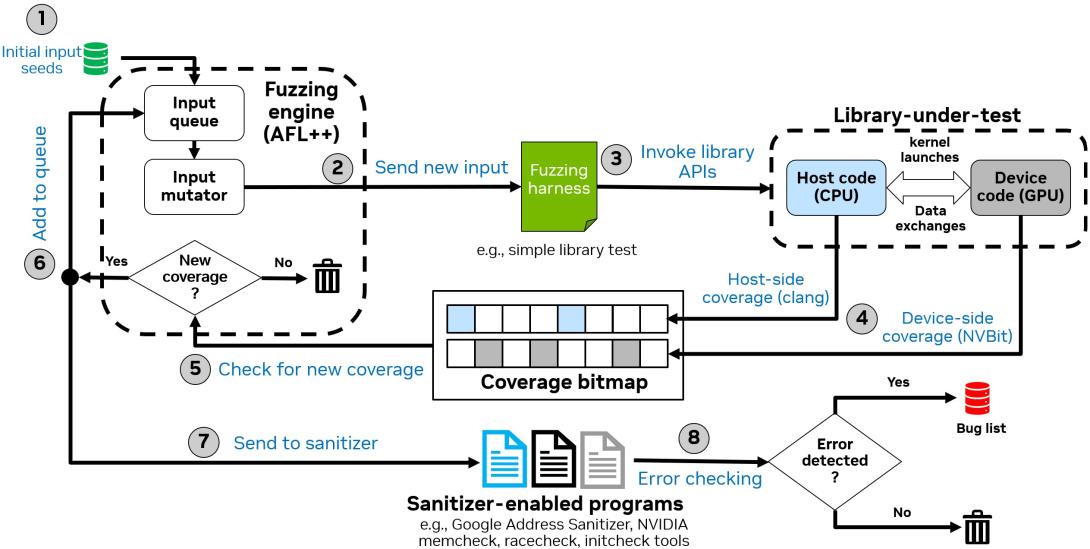
cuFuzz uses whole program fuzzing to avoid false positives from independently fuzzing device-side kernels. It leverages NVBit to instrument device-side instructions and merges the resultant coverage with compiler-based host coverage. Finally, cuFuzz decouples sanitization from coverage collection by executing host- and device-side sanitizers in separate processes. cuFuzz uncovers 43 previously unknown bugs (19 in commercial libraries) across 14 CUDA programs, including illegal memory accesses, uninitialized reads, and data races. cuFuzz achieves significantly more discovered edges and unique inputs compared to baseline approaches, especially on closed-source targets. Moreover, we quantify the execution time overheads of the different cuFuzz components and add persistent-mode support to improve the overall fuzzing throughput. Our results demonstrate that cuFuzz is an effective and deployable addition to the GPU testing toolbox. cuFuzz is publicly available at https://github.com/NVlabs/cuFuzz.
Publication Date
Uploaded Files
Copyright
Copyright by the Association for Computing Machinery, Inc. Permission to make digital or hard copies of part or all of this work for personal or classroom use is granted without fee provided that copies are not made or distributed for profit or commercial advantage and that copies bear this notice and the full citation on the first page. Copyrights for components of this work owned by others than ACM must be honored. Abstracting with credit is permitted. To copy otherwise, to republish, to post on servers, or to redistribute to lists, requires prior specific permission and/or a fee. Request permissions from Publications Dept, ACM Inc., fax +1 (212) 869-0481, or permissions@acm.org. The definitive version of this paper can be found at ACM's Digital Library http://www.acm.org/dl/.