
Monitor refresh rate impacts FPS video gamers' perceptions of display ‘smoothness’ and target acquisition performance
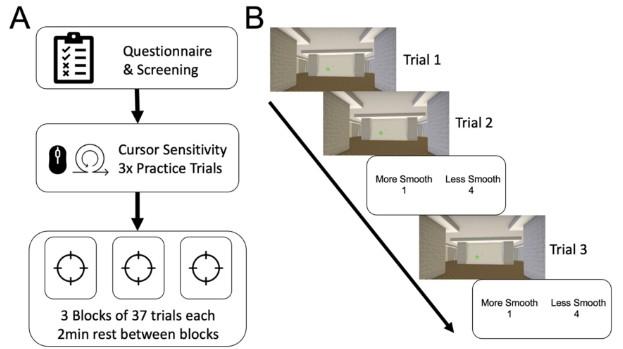
Esports, particularly First-Person Shooter (FPS) games, rely heavily on one's ability to rapidly perceive and respond to visual targets, a skill known as target acquisition. Modern gaming monitors increasingly feature higher refresh rates (up to 360Hz). The current study examined whether FPS gamers can perceptually distinguish between different monitor refresh rates (60Hz, 144Hz, 360Hz) and whether these differences translate to performance improvements in target acquisition tasks. Gamers (N = 101) completed a custom FPS task across three refresh rate conditions. Participants judged the perceived smoothness of display transitions and completed timed trials requiring accurate destruction of on-screen targets. Perceptual data, adjusted for response bias, showed that participants could reliably distinguish between large refresh rate differences (e.g., 60Hz vs. 360Hz), but not between more subtle differences (e.g., 144Hz vs. 360Hz). Changes in target speed modulated perceptual sensitivity, with greater difficulty perceiving latency increases when targets changed from a slow to a fast transition. Performance analyses revealed that reductions in system latency via increased refresh rate led to significant improvements in target accuracy and faster destruction times. Notably, transitions from 60Hz to higher refresh rates improved performance, while shifts from higher to lower refresh rates degraded it. However, performance did not significantly differ between 144Hz and 360Hz conditions. These findings suggest that while FPS gamers can perceive and benefit from refresh rate increases beyond 60Hz, perceptual and performance gains diminish at higher refresh rates. This has implications for hardware optimization in esports, highlighting 144Hz as a possible threshold beyond which further improvements yield marginal returns.