
Adaptive Time Delay for Improving Player Experience and Fairness in First-Person Shooter Games with Network Latency
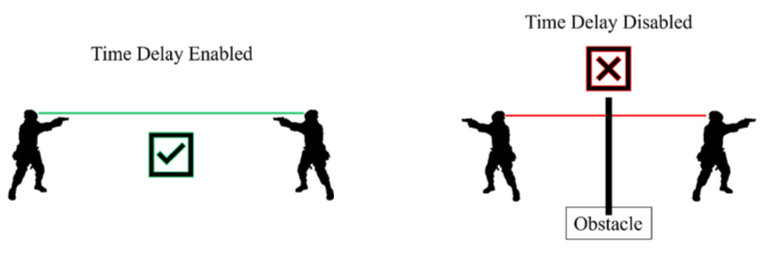
In a multiplayer networked game, actions for players with higher latencies are received and (potentially) acted upon later than players with lower latencies, leading to unfairness, especially important in competitive games. Time delay is a latency compensation technique that can mitigate this unfairness by adding latency to players with lower latency so that all players experience the same latency. Although this provides equal latency to all players, it unnecessarily degrades the responsiveness for the lower-latency players when the players are not interacting. We propose an adaptive time delay technique that only adds latency to low-latency players when they are interacting with players with higher latency. We conducted three separate user studies assessing player performance and experience with network latency and different compensation techniques. Analysis of the results shows adaptive time delay improves average quality of experience compared to fixed time delay while preserving time delay's fairness.
Publication Date
Published in
Research Area
External Links
Uploaded Files
Copyright
Copyright by the Association for Computing Machinery, Inc. Permission to make digital or hard copies of part or all of this work for personal or classroom use is granted without fee provided that copies are not made or distributed for profit or commercial advantage and that copies bear this notice and the full citation on the first page. Copyrights for components of this work owned by others than ACM must be honored. Abstracting with credit is permitted. To copy otherwise, to republish, to post on servers, or to redistribute to lists, requires prior specific permission and/or a fee. Request permissions from Publications Dept, ACM Inc., fax +1 (212) 869-0481, or permissions@acm.org. The definitive version of this paper can be found at ACM's Digital Library http://www.acm.org/dl/.