
QCalEval: Benchmarking Vision-Language Models for Quantum Calibration Plot Understanding
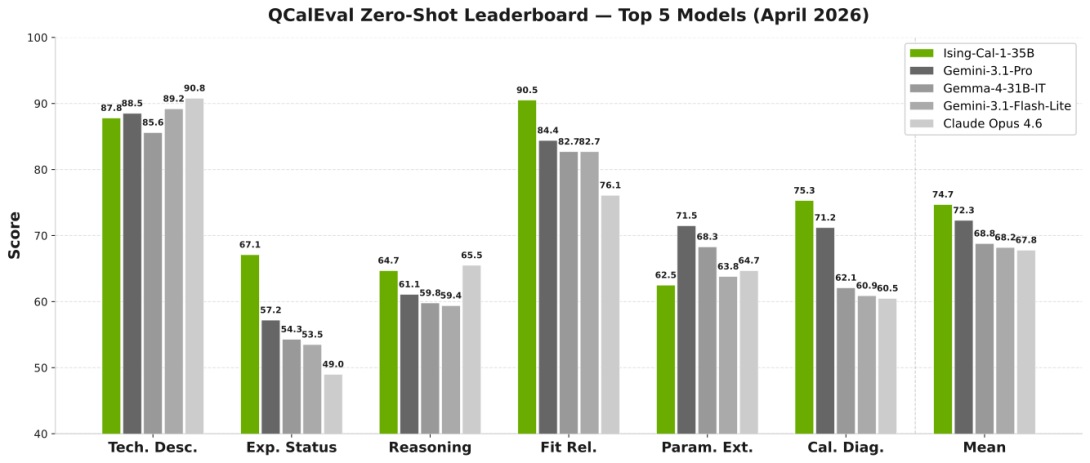
Quantum computing calibration depends on interpreting experimental data, and calibration plots provide the most universal human-readable representation for this task, yet no systematic evaluation exists of how well vision-language models (VLMs) interpret them. We introduce QCalEval, the first VLM benchmark for quantum calibration plots: 243 samples across 87 scenario types from 22 experiment families, spanning superconducting qubits and neutral atoms, evaluated on six question types in both zero-shot and in-context learning settings. The best general-purpose zero-shot model reaches a mean score of 72.3, and many open-weight models degrade under multi-image in-context learning, whereas frontier closed models improve substantially. A supervised fine-tuning ablation at the 9-billion-parameter scale shows that supervision format is critical, zero-shot-formatted and in-context-learning-formatted fine-tuning improve different capabilities, and no single recipe improves open-ended analysis. As a reference case study, we release NVIDIA Ising Calibration 1, an open-weight model based on Qwen3.5-35B-A3B that reaches 74.7 zero-shot average score.