
Impact of Graphical Fidelity and Frame-Time Stutter in a First-Person Shooter Game
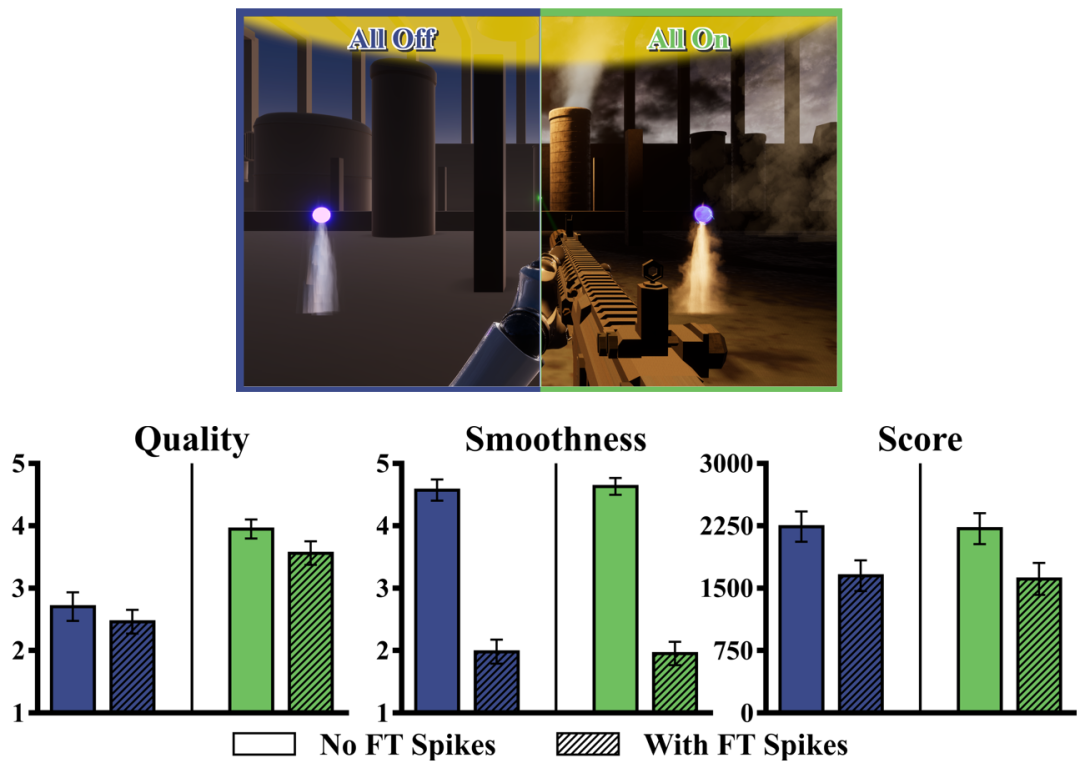
Frametime spikes and graphical fidelity both matter for the feel of first-person shooter (FPS) games, yet their combined effects are not well understood. This paper examines how graphics settings and frametime spikes during aiming interact with player performance and experience. We developed a custom FPS game with configurable textures, lighting, and visual effects, and induced frametime spikes of 0 ms, 225 ms, or 675 ms during play. Twenty-one participants completed all combinations of graphics and spikes while providing performance data and subjective ratings for visual quality and smoothness. Results show that graphics quality primarily affects perceived visual quality, while frametime spikes primarily reduce perceived smoothness. Performance (i.e., score and accuracy) declines with larger spikes but remains largely unchanged across graphics settings. These findings suggest that spike magnitude, rather than graphics quality, is the dominant factor shaping smoothness and performance, while players still notice higher-quality graphics.
Publication Date
Published in
Research Area
External Links
Uploaded Files
Copyright
Copyright by the Association for Computing Machinery, Inc. Permission to make digital or hard copies of part or all of this work for personal or classroom use is granted without fee provided that copies are not made or distributed for profit or commercial advantage and that copies bear this notice and the full citation on the first page. Copyrights for components of this work owned by others than ACM must be honored. Abstracting with credit is permitted. To copy otherwise, to republish, to post on servers, or to redistribute to lists, requires prior specific permission and/or a fee. Request permissions from Publications Dept, ACM Inc., fax +1 (212) 869-0481, or permissions@acm.org. The definitive version of this paper can be found at ACM's Digital Library http://www.acm.org/dl/.