
Editing Physiological Signals in Videos Using Latent Representations
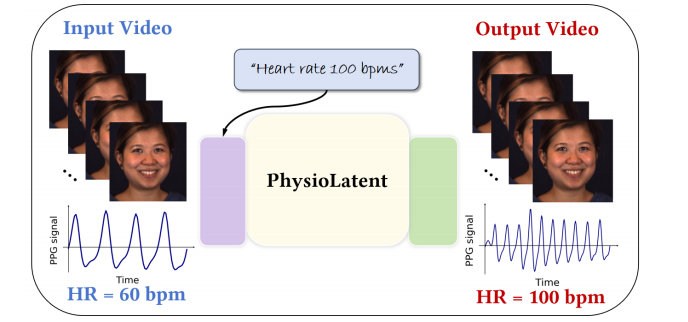
Camera-based physiological signal estimation provides a convenient and non-contact way to monitor heart rate, but it also raises serious privacy concerns because facial videos can leak sensitive information about a person’s health and emotional state. We present a learned framework for editing physiological signals in videos while preserving visual fidelity. Our method first encodes an input video into a latent representation using a pretrained 3D Variational Autoencoder, and embeds a target heart-rate prompt through a frozen text encoder. The two representations are fused by trainable spatio-temporal layers with Adaptive Layer Normalization to model the strong temporal coherence of remote photoplethysmography signals. To better preserve subtle physiological variations during reconstruction, we apply Feature-wise Linear Modulation in the decoder and fine-tune its output layer. Across multiple benchmark datasets, our approach preserves visual quality with an average PSNR of 38.96 dB and SSIM of 0.98, while achieving an average heart-rate modulation error of 10.00 bpm MAE and 10.09% MAPE under a state-of-the-art rPPG estimator. These results suggest that our framework is useful for privacy-preserving video sharing, biometric anonymization, and the generation of realistic videos with controllable vital signs.
Publication Date
Published in
Research Area
External Links
Uploaded Files
Copyright
This material is posted here with permission of the IEEE. Internal or personal use of this material is permitted. However, permission to reprint/republish this material for advertising or promotional purposes or for creating new collective works for resale or redistribution must be obtained from the IEEE by writing to pubs-permissions@ieee.org.